
Concrete courtyards soak up sun and then dump that heat right back at you when you try to sit outside. A thin layer of green, whether it is moss or a slick biofilm, can change that experience more than most people expect.
I have watched the same walkway feel tolerable in one corner and harsh in another, even though it is the same slab. The difference is often moisture, surface roughness, and whether moss biofilm on concrete cooling has had a chance to take hold.
Urban moss growth is not magic paint, and it is not always welcome. But if you care about courtyard comfort, it is worth understanding how albedo, evaporative cooling, and the concrete microclimate shift once living films move in.
Why concrete gets hot (and where moss fits in)
Concrete heats up because it is dense, it stores energy, and it often sits in full sun with little airflow. Darkened concrete gets worse because it absorbs more solar radiation and has a lower albedo than a pale, clean surface.
Once the surface is hot, it radiates heat back into the courtyard and pushes up the mean radiant temperature you actually feel. That is why a bench can be in shade and still feel miserable if the surrounding paving is cooking.
Moss and biofilm change the physics in two main ways, they alter reflectance and they change water behavior at the skin of the slab. The albedo shift can be small or noticeable depending on species and thickness, but the moisture effect is usually the bigger story.
When moss is hydrated, it can drive evaporative cooling at the surface, pulling heat as water moves from liquid to vapor. In a tight courtyard, that cooling can be local and patchy, but your feet and ankles notice patchy cooling more than you think.
The catch is that moss biofilm on concrete cooling is strongest when water is available and the air can take that vapor. If the slab is bone dry for weeks, moss is mostly a darker coating with less evaporative cooling to offer.
Moss vs. algae vs. lichens: quick field differences
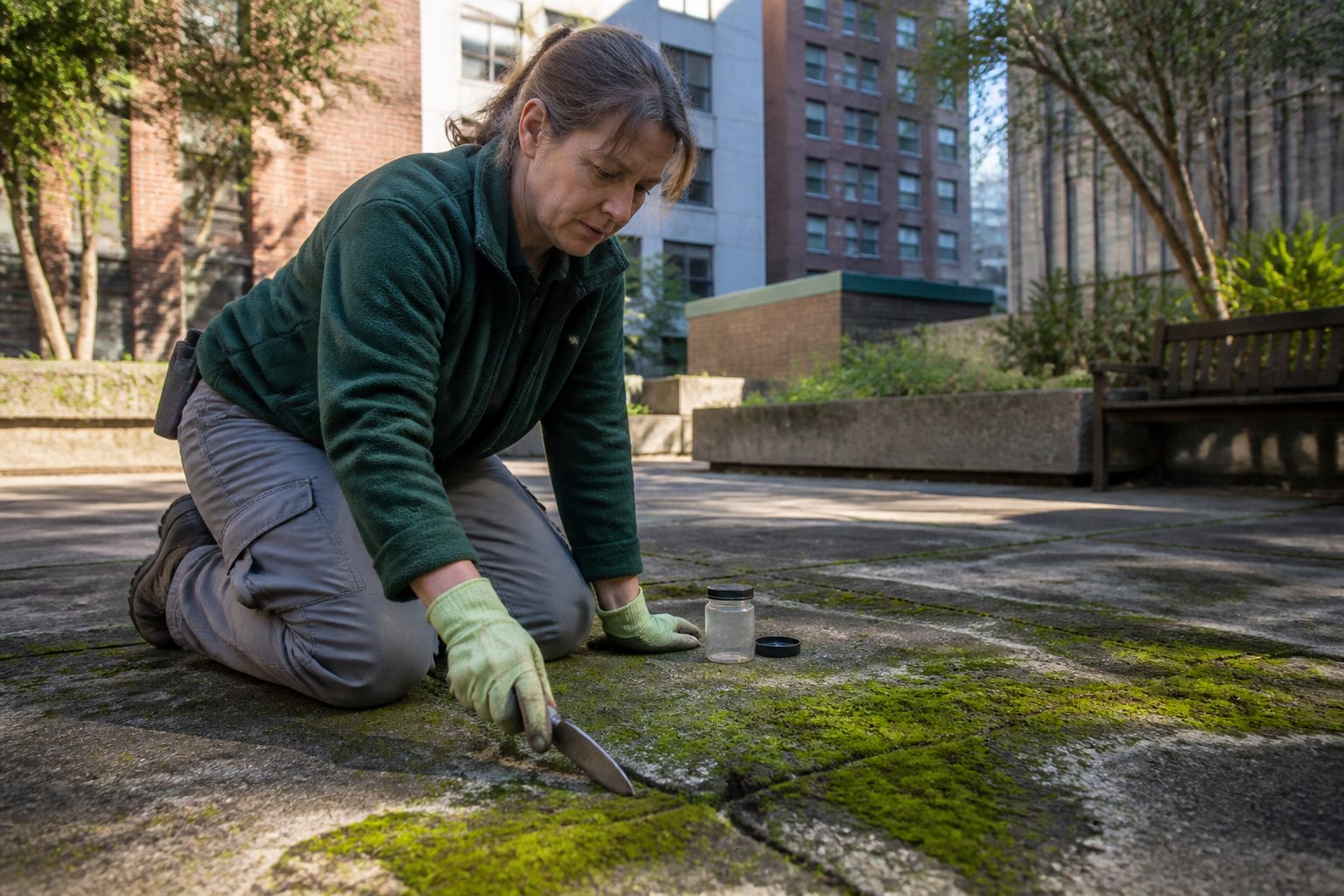
People call any green film “moss,” but in courtyards you often see algae first, then moss later, and lichens on older, quieter surfaces. You can make better decisions about cleaning and cultivation if you can tell them apart on sight.
Algae usually looks like a thin paint wash or slippery smear, and it often turns darker when wet. It tends to hug the surface with no obvious stems or leaves, and it can show up fast after rain or irrigation overspray.
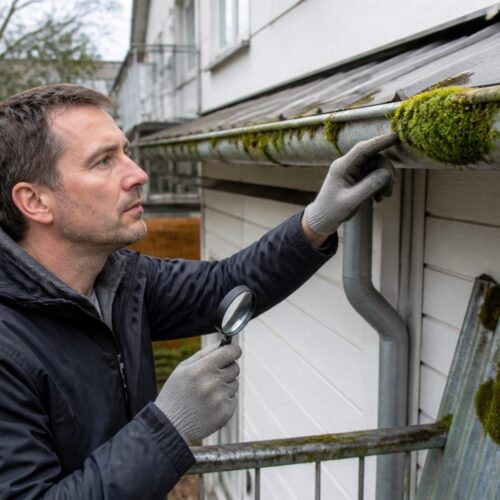
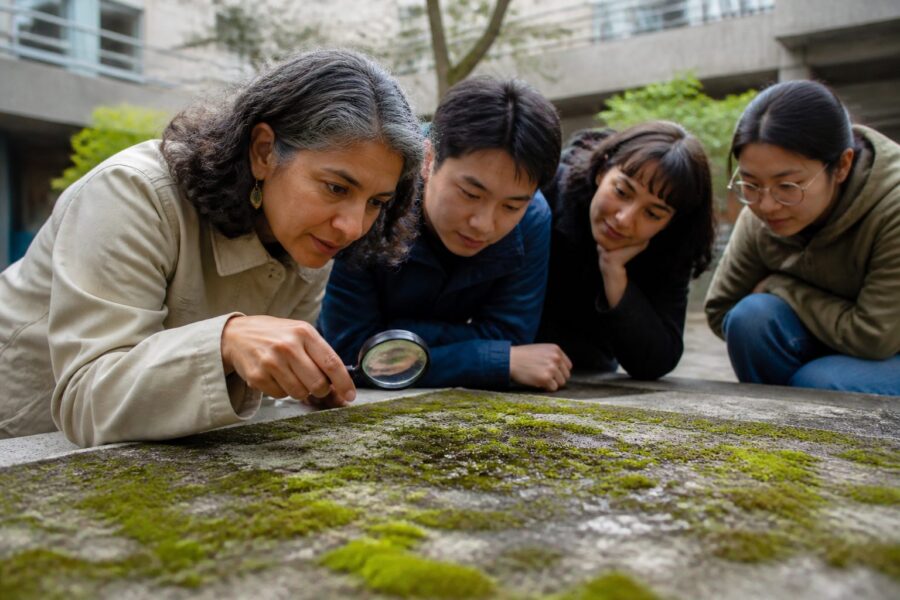
Moss has visible structure when you look closely, even if it is short and tight to the ground. You will see tiny shoots, little leaflets, and sometimes a fuzzy edge where it meets bare concrete.
Lichens look like crusts, flakes, or small rosettes, and they can be gray, orange, black, or greenish. They grow slowly, and they often show up where fertilizer runoff is low and the surface stays relatively stable.
For cooling, algae can matter because a wet biofilm changes the boundary layer and can hold water, but it also raises slip risk quickly. Moss tends to be less slick when established, and it can hold more water volume per area than a thin algal film.
How surface texture and porosity affect colonization
Concrete is not one material in practice, because mixes, finishing methods, and age create very different skins. A steel trowel finish can be almost sealed, while broomed concrete and exposed aggregate have pores and pockets that stay damp longer.
Porosity matters because it controls how long a surface stays in the “damp but not flooded” window that moss likes. Texture matters because it gives anchoring points for rhizoids and traps dust, which becomes the starter soil for biofilm.
| Concrete surface type | What it does with water | Colonization tendency |
|---|---|---|
| Steel trowel, smooth | Sheds fast, dries fast | Algae streaks, slow moss |
| Broom finish | Holds in grooves, slower dry-down | Good moss footholds |
| Exposed aggregate | Micro pockets around stones | Patchy moss islands |
| Old, carbonated, microcracked | Wicks and retains in cracks | Fast biofilm, then moss |
| Sealed or painted | Blocks absorption, beads water | Mostly algae on top film |
Measuring heat change with simple surface readings
You do not need a lab to see whether living coverage changes surface heat. A basic infrared thermometer and a notebook can show patterns that match what your body already senses.
Start by picking paired spots that share the same sun exposure and wind but differ in coverage, like bare concrete next to mossy concrete. Take readings at the same time of day, because morning differences can flip by late afternoon.
IR thermometers can lie if you ignore emissivity, but for side by side comparisons they still work well. Keep the distance and angle consistent, and do not measure shiny wet puddles because reflections can skew the number.
Write down whether the surface is dry, damp, or visibly wet, because evaporative cooling depends on that status. Also note whether the spot is in sun, in open shade, or in shade with sky view blocked by walls.
If you want one extra step, log air temperature and relative humidity from a cheap pocket meter. High humidity can blunt evaporation, so a mossy patch may look less impressive on a muggy day even if it still helps the concrete microclimate.
Moisture cycles: dew, rain, and dry-down rates
Courtyard moss lives and dies by small water events, not just big storms. Dew, sprinkler mist, and a short drizzle can keep a thin mat active long enough to matter for moss biofilm on concrete cooling.
Concrete itself can act like a sponge at the surface, especially when it has fine cracks and accumulated dust. That stored water can re-wet biofilm after sunrise, which extends evaporative cooling into the part of the day when heat stress ramps up.
Dry-down rate is the detail most courtyard owners miss, and it is where moss often beats algae. A mature moss mat can shade its own base and slow evaporation, while a thin algal film can flash dry and leave a darker, hotter stain behind.
Watch how water moves after rain, because runoff paths tell you where growth will concentrate. Downspout splash zones, wall drip lines, and the low edge of a slight slope are usually the first places to green up.
If the courtyard has irrigation, overspray can create a daily wetting cycle that favors slick biofilm over moss. Adjusting a sprinkler head by a few degrees can shift the balance from slippery algae to more stable moss coverage.
Shade patterns and their impact on growth and cooling
Shade is not one thing, because a courtyard has moving shadows and different kinds of sky exposure. A spot shaded by a wall at noon can still bake under bright morning sun and high reflected light later.
Moss usually prefers bright shade or short sun windows, while heavy sun favors drought tolerant crusts or frequent dieback. If you see moss surviving in full sun, it is often because the surface stays damp from seepage, irrigation, or persistent dew.
For cooling, shade and moss can stack, but they can also trade off depending on moisture. Deep shade lowers surface temperature directly, but it can also reduce evaporation if the air stays still and humid near the ground.
Reflected light off pale walls can keep moss photosynthesizing in places that look shady to a person. That same reflection can raise radiant load on bare paving, which is one reason a small green strip near a wall can feel like relief.
If you want predictable results, map shade with photos taken every hour on a clear day. A simple collage can explain why one patch thrives and another fails on the same slab.
Encouraging safe moss establishment on masonry
If you want moss on concrete, you have to stop treating the surface like it must look brand new all the time. A little dust and a little roughness are friends, and constant bleaching is the fastest way to keep the slab sterile and hot.
Start with the right target zones, like edges, joints, and vertical faces that stay damp but do not carry foot traffic. I like “moss margins” along planters or walls, because they can influence the concrete microclimate without turning the main path into a skating rink.
- Pick low-traffic edges and corners
- Favor broomed or aged concrete over sealed slabs
- Rinse dust lightly, avoid harsh stripping
- Keep a short wetting cycle during establishment
- Use local moss fragments, not invasive imports
- Stop fertilizer runoff onto target areas
Managing slip risk and aesthetic concerns
Slip risk is real, and pretending otherwise makes moss cultivation look irresponsible. The trick is to steer growth to places where people do not pivot, accelerate, or step down from a threshold.
Algal biofilm is usually the worst offender because it forms a thin lubricating layer when wet. If a patch feels slick under a shoe, treat it as a safety issue first and a biology project second.
Texture helps, so a broom finish or exposed aggregate can keep traction even with some coverage. Smooth concrete plus frequent wetting is the combination that gets property managers angry fast.
Aesthetics are personal, but patchiness often reads as neglect unless it looks intentional. Clean borders, consistent edges, and keeping moss off bright white walls can make a big difference in how people accept it.
If you need a compromise, maintain moss on vertical surfaces and shaded edges while keeping main walking lines clean. You can still get some moss biofilm on concrete cooling benefits because cooler edges reduce radiant heat near seating and doorways.
Cleaning practices that preserve beneficial coverage
Most courtyard cleaning routines are designed for speed, not for microclimate comfort. Pressure washing and chlorine bleach erase living coverage, roughen the surface in uneven ways, and often make recolonization uglier.
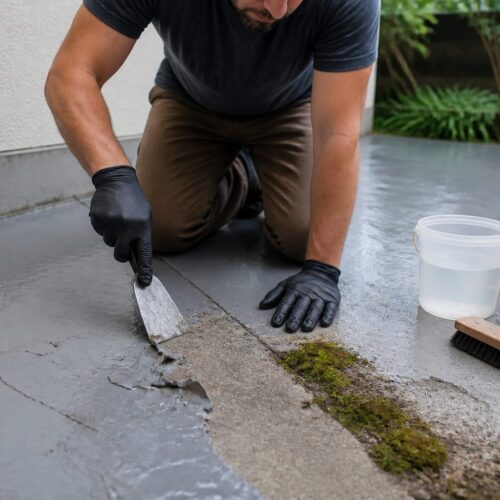
If you want to keep some moss, clean with a light hand and only where traction demands it. A stiff brush, plain water, and spot treatment beat a full surface blast almost every time.
Avoid routine copper or quaternary ammonium products if your goal is stable moss, because residues can suppress regrowth for months. If you must use a biocide for safety, confine it to the walking line and rinse thoroughly after the label dwell time.
Do not chase every green stain on day one, because early biofilm often precedes moss that is less slick and more durable. I would rather manage where growth happens than start a cycle of stripping and re-staining.
After cleaning, watch where water sits, because cleaning can change microtexture and redirect runoff. If a cleaned strip stays wet longer than before, it may come back greener and lower albedo than the surrounding slab.
Interpreting results for small-site climate comfort
A courtyard is small, so you will not “fix” city heat with moss, but you can change how a space feels at human height. Comfort comes from surface temperature, radiant load, and whether the air feels dry or sticky near seating.
If mossy areas read cooler on an IR thermometer during sunny hours, that usually tracks with evaporative cooling and sometimes a small albedo change. If they read warmer when dry, you may be seeing a darker surface with no moisture benefit, which is a fair reason to keep coverage limited to damp zones.
Compare the same spots across weather types, like a dry week, a day after rain, and a humid heat wave. You will learn quickly whether your courtyard’s concrete microclimate supports consistent cooling or only brief relief after wetting.
Pay attention to where people choose to stand or sit, because behavior is a measurement tool too. When a shaded, slightly mossy edge becomes the default waiting spot, you have practical proof that surface heat changed in a way people notice.
My bias is to treat moss as one lever among many, alongside shade trees in planters, permeable joints, and lighter colored paving repairs. Used that way, moss biofilm on concrete cooling can be a quiet upgrade instead of a constant fight.
Conclusion
Moss and biofilm on concrete change courtyard heat because they reshape water timing and, to a lesser degree, albedo. The best results show up where moisture cycles are frequent enough to power evaporative cooling without creating slippery walking lines.
If you measure surface temperatures, map shade, and manage cleaning with intention, you can keep beneficial coverage where it works. That approach makes the concrete microclimate less harsh and makes small courtyards easier to use on hot days.