
Urban noise is a constant companion for many city dwellers, a relentless hum of traffic, construction, and human activity. This pervasive sound pollution affects our well-being, from stress levels to sleep quality. People often look for innovative solutions to quiet their personal corners of the city, especially in those tight, reflective spaces.
Hard surfaces like concrete, brick, and glass bounce sound waves around, amplifying rather than muffling the din. This is where the humble bryophyte, or moss, steps in as a surprisingly effective agent for peace. Moss urban sound dampening courtyards offers a beautiful, living answer to an old city problem.
Imagine a quiet reading nook or a calm outdoor dining area, even in the middle of a busy block. Incorporating moss can transform these noisy pockets into serene retreats. We will explore how these ancient plants contribute to a more tranquil urban experience.
The science behind moss’s acoustic benefits is both simple and profound. Its unique structure interferes with sound waves, reducing their energy. This natural approach contrasts sharply with traditional, often sterile, soundproofing materials.
Understanding the basic principles of sound in urban environments helps us appreciate moss’s role. We are not just adding greenery; we are installing a living acoustic panel. This article breaks down the practical applications and scientific basis for using moss to quiet your city space.
How Sound Moves Through Urban Spaces
Sound travels as waves, and in cities, these waves encounter a relentless series of hard, flat surfaces. Buildings, paved roads, and concrete walls act like giant mirrors, reflecting sound energy. This reflection creates echoes and reverberation, intensifying existing noise rather than allowing it to dissipate.
Think about a typical urban courtyard surrounded by tall buildings. A single conversation can quickly become a cacophony as sound bounces off every available surface. This phenomenon is why city centers often feel much louder than suburban areas, even with similar levels of direct noise sources.
The geometry of urban spaces plays a significant role in noise amplification. Narrow streets and enclosed courtyards trap sound waves, preventing them from escaping. This acoustic trapping leads to higher perceived noise levels and a general sense of oppressive sound.
Sound energy loses very little power when it reflects off dense, smooth materials. This means that a sound wave can bounce many times before its energy finally diminishes. The cumulative effect of these reflections makes quiet conversation difficult and general background noise overwhelming.
Traditional urban design has historically prioritized durability and aesthetics over acoustic comfort. Materials like glass, steel, and concrete are popular for their strength and modern look, but they are terrible for sound absorption. This creates an environment that inadvertently magnifies noise pollution.
Even a relatively quiet sound, like a distant siren, can seem much closer and louder due to these reflections. The lack of soft, porous surfaces to absorb sound is a fundamental issue in urban acoustics. We need materials that can effectively break up and absorb sound waves.
Understanding these principles helps us appreciate the challenge of urban noise reduction. Simply blocking sound is often not enough; we also need to absorb the sound that manages to get in. This is where living surfaces, like moss, offer a distinct advantage over inert materials.
Acoustic engineers spend considerable effort trying to mitigate these reflective properties in indoor spaces. Applying similar principles to outdoor urban areas, especially in smaller, contained environments, can yield significant improvements. Moss urban sound dampening courtyards directly addresses this reflective problem.
The Acoustic Properties of Moss: Absorption vs. Reflection
Moss operates differently from hard urban surfaces when sound waves hit it. Instead of reflecting sound, its intricate, porous structure works to absorb and dissipate sound energy. This fundamental difference makes it a valuable tool for acoustic improvement.
The tiny leaves, stems, and rhizoids of bryophytes create a complex network of air pockets and irregular surfaces. When sound waves penetrate this network, they lose energy through friction and vibration within the moss itself. This process effectively converts sound energy into a small amount of heat, reducing the audible noise.
| Material Type | Sound Absorption Coefficient (NRC) | Key Acoustic Benefit |
|---|---|---|
| Concrete Wall | 0.05 | High reflection, low absorption |
| Glass Window | 0.10 | High reflection, low absorption |
| Thick Moss Mat (5cm) | 0.30 – 0.50 | Porous absorption, reduces echo |
| Acoustic Panel (Felt) | 0.60 – 0.80 | Engineered absorption, broad spectrum |
| Dense Shrubbery | 0.15 – 0.25 | Some diffusion, minor absorption |
| Wood Panel | 0.10 – 0.20 | Reflection and some diffusion |
Moss sound absorption is particularly effective at dampening high-frequency sounds, which often contribute most to perceived harshness and echo. The delicate, irregular surfaces of moss break up these shorter, faster waves. This helps create a softer, more pleasant acoustic environment.
The density and thickness of a moss layer directly impact its ability to absorb sound. A thicker, more robust layer of moss contains more air pockets and surface area, leading to greater sound energy dissipation. Thin, sparse patches will offer minimal acoustic benefits.
Compared to typical building materials, moss provides a significant contrast in its acoustic behavior. Concrete has an extremely low Noise Reduction Coefficient (NRC), meaning it reflects almost all sound. Moss, even at moderate thicknesses, offers a measurable improvement in sound absorption.
This natural sound dampening capability positions moss as a sustainable alternative or complement to manufactured acoustic panels. We are using nature’s own design to solve an urban problem. The green wall acoustic properties of moss are a testament to its ecological versatility.
The ability of moss to reduce reverberation is especially valuable in enclosed spaces like courtyards. By absorbing sound rather than reflecting it, moss helps to shorten the decay time of sound waves. This makes conversations clearer and ambient noise less intrusive.
Which Moss Types and Thicknesses Dampen Sound Most
Not all moss is created equal when it comes to acoustic performance; certain types and thicknesses offer superior sound dampening. Generally, denser, cushion-forming mosses with complex structures tend to absorb sound more effectively. Their tightly packed growth creates more intricate air pockets.
Species like cushion moss (Leucobryum glaucum) or broom moss (Dicranum scoparium) are excellent choices due to their robust, three-dimensional growth habit. These types form thick, spongy mats that can trap and dissipate sound waves with greater efficiency. Their natural resilience also makes them good candidates for urban installations.
Carpet-forming mosses, such as hypnum moss (Hypnum cupressiforme), also contribute to sound absorption, especially when grown in thick, continuous layers. While individual plants might be flatter, their collective density across a surface creates a beneficial acoustic barrier. These mosses are often easier to establish on vertical surfaces.
The thickness of the moss layer is perhaps the most critical factor for effective noise reduction. A layer of at least 5-10 centimeters (2-4 inches) provides noticeable acoustic benefits. Thinner layers, while still aesthetically pleasing, offer only marginal sound absorption.
Research suggests that increasing moss thickness correlates directly with improved sound absorption, particularly for lower frequency sounds. While moss generally excels at high-frequency dampening, a substantial layer can start to impact mid-range frequencies as well. This broader absorption spectrum enhances overall acoustic comfort.
Live moss installations, often found in green walls or moss art, typically use preserved moss, but living moss offers additional environmental benefits. Living moss also maintains its porous structure more effectively over time, assuming proper care and hydration. The continuous growth of living moss helps to sustain its acoustic properties.
Consider the natural environment where moss thrives: damp, shaded areas with stable temperatures. Replicating these conditions in an urban courtyard helps ensure the moss grows thick and healthy. A thriving moss layer is an acoustically effective moss layer.
Before selecting a specific moss, assess the site’s light, moisture, and air quality conditions. Choosing species adapted to your local climate and urban pollutants ensures better establishment and long-term acoustic performance. This careful selection is key to successful bryophyte noise reduction.
Placement Strategies for Noise-Sensitive Urban Sites
Strategic placement of moss is key to maximizing its sound-dampening capabilities in urban environments. We need to identify surfaces where sound reflections are most problematic and target those areas for moss cultivation. Vertical surfaces, like courtyard walls, are often ideal candidates.
Consider the primary sources of noise and the paths sound waves take within a space. If traffic noise is the main issue, a moss wall facing the street or along the courtyard’s perimeter can intercept sound before it fully penetrates. This creates a buffer zone of moss sound absorption.
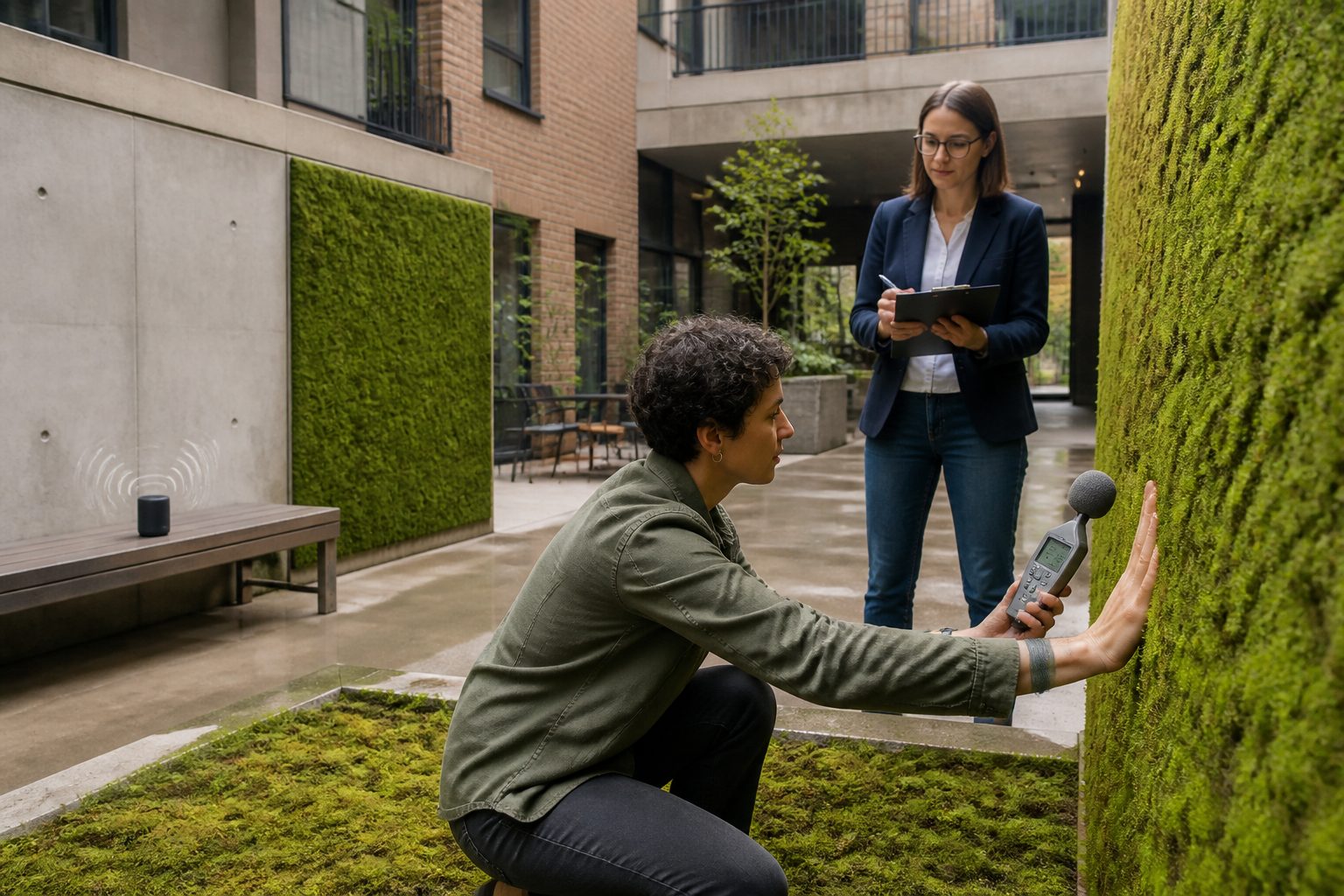
Enclosed courtyards, light wells, and small urban patios benefit immensely from moss installations on their surrounding walls. These spaces often suffer from severe reverberation, where sounds bounce repeatedly, making them feel much louder. Moss walls here can dramatically reduce echo and create a calmer atmosphere.
Moss can also be incorporated into ground cover in specific areas, especially under benches or around seating arrangements. While less impactful than vertical installations, dense moss ground cover can still contribute to overall sound absorption by soaking up ground-level reflections. This adds another layer to moss urban sound dampening courtyards.
Rooftops, particularly those on lower buildings adjacent to taller structures, also offer opportunities. A moss-covered green roof can absorb airborne sound waves before they reflect downwards into courtyards or nearby windows. This approach contributes to green wall acoustic properties on a larger scale.
Think about areas where people gather or spend time outdoors. Installing moss panels or living walls directly behind seating areas or along walkways creates localized zones of quiet. This makes conversations easier and enhances the comfort of these spaces.
For optimal effect, aim for large, continuous sections of moss rather than small, scattered patches. A substantial moss surface provides a more consistent and effective acoustic barrier. The greater the surface area covered, the more sound energy can be absorbed.
Even small architectural features like planters or retaining walls can be covered with moss to contribute to noise reduction. Every square foot of moss adds to the overall acoustic improvement of the space. This cumulative effect is what makes bryophyte noise reduction so promising.
Pairing Moss With Other Sound-Absorbing Materials
While moss offers fantastic acoustic benefits, combining it with other sound-absorbing materials can create an even more effective noise reduction system. This layered approach addresses a wider range of sound frequencies and enhances overall acoustic comfort. Think of moss as one component in a holistic sound strategy.
Consider the strengths of moss, which excels at high-frequency absorption and reverberation control. Pairing it with materials that handle lower frequencies or provide additional mass can lead to a truly quiet urban space. This synergy maximizes the impact of moss urban sound dampening courtyards.
- Wooden slats or panels
- Fabric acoustic panels
- Perforated metal screens
- Dense shrubbery or climbing plants
- Rubber or recycled tire mats
- Thick outdoor carpeting
- Water features with gentle sounds
- Earth berms or raised garden beds
Wood, especially in slatted or perforated designs, can scatter and absorb sound waves, complementing moss’s direct absorption. Fabric acoustic panels, designed for outdoor use, can be strategically placed behind or around moss installations for added dampening. These materials work together to create a more comprehensive acoustic barrier.
Dense plantings of shrubs or climbing vines, while not as porous as moss, can diffuse sound and add some mass for sound blocking. A mix of different plant textures, from moss to leaves, creates a more varied acoustic surface. This variety ensures better moss sound absorption across different frequencies.
Water features, such as small fountains or trickling streams, do not absorb sound but can introduce pleasant white noise that masks unwanted urban sounds. The gentle gurgle of water can make traffic noise less noticeable. This psychological dampening works well alongside physical sound absorption.
Earth berms or raised garden beds filled with soil and plants provide significant mass, which helps block sound transmission. These can be integrated into courtyard designs to create physical barriers that sound struggles to penetrate. Covering these berms with moss further enhances their acoustic properties.
Even simple elements like thick outdoor rugs or furniture with upholstered cushions can contribute to overall sound absorption in an outdoor setting. Every soft, porous surface helps reduce the amount of sound reflecting off hard surfaces. Think creatively about all the elements in your space.
When designing a green wall, integrating a layer of sound-absorbing material behind the moss substrate can boost its performance. This combination leverages the green wall acoustic properties of the moss with the structural absorption of the backing material. Such thoughtful design leads to superior bryophyte noise reduction.
Measuring Acoustic Improvement With Simple Tools
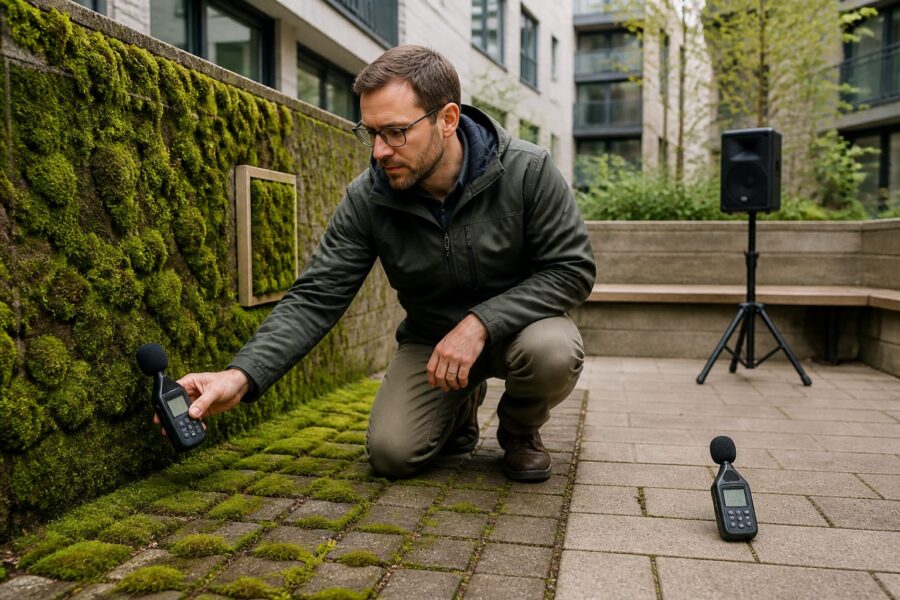
You do not need expensive professional equipment to get a basic sense of acoustic improvement from your moss installations. Simple tools and careful observation can provide valuable insights into how well your moss is dampening sound. This allows you to assess the effectiveness of your moss urban sound dampening courtyards.
A decibel meter app on your smartphone is a surprisingly useful starting point. While not laboratory-grade accurate, these apps can give you relative measurements before and after moss installation. Make sure to use the same app, phone, and measurement location each time for consistent results.
Take baseline decibel readings at various points in your courtyard before you install any moss. Record these measurements at different times of day to account for varying ambient noise levels. Then, after your moss is established, repeat the measurements under similar conditions.
Listen for changes in the quality of sound, not just its perceived loudness. Does the space sound less “tinny” or “hollow”? Is there less echo when you clap your hands or speak? These subjective observations are important indicators of reduced reverberation and improved moss sound absorption.
Perform a “clap test” in the center of the space both before and after moss installation. Listen carefully to how quickly the sound of your clap dissipates. A noticeable reduction in the duration of the echo indicates that the moss is effectively absorbing sound waves.
Ask friends or family to spend time in the space and provide their feedback. Their subjective experience of the acoustic environment can be just as telling as quantitative data. People often immediately notice a difference in comfort and clarity.
Pay attention to how easily you can hold a conversation at a normal volume. In highly reverberant spaces, you often need to raise your voice to be heard clearly. If conversations become less effortful, it is a good sign that your green wall acoustic properties are working.
Keep a simple log of your observations, noting dates, times, and specific sound measurements or subjective comments. This documentation helps you track progress and identify the most impactful areas of your moss installation. It provides concrete evidence of bryophyte noise reduction.
Realistic Expectations: What Moss Can and Cannot Do for Noise
It is important to have realistic expectations about what moss can achieve for noise reduction in urban settings. Moss is a fantastic natural sound absorber, but it is not a complete soundproofing solution for all types of noise. We must understand its limitations to apply it effectively.
Moss excels at reducing reverberation and dampening high-frequency sounds, which makes a space feel quieter and more pleasant. It is highly effective at absorbing echoes within an enclosed courtyard or small patio. This contributes significantly to the perceived calmness of the environment.
However, moss will not block loud, low-frequency noises like heavy traffic, construction equipment, or distant sirens. These powerful sound waves require substantial mass and specialized materials to mitigate effectively. A thin layer of moss simply does not have the density to stop such sounds.
Think of moss as a “finishing layer” for acoustics, improving the quality of sound within a space rather than completely isolating it. It reduces the harshness and echo that often amplify existing urban noise. This is where moss urban sound dampening courtyards truly shines.
The primary benefit of moss sound absorption is creating a more comfortable and intelligible acoustic environment. Conversations become clearer, and general background chatter feels less intrusive. It transforms a jarring soundscape into a softer, more inviting one.
For significant sound blocking, moss needs to be combined with other materials, as discussed earlier. A dense wall structure behind a moss installation, for example, provides the mass needed to block sound transmission. Moss then handles the internal reflections, improving green wall acoustic properties.
Do not expect your moss wall to silence a busy highway directly adjacent to your property. Instead, anticipate a noticeable reduction in the “liveliness” of the sound within your immediate outdoor space. This makes the space feel more contained and peaceful.
The aesthetic and ecological benefits of moss are also substantial, regardless of its acoustic performance. It adds natural beauty, supports biodiversity, and helps cool urban surfaces. These combined benefits make bryophyte noise reduction a worthwhile investment, even with its acoustic limitations.
Conclusion
Embracing moss for urban sound dampening offers a unique and beautiful solution to a common city problem. These ancient plants provide a natural, sustainable way to transform noisy courtyards and small outdoor spaces into tranquil havens. Their intricate structure provides effective moss sound absorption.
By understanding how sound behaves in urban environments and the specific acoustic properties of moss, we can strategically apply this living material. The goal is not always to eliminate all noise, but to create spaces where sound is softer and less intrusive. This improves the quality of urban life significantly.
The combination of aesthetic appeal, ecological benefits, and genuine acoustic improvement makes moss an exciting option for urban design. From green walls to ground cover, moss offers versatile applications for improving city soundscapes. Think about the potential for your own quiet urban retreat.
Remember that careful selection of moss types, sufficient thickness, and strategic placement are key to maximizing its noise reduction capabilities. Pairing moss with other materials can further enhance its performance, tackling a broader range of sound frequencies. This holistic approach makes the biggest difference.
Ultimately, investing in moss urban sound dampening courtyards is an investment in personal well-being and a more harmonious urban environment. It is a simple, elegant way to bring a touch of nature’s calm into the heart of the bustling city. Let the quiet growth of moss bring peace to your urban oasis.