
Urban environments face a constant battle with stormwater runoff, a significant source of pollution entering our waterways. Rainwater cascading across impervious surfaces like roofs, roads, and sidewalks picks up various contaminants along its path. This is where the often-overlooked world of bryophytes, specifically moss, offers a surprisingly powerful solution for improving moss rainwater filtration quality.
These unassuming green carpets, traditionally associated with damp, shady forests, are increasingly recognized for their ecological value in cityscapes. Researchers and urban planners are now exploring moss’s unique properties to act as a natural, low-cost `moss stormwater filter`. It turns out these simple plants do much more than just look pretty on a rock.
The ability of moss to intercept, absorb, and filter water before it enters drainage systems presents a compelling case for its wider adoption. Understanding the mechanisms behind `bryophyte water filtration` reveals a fascinating intersection of biology and environmental engineering. We should absolutely be paying more attention to what moss can do for our cities.
Consider the sheer volume of rainwater that hits a city during a storm. All that water carries pollutants directly into rivers and lakes, impacting aquatic ecosystems and even human health. Moss offers a decentralized, living solution to mitigate some of these problems right at the source.
This article will explore how moss functions as a natural water purifier, what it can and cannot filter, and how we can integrate it into effective urban design strategies. We will examine the science behind its filtration capabilities and discuss practical applications for improving urban `green roof water quality` and beyond. It is time we gave moss the credit it deserves.
How Moss Intercepts and Holds Rainwater
Mosses are non-vascular plants, meaning they lack the internal transport systems found in larger plants. Instead, they absorb water directly through their leaves and stems, behaving much like a dense, living sponge. This unique anatomy allows them to capture and retain significant amounts of rainfall right where it falls.
When rain falls on a moss-covered surface, the intricate network of tiny leaves and stems physically breaks the impact of the raindrops. This action immediately reduces the kinetic energy of the water, preventing splash erosion and slowing down the flow. Imagine countless miniature umbrellas, each catching a tiny bit of the storm.
The dense, interlocking mats formed by many moss species create an incredibly high surface area. This expansive surface traps water droplets, allowing them to cling to the plant structure rather than immediately running off. It is a brilliant natural design for water management.
Mosses also possess specialized root-like structures called rhizoids, which anchor them to surfaces but do not absorb water in the same way true roots do. These rhizoids contribute to the stability of the moss mat, ensuring it stays in place even during heavy downpours. This stability is key for maintaining its filtering capabilities over time.
The capillary action within the dense moss layer further enhances its water-holding capacity. Water is drawn into the tiny spaces between the plant parts, where it can be stored for extended periods. This process is similar to how a paper towel wicks up spilled liquid, but on a much larger scale across a whole surface.
This interception and retention capability significantly reduces the volume of runoff that reaches storm drains during precipitation events. By holding water on the surface, moss delays its entry into the stormwater system. This delay helps to alleviate pressure on urban drainage infrastructure, which is a major benefit for flood control.
Studies have shown that moss layers can absorb water equivalent to several times their own dry weight. This impressive capacity means they can effectively manage light to moderate rainfall events entirely on site. Think about how much less water ends up in the sewers simply because of these small plants.
Ultimately, moss acts as a natural buffer, mitigating the immediate surge of stormwater and allowing more time for water to evaporate or slowly infiltrate the ground. This contributes directly to better `moss rainwater filtration quality` by slowing the transport of pollutants. It truly is a remarkable natural engineering feat.
Which Contaminants Moss Can Capture or Slow
Mosses are surprisingly effective at capturing a range of pollutants commonly found in urban stormwater runoff. Their unique physical structure and biological properties allow them to interact with contaminants in several ways. This makes them an excellent first line of defense in improving water quality.
One of the most immediate benefits of a `moss stormwater filter` is its ability to trap particulate matter. Dust, pollen, soot, and tiny fragments of tires or asphalt are all physically intercepted by the dense moss mat. These particles would otherwise wash directly into storm drains, contributing to turbidity and sediment buildup.
Moss can also slow the movement of nutrient pollutants like nitrogen and phosphorus, which often come from fertilizers and decaying organic matter. While they don’t necessarily “filter” these out completely in the same way a chemical plant would, they can absorb some nutrients for their own growth. This absorption reduces the immediate nutrient load in runoff, helping to prevent algal blooms downstream.
Certain types of organic pollutants, including some hydrocarbons from vehicle exhaust and oil leaks, can be adsorbed onto the moss surface. The large surface area of moss provides ample sites for these hydrophobic compounds to attach. This temporarily removes them from the water flow, preventing their rapid dispersal.
Beyond physical trapping, mosses possess ion-exchange properties that allow them to bind certain dissolved substances. Their cell walls contain negatively charged sites that can attract and hold positively charged ions, including various metal cations. This is a key mechanism for their reported ability to retain heavy metals.
The slow passage of water through the moss layer provides more contact time for these interactions to occur. This extended contact increases the chances of pollutants being trapped or bound before the water eventually drains away. It is not just about absorption but also about the duration of contact.
While moss might not fully break down complex chemical pollutants, its ability to capture and hold them is still incredibly valuable. By sequestering these substances on site, it prevents them from reaching sensitive aquatic ecosystems. This localized containment is a significant step towards better `bryophyte water filtration` outcomes.
Ultimately, moss contributes to an overall improvement in `moss rainwater filtration quality` by reducing the load of suspended solids, nutrients, and some dissolved contaminants. It acts as a living biofilter, performing essential cleanup services right where the rain falls. This natural process offers a low-tech yet effective solution for urban pollution.
Study Results on Moss and Heavy Metal Retention
Research consistently demonstrates moss’s impressive capacity for accumulating heavy metals from atmospheric deposition and stormwater runoff. These tiny plants act as biological monitors, often reflecting the metal concentrations in their surrounding environment. This bioaccumulation makes them particularly valuable for urban `green roof water quality` initiatives.
Mosses lack a protective cuticle, allowing them to absorb nutrients and pollutants directly from precipitation and dry deposition. This direct absorption pathway means they are highly efficient at removing metals like lead, zinc, and copper from water passing through their tissues. Their ability to bind these harmful elements is a major environmental benefit.
| Heavy Metal | Common Urban Source | Moss Interaction/Retention Mechanism |
|---|---|---|
| Lead (Pb) | Old paint, industrial emissions, historical vehicle exhaust | Ion exchange with cell walls, adsorption onto surfaces |
| Zinc (Zn) | Tire wear, galvanized metals, industrial runoff | Active uptake, ion exchange, chelation |
| Copper (Cu) | Brake pads, architectural copper, industrial discharges | Strong binding to cell wall components, chelation |
| Cadmium (Cd) | Batteries, industrial waste, tire wear | Ion exchange, intracellular accumulation |
| Nickel (Ni) | Vehicle exhaust, industrial processes, metal plating | Adsorption, bioaccumulation within plant tissues |
Limitations: What Moss Cannot Filter
While moss offers remarkable benefits for `moss rainwater filtration quality`, it is essential to understand its limitations as a standalone filtration system. Moss is a biological filter, not a comprehensive water treatment plant. We must manage our expectations about what it can achieve on its own.
Moss is generally less effective at removing dissolved contaminants that do not readily bind to its cell structures or get absorbed for growth. Substances like salts, certain soluble pesticides, or pharmaceuticals might pass through the moss layer largely unchanged. These pollutants require more sophisticated treatment methods.
Pathogens, such as bacteria, viruses, and protozoa, are also not effectively filtered or eliminated by moss. While moss can physically trap some larger microorganisms, it does not sterilize water or remove disease-causing agents. Water collected directly from moss should not be considered potable without further purification.
The capacity of moss to retain pollutants, particularly heavy metals, is finite. If exposed to excessively high concentrations of contaminants over prolonged periods, the moss itself can become saturated. Once saturated, its ability to bind or absorb new pollutants diminishes, and it might even begin to release previously stored substances.
Moss’s effectiveness also depends on the specific type of pollutant and its chemical form. Some pollutants are more bioavailable or have a higher affinity for moss tissues than others. This variability means that a blanket assumption of filtration for all contaminants is simply inaccurate.
Furthermore, moss generally has a limited ability to break down complex organic chemicals through biodegradation. While some microbial activity within the moss mat might contribute to minor degradation, it is not a primary mechanism for widespread chemical breakdown. This is a job for more specialized bioremediation systems.
The volume and intensity of rainfall also play a role in moss’s filtering efficiency. During very heavy downpours, water may flow too quickly through the moss layer for sufficient contact time with the plant tissues. This reduced contact time can lead to a lower percentage of pollutant removal, as the system gets overwhelmed.
Therefore, while `bryophyte water filtration` is a powerful tool, it should be viewed as one component within a larger, integrated stormwater management strategy. It works best as part of a multi-layered system that addresses various types of pollutants. Relying solely on moss for all water purification needs would be a mistake.
Pairing Moss With Other Filtration Layers
Recognizing the limitations of moss, urban designers often integrate it into multi-layered filtration systems for enhanced performance. This approach leverages moss’s unique capabilities while compensating for its weaknesses with other complementary materials. Think of it as building a robust team where each player has a specific, valuable role.
When combined with other elements, moss can contribute significantly to a comprehensive `moss stormwater filter` design. These integrated systems are far more effective at managing both water quantity and quality than any single component alone. This holistic strategy is what truly drives sustainable urban water management.
- Gravel Base: Provides structural support and initial coarse filtration.
- Sand Layers: Offers fine particulate removal and improved drainage.
- Engineered Soil Media: Supports plant growth, enhances nutrient removal, and provides biological degradation.
- Geotextile Fabric: Prevents mixing of different layers and maintains structural integrity.
- Underdrain Systems: Manages excess water, preventing saturation and promoting controlled runoff.
- Bioretention Cells: Incorporates various plants and soil layers for comprehensive treatment.
- Rain Gardens: Depressed landscape areas designed to capture and filter stormwater.
- Vegetated Swales: Shallow, vegetated channels that slow and filter runoff.
- Activated Carbon: Removes dissolved organic pollutants and odors.
- Zeolite: Specifically targets ammonia and other dissolved ions through ion exchange.
Monitoring Runoff Quality From Moss-Covered Surfaces
Implementing moss-based filtration systems is only half the battle; the other half involves rigorously monitoring their performance. We need actual data to confirm that these living filters are achieving the desired improvements in `moss rainwater filtration quality`. Without monitoring, we are just guessing at their effectiveness.
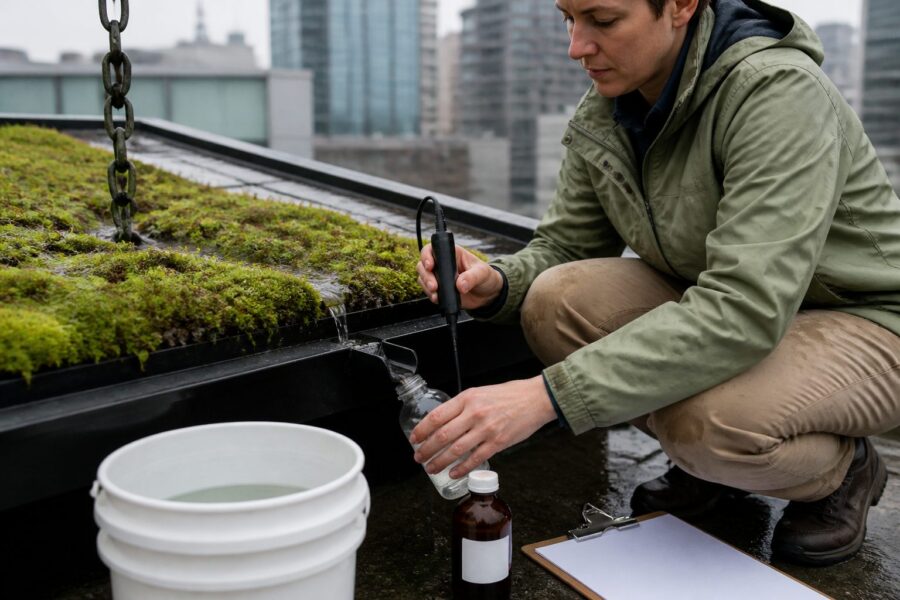
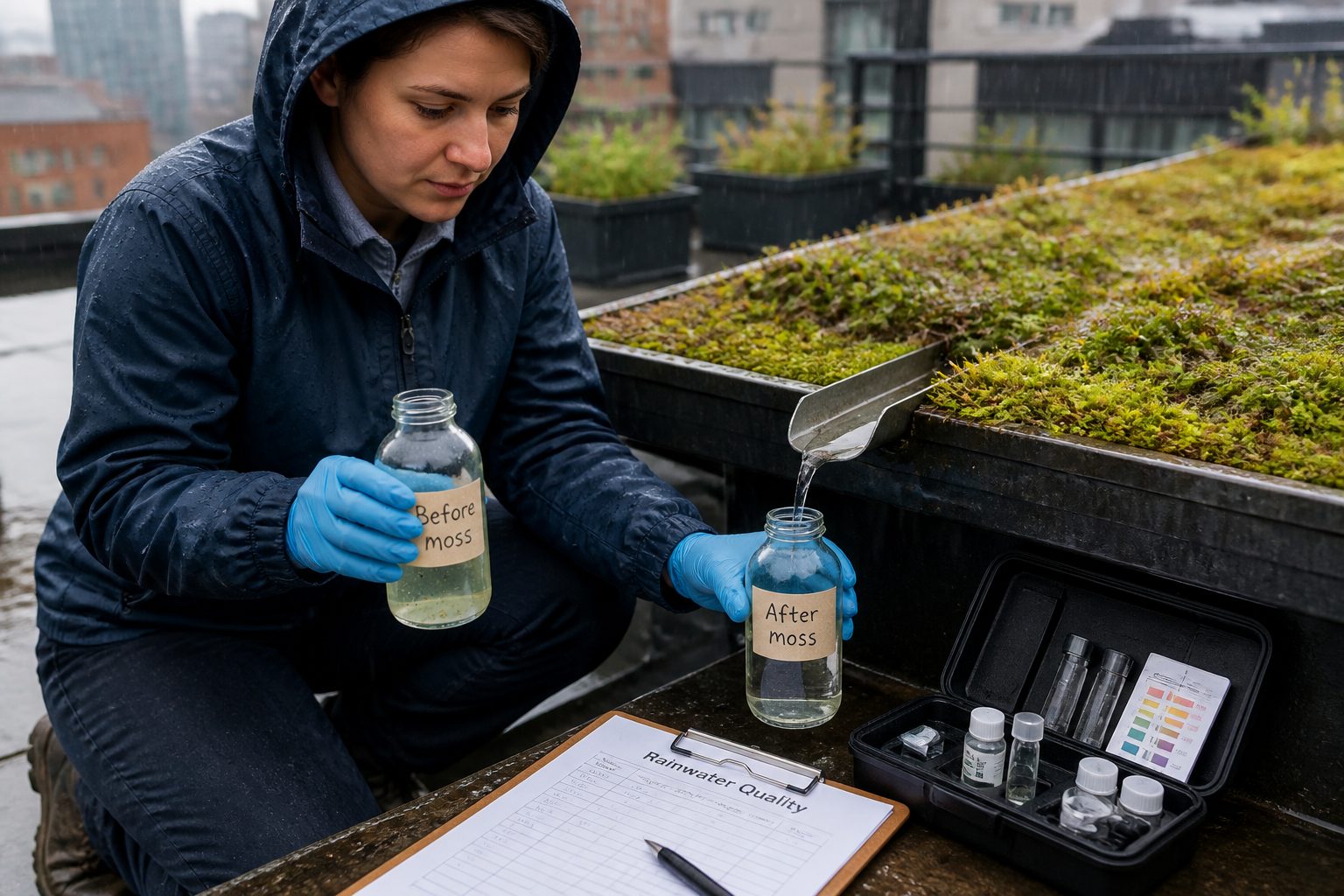
Establishing a monitoring program involves collecting runoff samples from moss-covered surfaces and comparing them to samples from conventional impervious surfaces. This comparative analysis helps quantify the reduction in various pollutants. It gives us tangible proof of the moss’s impact.
Key parameters to test include total suspended solids (TSS), which indicate the amount of particulate matter in the water. We also need to analyze concentrations of heavy metals like lead, zinc, and copper, as well as nutrient levels such as nitrogen and phosphorus. These are common urban pollutants that moss is expected to address.
pH levels and conductivity are also important indicators of water quality that should be regularly measured. Changes in these parameters can signal shifts in the chemical composition of the runoff. A comprehensive monitoring plan offers a full picture of the system’s performance.
Collecting baseline data before installing moss systems is absolutely essential. This initial data provides a reference point against which future performance can be accurately measured. Without a baseline, it is difficult to attribute improvements directly to the moss. We need to know where we started.
Regular monitoring helps identify periods of peak pollutant retention and potential saturation points of the moss. If pollutant levels in the runoff begin to increase after a certain period, it might indicate that the moss layer needs maintenance or replacement. This proactive approach ensures the system continues to function optimally.
The data gathered from monitoring informs ongoing design adjustments and maintenance protocols for `green roof water quality` systems. Understanding how different moss species perform under various pollutant loads can lead to more effective future installations. This iterative process of learning and adapting is crucial for success.
Ultimately, robust monitoring programs build confidence in `bryophyte water filtration` technologies and justify their broader adoption in urban planning. Demonstrating measurable improvements in water quality provides the evidence needed to scale up these sustainable solutions. We cannot advocate for moss without showing its tangible benefits.
Design Considerations for Drainage and Flow Rate
Successful urban moss cultivation for water filtration requires careful attention to drainage and flow rate in the design phase. Simply spreading moss on a surface without considering how water will move through and away from it will lead to failure. We need to engineer these systems thoughtfully.
The underlying substrate and its slope are critical factors. Moss needs consistent moisture but cannot tolerate prolonged waterlogging, which can lead to rot and plant death. A slight slope, typically 1-2%, is often recommended to ensure excess water drains away efficiently. This slope prevents stagnant water from harming the moss.
Incorporating effective underdrainage systems is essential, especially for `green roof water quality` applications. Layers of gravel or specialized drainage mats beneath the moss and substrate prevent water from accumulating. These systems direct filtered water to collection points or into the ground, ensuring proper flow management.
The choice of substrate also influences both water retention and drainage. A lightweight, porous substrate that holds some moisture but allows excess to pass through is ideal. Materials like expanded clay aggregates, perlite, or specific engineered soil mixes work well in conjunction with moss layers. This careful selection balances the needs of the plant with the demands of filtration.
Designing for appropriate flow rates through the moss layer is also important for optimizing `moss rainwater filtration quality`. If water flows too quickly, there isn’t enough contact time for pollutants to be trapped or absorbed. If it flows too slowly, the system can become waterlogged, harming the moss and potentially creating anaerobic conditions.
Consider the potential for erosion, especially during intense rainfall events. A well-established, dense moss mat is generally resilient, but new installations might be vulnerable. Design elements like edge restraints, shallow depressions, or subtle terracing can help stabilize the moss layer and prevent washout. Protecting the moss is paramount for its long-term function.
Integrating overflow mechanisms is a practical necessity for any `moss stormwater filter` system. During extreme storms, the system’s capacity might be exceeded, and water needs a safe path to drain. These overflows ensure that the system does not fail catastrophically and that water is managed even in peak conditions.
Finally, regular maintenance, including checking for blockages in drainage systems and ensuring the moss remains healthy, is part of good design. A system designed for easy access and inspection will be more effectively maintained over its lifespan. Thinking about the long term from the start pays dividends.
Conclusion
Moss, often overlooked, emerges as a surprisingly powerful ally in the quest for improved urban water quality. Its unique ability to intercept, retain, and filter rainwater offers a natural and sustainable solution for managing stormwater runoff. We should absolutely embrace these tiny plants for their big impact.
The science shows that moss effectively reduces suspended solids, slows nutrient transport, and can even sequester significant amounts of heavy metals. This makes `moss rainwater filtration quality` a tangible benefit for our cities and natural ecosystems. It is a living, breathing filter working quietly in the background.
While moss has its limitations, particularly with dissolved pollutants and pathogens, its role as a `moss stormwater filter` is undeniable. When integrated into multi-layered green infrastructure, it becomes a crucial component of a more resilient urban water management system. We must see it as part of a larger, smarter approach.
As cities continue to grapple with the challenges of pollution and climate change, embracing innovative, nature-based solutions like `bryophyte water filtration` becomes increasingly important. Cultivating moss on roofs, walls, and permeable surfaces can transform urban landscapes into more functional, eco-friendly spaces. This is a practical step towards greener, healthier communities.
By understanding moss’s capabilities and designing systems that optimize its performance, we can unlock its full potential for improving `green roof water quality` and urban hydrology. The future of sustainable urban living might just be a lot greener, thanks to these unassuming, yet powerful, plants. It is time we started planting more moss.