
You have likely seen Ceratodon purpureus, even if you did not know its name. This small, unassuming moss thrives in many urban environments, often going unnoticed by busy city dwellers. It is a true pioneer, quickly colonizing bare ground and disturbed surfaces across rooftops, sidewalks, and derelict lots.
Identifying this resilient species, commonly known as purple-stalked moss or fire moss, is straightforward once you know what to look for. Its ability to grow where other plants struggle makes it a fascinating subject for urban ecology and a candidate for intentional cultivation. Understanding Ceratodon purpureus identification on urban roofs helps us appreciate the hidden botanical life in our concrete jungles.
This article will guide you through recognizing Ceratodon purpureus, exploring its preferred habitats, and even offering tips for growing it yourself. We will examine its distinctive features, discuss its ecological role, and clarify how to distinguish it from similar urban mosses. Get ready to discover the subtle beauty of this widespread urban dweller.
Why the Purple Seta Is the Easiest Identification Clue
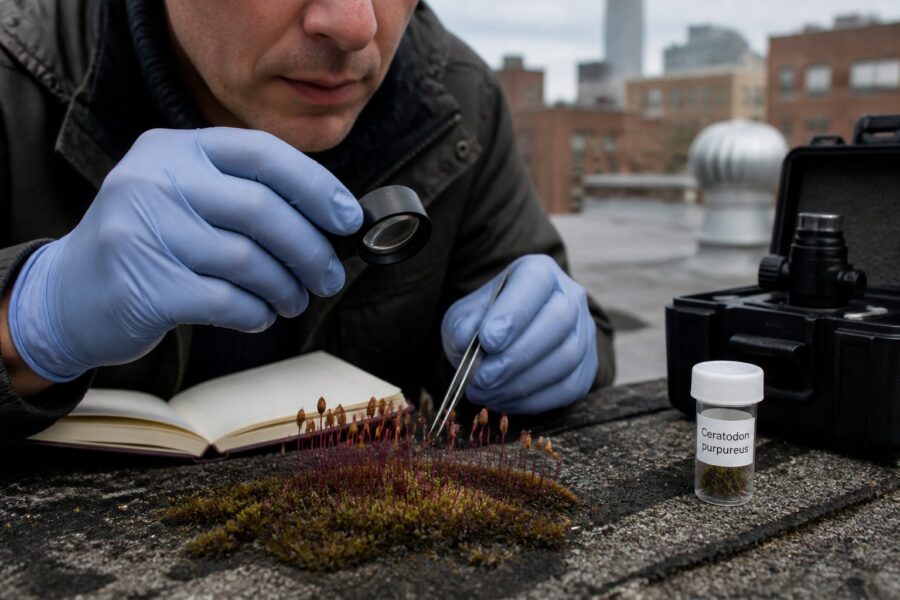
The most striking and reliable feature for Ceratodon purpureus identification is its sporophyte seta. This slender stalk, supporting the spore-producing capsule, displays a distinctive deep purple or reddish-purple color, standing out sharply against the green foliage of the moss itself.
These purple stalks typically emerge in late winter or early spring, persisting through summer in many regions. Reaching heights of one to three centimeters, they often create a fuzzy, reddish haze over extensive patches. When you see a moss with numerous tiny purple stalks, you are almost certainly looking at Ceratodon purpureus.
The spore capsule itself is also characteristic, starting green and ripening to a brownish-red. It is an erect, cylindrical capsule, often slightly ribbed when dry, with a distinct operculum or lid. This combination of the purple seta and capsule shape provides robust visual cues for identification.
While many mosses produce sporophytes, few exhibit such a consistently bright purple seta. This unique pigmentation is a key differentiator, making it instantly recognizable, especially for those new to moss identification.
Once people learn to look for the purple stalks, they start seeing Ceratodon purpureus everywhere. This simple visual cue demystifies identification, simplifying the process considerably for what might otherwise seem like a generic green carpet.
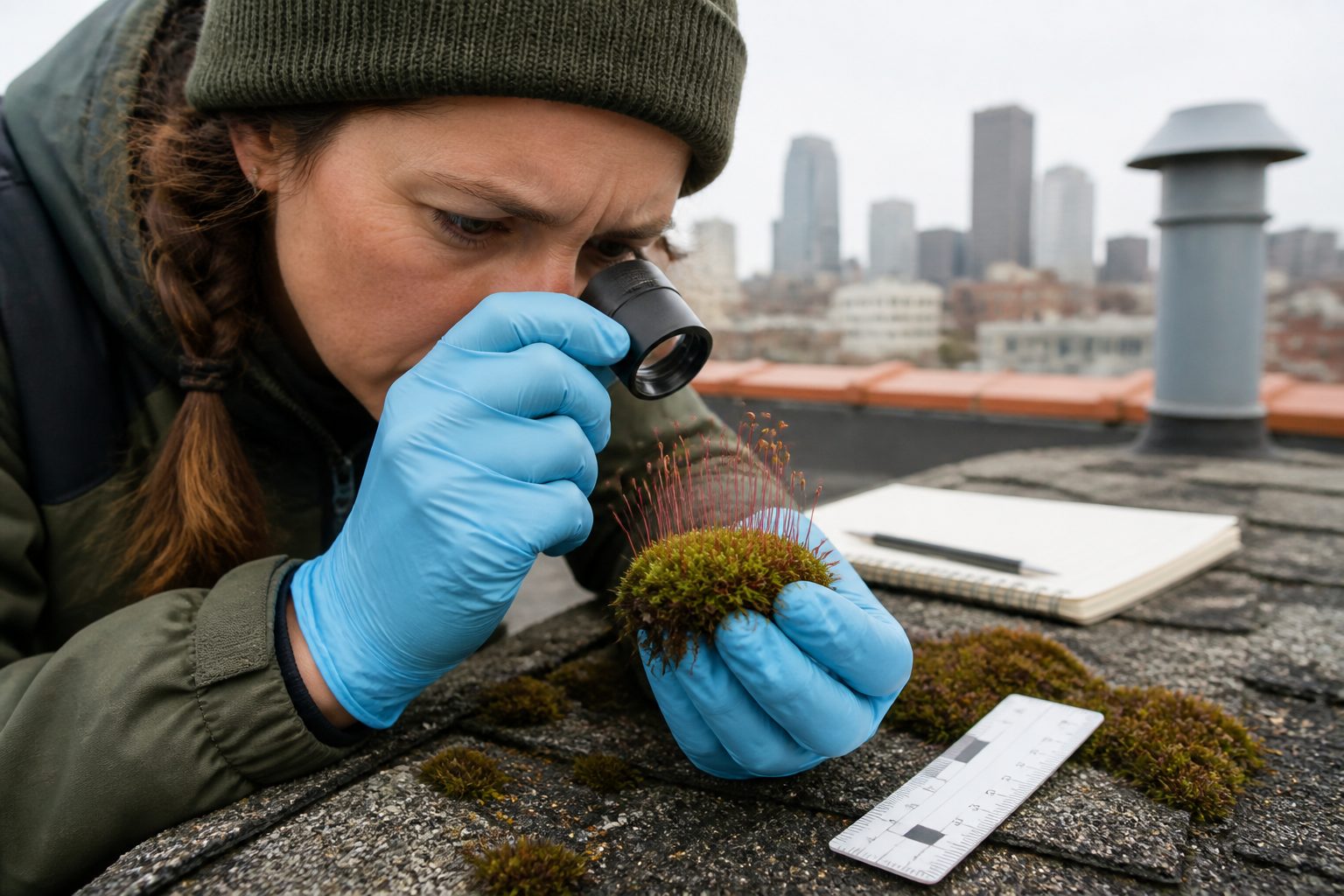
The purple-stalked moss identify quest often begins and ends with this single feature during its reproductive phase. It is a powerful indicator, making field identification much quicker and more confident. Look for those distinctive purple stems poking through the green mats.
Even from a distance, large colonies of Ceratodon purpureus can take on a reddish tint due to the sheer number of these purple sporophytes, providing a broad visual signature for initial recognition.
Leaf Features and Growth Form Without Sporophytes
While the purple seta is a dead giveaway, Ceratodon purpureus can still be identified vegetatively. Its characteristics offer consistent clues: lance-shaped leaves, tapering to a sharp point, usually less than 2 millimeters long.
These leaves are arranged spirally around the stem, giving the plant a bristly or star-like appearance. Each leaf has a strong central vein (costa) extending to or slightly beyond the tip, distinguishing it from mosses with fainter costae.
Leaf margins are usually entire, lacking teeth or serrations. When dry, leaves become appressed or twisted; when moist, they spread widely. This change in posture with moisture is a useful observation.
Ceratodon purpureus typically forms dense, cushion-like mats or low, sprawling carpets. Color varies from yellowish-green to dull green, often with reddish or brownish tones in exposed, dry conditions, depending on moisture and sun exposure.
Stems are relatively short, a few centimeters tall, and typically unbranched or sparsely branched. Its acrocarpous growth habit means sporophytes emerge from stem tips, helping create compact, resilient mats.
Even without purple stalks, careful examination of these leaf and growth characteristics often leads to correct Ceratodon purpureus identification. Training your eye to notice subtle details that differentiate moss species becomes very rewarding.
I often look for the slightly bristly texture and how leaves tightly clasp the stem when dry, unfurling with moisture. This consistent behavior reliably indicates the species, confirming suspicions even without sporophytes.
The plant’s robust yet compact appearance, combined with its preference for open, exposed sites, often hints at its identity. Over time, you learn to recognize its general “look” before scrutinizing individual leaves, developing a good eye for mosses.
Where It Grows in Cities: Rooftops, Bare Soil, and Disturbed Surfaces
Ceratodon purpureus is an incredibly adaptable species, perfectly suited to the harsh, often overlooked niches of urban environments. This purple stalk moss identify candidate thrives on a wide array of substrates and locations within cities, excelling where other plants struggle.
Its common presence on rooftops exemplifies its pioneering spirit and tolerance for extreme conditions. Urban roofs, particularly flat or low-slope ones, offer exposed, nutrient-poor, well-drained surfaces ideal for Ceratodon purpureus, making roof moss identification a common task for urban naturalists.
| Urban Habitat Type | Typical Substrate | Key Characteristics |
|---|---|---|
| Rooftops (Flat/Low-Slope) | Gravel, tar, bare soil, cracked concrete | Full sun, high drainage, temperature extremes |
| Sidewalk Cracks & Pavement | Accumulated dust, grit, thin soil layers | Foot traffic, compacted, periodic moisture |
| Bare Ground & Construction Sites | Disturbed soil, sand, gravel, rubble | Early colonizer, nutrient-poor, exposed |
| Planters & Containers | Exposed soil, edges of pots | Often overlooked, rapid colonization |
| Fire-Affected Areas | Ash, charred soil | Nutrient flush, reduced competition |
| Old Walls & Fences | Mortar, weathered wood, crevices | Sheltered but exposed, good drainage |
Beyond roofs, Ceratodon purpureus identification urban roofs is just one facet of its urban range. This moss commonly colonizes sidewalk cracks, gaps in pavement, and any patches of bare soil or grit, providing perfect microhabitats for this hardy plant in forgotten city corners.
Construction sites and recently disturbed ground are prime locations to spot Ceratodon purpureus fire moss. It quickly establishes on newly exposed soil, sand, or gravel, acting as one of the first green pioneers. Its tolerance for low nutrient levels and full sun makes it dominant in these raw, open sites.
I often see it at the base of street trees where soil is compacted and sparse, or along neglected planters. It thrives in these challenging spots, forming extensive, colorful mats, meaning you do not have to look far to find it in any city.
How It Colonizes After Fire, Scraping, or Renovation
Ceratodon purpureus earned its nickname “fire moss” for its remarkable ability to colonize sites recently disturbed by fire. It thrives in the aftermath of forest, brush, and urban blazes, where ash-rich soil and reduced competition create an ideal environment for its spores to germinate.
Fire’s heat can sterilize soil, eliminating competing plants and pathogens. This clearing gives Ceratodon purpureus a significant advantage, allowing it to rapidly establish and spread, bringing green life back to a scorched landscape.
Beyond fire, this moss is an opportunistic colonizer of any disturbed surface. Urban renovation projects, for example, often leave bare soil, gravel, or exposed concrete patches, which Ceratodon purpureus quickly targets.
When a roof is scraped clean or a garden bed dug up, Ceratodon purpureus spores are often among the first to land and germinate. Its small size, rapid growth, and tolerance for harsh conditions make it a perfect pioneer, so Ceratodon purpureus identification on urban roofs often points to recent construction or maintenance.
Its colonization strategy relies on efficient spore dispersal and high tolerance for environmental stress. Numerous sporophytes release countless tiny spores into the wind, settling on available substrates. These spores are incredibly resilient and can remain viable for long periods.
I have observed this moss appearing almost overnight on newly exposed soil after heavy machinery has cleared a site. Its swift colonization and ability to establish a foothold in seemingly barren conditions are hallmarks of its ecological success.
Ceratodon purpureus’ resilience makes it a valuable ecological indicator of disturbance. Its presence often signals recent disruption, whether natural or human-induced, a testament to the power of pioneer species.
The ability of Ceratodon purpureus fire moss to thrive in challenging environments highlights its robust nature and ecological importance. It stabilizes disturbed soils, prevents erosion, and initiates ecological succession, making it a crucial player in recovery.
Separating Ceratodon From Similar Urban Mosses
In the urban jungle, Ceratodon purpureus shares habitat with several other common moss species, sometimes leading to confusion. Distinguishing purple stalk moss identify from lookalikes requires close attention to specific details for accurate identification.
Bryum argenteum, or silver moss, often grows alongside Ceratodon. It has a distinctive silvery-green appearance from tightly overlapping, often whitish-tipped leaves. Its sporophytes, when present, have brownish-red capsules on slender, reddish-brown setae, rarely as distinctly purple as Ceratodon’s.
- Check seta color for bright purple (Ceratodon) vs. reddish-brown (Bryum).
- Observe leaf color: silvery-green (Bryum) vs. yellowish-green to dull green (Ceratodon).
- Look for leaf shape: lance-shaped (Ceratodon) vs. broader, concave (Bryum).
- Examine leaf costa: strong to tip (Ceratodon) vs. shorter, weaker (Bryum).
- Consider habitat: pioneer on disturbed soil (Ceratodon) vs. often on compacted soil (Bryum).
- Note capsule shape: erect, cylindrical (Ceratodon) vs. pendulous, pear-shaped (Funaria).
- Feel leaf texture: stiff, bristly (Ceratodon) vs. soft, often recurved (Syntrichia).
- Observe leaf tips: sharp point (Ceratodon) vs. hair-point (Syntrichia).
Funaria hygrometrica, common cord moss, also colonizes disturbed urban sites, especially after fires. While it produces sporophytes, its setae are usually reddish-brown, not purple, and its capsules are distinctly pear-shaped and often pendulous, clearly distinguishing it from Ceratodon purpureus fire moss’s erect, cylindrical capsules.
Syntrichia species, like Syntrichia muralis (wall screw-moss), are found on urban roofs and walls. These mosses often have leaves with a distinctive hair-point (a translucent costa extension) which Ceratodon lacks. Their leaves also tend to be broader and often recurved when dry, giving them a different texture and appearance.
Focus on the unique combination of features: the bright purple seta, lance-shaped leaves with a strong costa, and erect cylindrical capsule. This holistic approach makes roof moss identification much more reliable.
While microscopic examination reveals further differences, macroscopic features are usually sufficient for field identification. Practice and careful observation are your best tools for telling these urban mosses apart, developing your eye for these details over time.
Remembering the keyword, Ceratodon purpureus identification urban roofs, helps focus on its common settings. By comparing its traits against other urban dwellers, you can confidently identify this fascinating species with a little patience.
Seasonal Variation: What Changes Through the Year
Ceratodon purpureus’ appearance shifts significantly throughout the year, primarily influenced by moisture availability and its reproductive cycle. Understanding these seasonal changes aids identification regardless of the time of year, as it’s a resilient organism adapting to varying conditions.
In late autumn and winter, as temperatures drop and moisture increases, Ceratodon purpureus enters its prime reproductive phase. Distinctive purple setae emerge from leafy gametophytes. Moss patches might appear greener and more lush during this cooler, wetter period.
By late winter and early spring, sporophytes are usually fully developed, with capsules ripening. This is the peak time for Ceratodon purpureus identification urban roofs due to the striking seta color. The entire patch can take on a reddish-purple hue from the mass of sporophytes, creating quite a spectacle.
As spring progresses into summer, capsules mature and release spores. Setae often persist but may become more brittle and faded. Green leaves might show brownish or reddish tints, especially in very sunny and dry locations, a common stress response.
During hot, dry summer months, Ceratodon purpureus can appear desiccated and less vibrant. Its leaves will often be tightly appressed to the stem, and the mat might shrink, taking on a dull, reddish-brown or grayish-green color, entering a dormant state to conserve moisture.
Do not be fooled by its dried appearance; the moss simply waits for favorable conditions. A good rain shower quickly rehydrates the plants, causing leaves to unfurl and the mat to regain its green color. This rapid recovery testifies to its hardiness.
I have seen patches that looked completely dead in August spring back to life within hours of a summer downpour. This ability to withstand prolonged desiccation is key to its success in exposed urban environments, making the purple stalk moss identify challenge more interesting.
Autumn brings cooler temperatures and increased rainfall, prompting the moss to rehydrate and begin its growth cycle anew. Vegetative mats become more robust and greener, preparing the moss for the next reproductive season.
Observing Ceratodon purpureus fire moss throughout the year offers a wonderful lesson in bryophyte resilience and adaptation. Each season presents a slightly different face of this common species, a constantly evolving picture of life in the city.
Cultivation Notes for Those Who Want to Grow It Intentionally
For urban moss cultivation, Ceratodon purpureus is an excellent candidate due to its hardiness and widespread availability. Growing it intentionally adds interesting texture and ecological value to urban landscapes, offering a low-maintenance green solution.
Cultivating Ceratodon purpureus begins with providing the right substrate. It thrives on mineral-rich, well-drained, often nutrient-poor soils like sandy or gravelly mixes, crushed brick, or bare concrete. Avoid heavily organic or moisture-retentive potting mixes, which can lead to rot.
Light requirements are flexible, but it generally prefers full sun to partial shade. In full sun, it develops more reddish or brownish tints (especially when dry) and often produces more sporophytes. In shaded conditions, it tends to remain a brighter green.
Moisture is important for establishment, but Ceratodon purpureus tolerates drought well once established. Regular misting or light watering during initial weeks after transplanting aids establishment; thereafter, natural rainfall is usually sufficient.
Propagate Ceratodon purpureus by transplanting small clumps from existing colonies. Gently lift a piece of the moss mat with some underlying substrate, place it onto your desired surface, and press gently for good contact.
Another method involves creating a moss slurry: blend small pieces of moss with buttermilk, beer, or water and a little sugar. Paint this mixture onto your chosen surface (rock, concrete planter, bare soil) to encourage broader colonization.
While Ceratodon purpureus identification urban roofs might lead you to collect samples for cultivation, always do so responsibly. Take only small amounts to avoid depleting local populations; ethical collection practices are very important.
This moss is particularly suitable for green roofs, rock gardens, and filling cracks in paving. Its low growth habit and drought tolerance make it an excellent choice for these challenging environments, providing ecological benefits like stormwater retention and microfauna habitat.
I have successfully grown Ceratodon purpureus on concrete pavers in my garden, creating a soft, green, no-mow carpet. It is a wonderfully low-maintenance groundcover, adding a natural touch to hard urban surfaces and making a great alternative to traditional groundcovers.
When considering roof moss identification for cultivation, remember Ceratodon purpureus is one of the easiest species to establish. Its robust nature forgives many beginner mistakes, so give it a try to add resilient green to your urban space.
It is a fantastic choice for a moss-dominant aesthetic where other plants struggle. Its tolerance for urban pollution and temperature extremes cements its value as a cultivated species that truly thrives on neglect.
Conclusion
Ceratodon purpureus, the purple-stalked moss, is a ubiquitous and fascinating component of urban ecosystems. Its distinct purple setae make Ceratodon purpureus identification urban roofs an accessible skill for anyone. This resilient species thrives where most plants cannot, making it a true pioneer.
From scorching rooftops to barren construction sites, this moss demonstrates an incredible capacity for survival and colonization. Its rapid establishment after disturbances like fire solidifies its nickname, Ceratodon purpureus fire moss. It plays a vital role in stabilizing disturbed areas.
Understanding its vegetative features, like lance-shaped leaves and strong costa, helps identification even without sporophytes. We explored distinguishing it from similar urban mosses, emphasizing key differences in leaf shape, color, and sporophyte characteristics. Careful observation is key to accurate identification.
Its seasonal variations, from lush green mats with vibrant purple stalks in spring to dormant, reddish patches in summer, showcase its adaptability. This dynamic presentation offers something new to observe throughout the year, reminding us of nature’s constant cycles.
For those inspired to cultivate this hardy bryophyte, its preference for well-drained, mineral-rich substrates and sun tolerance make it a straightforward, low-maintenance choice for green roofs, rock gardens, and other challenging urban spots, a testament to its robust nature.
Recognizing and appreciating species like Ceratodon purpureus enriches our perception of the urban environment, highlighting hidden biodiversity that persists even in built-up areas. This humble moss offers a glimpse into nature’s resilience.
So next time you are walking through the city or looking up at a rooftop, take a moment to look for the purple-stalked moss identify signature. You will likely find it, quietly thriving and contributing to the subtle greening of our concrete world, a small but powerful reminder of life’s persistent spirit.
Its ability to colonize and thrive in harsh conditions makes it a model of resilience, teaching us about adaptation and survival in challenging environments. It is a true survivor of the urban landscape.
This common urban moss has a fascinating story, from its pioneering role after fire to its surprising beauty. Observing Ceratodon purpureus connects us more deeply with the natural world, even within city limits, bringing a touch of wildness to the everyday.
By understanding and cultivating this species, we foster greater appreciation for bryophytes and their ecological contributions. Ceratodon purpureus is not just a moss; it is a symbol of enduring life in the urban sprawl, deserving our attention.