
Recognizing the diverse array of mosses in our urban environments can be a rewarding challenge for any budding bryologist. Among the many species thriving in cities, one genus stands out for its widespread presence and distinctive characteristics: Hypnum.
This group, often called feather mosses, includes some of the most common ground covers and epiphytes you will encounter on a city stroll. Mastering Hypnum moss identification urban feather moss varieties is a fantastic entry point into the fascinating world of urban bryophytes.
Understanding how to identify these resilient plants deepens our connection to nature right outside our doors, even in the most built-up areas. This guide will walk you through the specifics of recognizing Hypnum, particularly focusing on the ubiquitous Hypnum cupressiforme identification.
What Makes Hypnum Distinct From Other Feather Mosses
Hypnum mosses are pleurocarpous, meaning they have a sprawling, branched growth habit rather than growing upright from a single stem. This contrasts sharply with acrocarpous mosses, which tend to form upright cushions or tufts.
The term “feather moss” perfectly describes their appearance, as their branches often spread out in a feathery or fern-like manner. This growth form allows them to quickly cover large surfaces, creating extensive mats.
One of the most immediate visual cues for Hypnum is its typically glossy or somewhat shiny appearance, especially when moist. This sheen helps distinguish it from many duller moss species found in similar habitats.
They often form dense, interwoven mats that can be surprisingly tough and resilient. This mat-forming capability is a key characteristic that enables them to colonize a wide range of urban substrates.
The branches usually lie relatively flat against the substrate, giving the whole colony a somewhat flattened profile. This allows them to withstand foot traffic or other disturbances better than more erect mosses.
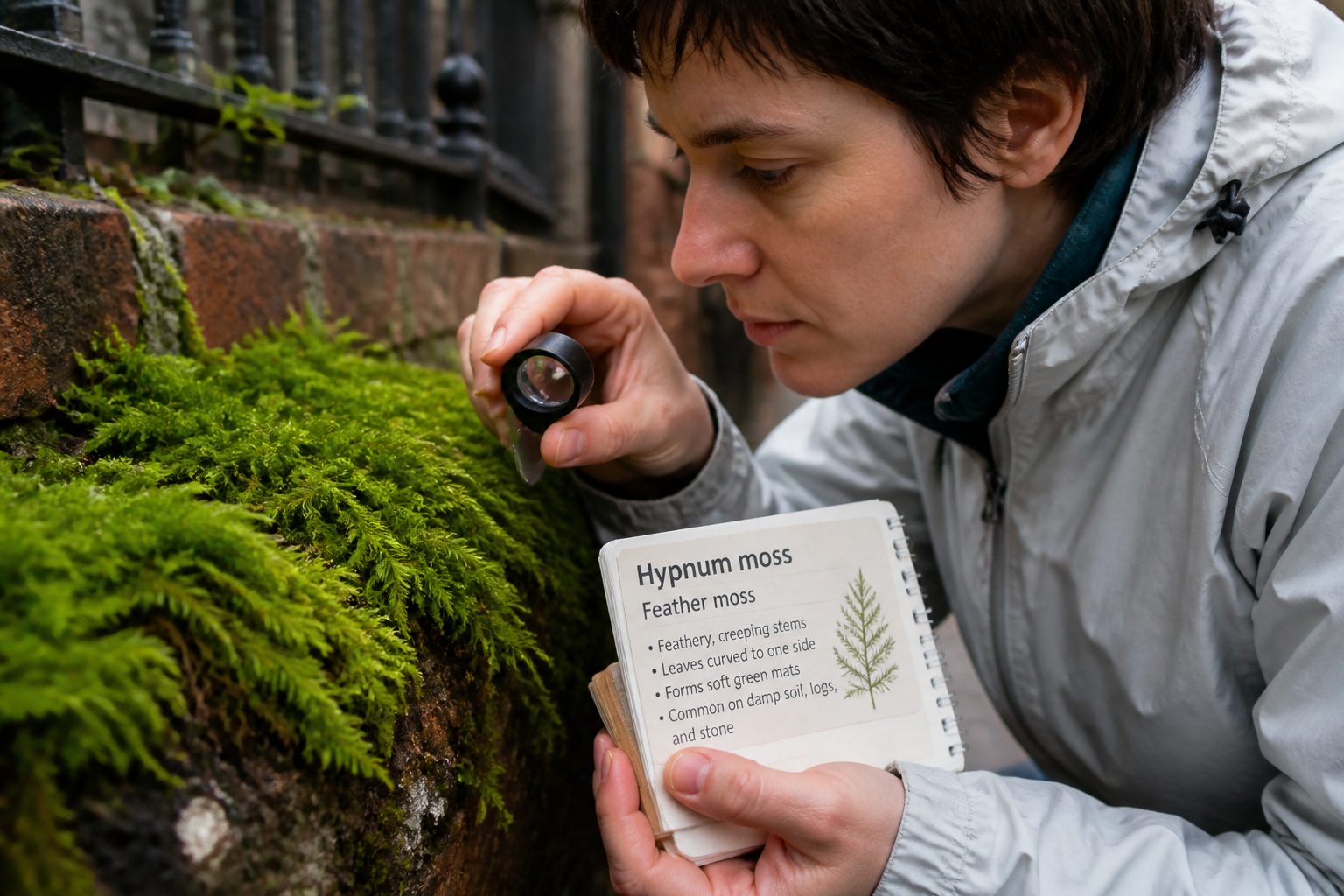
Their pleurocarpous nature makes them excellent colonizers, spreading rapidly across surfaces once established. This growth strategy is highly effective in the dynamic and often disturbed environments of cities.
When you see a large, sprawling carpet of moss with a noticeable luster, especially on bark or concrete, your first thought should definitely be a type of Hypnum moss identification urban feather moss.
Leaf Shape, Arrangement, and Color Clues
The leaves of Hypnum species, particularly Hypnum cupressiforme identification, are typically falcate-secund, which means they are curved like a sickle and sweep to one side of the stem. This distinctive curvature gives the moss its characteristic streamlined or swept-back look.
These leaves also often appear somewhat compressed or flattened against the stem and branches, contributing to the overall sleek appearance of the plant. The way the leaves overlap and curve uniformly creates a very cohesive and recognizable texture.
Another crucial feature is the absence of a prominent midrib or costa on the leaves. While some mosses have a very obvious central vein, Hypnum leaves either lack one entirely or possess a very short, double costa that is difficult to see without magnification.
The color of Hypnum mosses varies, ranging from a bright, fresh green in moist, shaded conditions to a more golden-green or even brownish hue when exposed to sun or drought. The glossy texture persists regardless of the exact shade.
When dry, the leaves often become more tightly appressed to the stems and branches, making the moss appear shriveled or less vibrant. However, a quick spray of water will usually revive its characteristic shape and luster.
Observing the consistent directionality of the curved leaves along the stems is a strong indicator for feather moss identify. This uniform arrangement is a hallmark of the genus and rarely varies within a single patch.
Paying close attention to these specific leaf characteristics – the falcate-secund shape, the lack of a strong costa, and the overall color and sheen – will greatly assist your Hypnum moss identification urban feather moss efforts.
Where Hypnum Grows in Cities: Bark, Soil, and Walls
Hypnum mosses are incredibly versatile, thriving across a surprising range of urban substrates due to their adaptability. You can find them forming lush carpets on tree bark, particularly on the north sides of trunks where moisture is retained.
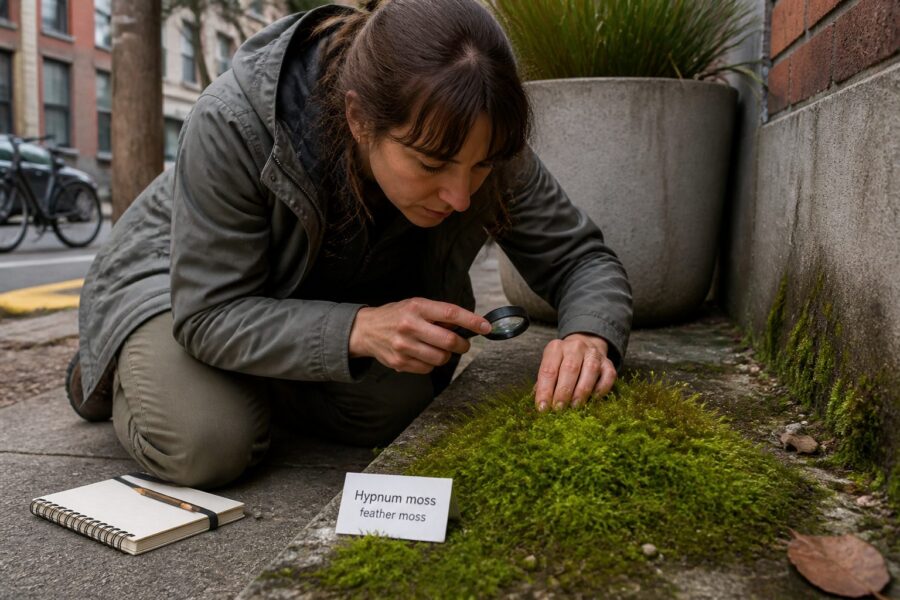
They are also common on disturbed soil, concrete walls, brickwork, and even old wooden fences, demonstrating their resilience in varied urban settings. This widespread distribution makes them excellent subjects for pleurocarpous moss urban studies.
| Habitat Type | Typical Location Examples | Associated Urban Features |
|---|---|---|
| Tree Bark | Maple, Oak, Sycamore trunks (especially older trees) | Parks, street trees, garden boundaries |
| Disturbed Soil | Flowerbeds, pathways, vacant lots, construction sites | Gardens, public squares, roadside verges |
| Concrete & Stone | Walls, sidewalks, old foundations, gravestones | Building facades, historical sites, urban ruins |
| Wood & Timber | Fences, decaying logs, old railway sleepers | Allotments, garden sheds, forgotten corners |
| Roofs & Gutters | Shaded sections of tiled or shingled roofs | Residential areas, commercial buildings |
How to Confirm With a Hand Lens
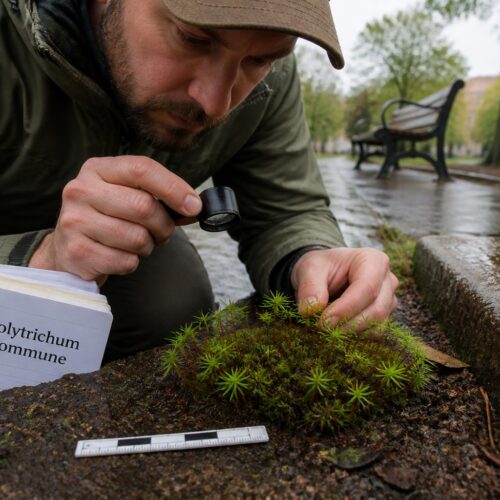
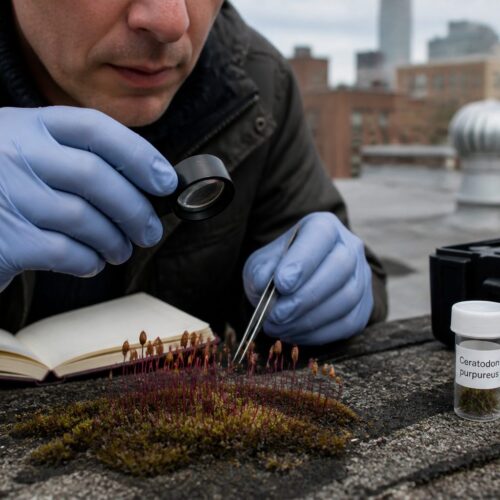
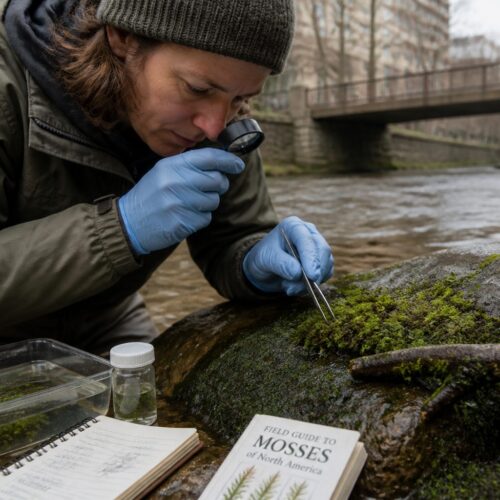
While visual cues are a good starting point, a hand lens (10x or 20x magnification) is indispensable for confirming Hypnum moss identification urban feather moss. This tool allows you to examine the finer details of the leaves and stems, which are often too small to see with the naked eye.
Focus on the individual leaves and observe their cellular structure. Hypnum species typically have long, narrow, and often somewhat worm-like laminal cells, which are the main cells forming the leaf blade.
Carefully look for the costa, or midrib, at the base of the leaf. As mentioned earlier, Hypnum leaves usually have a very short, double costa or none at all, making its absence a key diagnostic feature.
Examine the leaf margins, which are usually smooth and entire, without teeth or serrations. The lack of teeth is another characteristic that helps narrow down your identification.
You might also notice small, often somewhat differentiated cells at the corners of the leaf base where it attaches to the stem; these are called alar cells, and their appearance can be helpful for species-level Hypnum cupressiforme identification.
Pay attention to the branch tips; in many Hypnum species, the tips of the branches and sometimes the main stems curve noticeably, often giving the plant a somewhat hooked appearance. This curving is particularly evident when the moss is moist and turgid.
Consistent observation with a hand lens across multiple samples will train your eye to recognize these subtle but crucial features. This practice solidifies your ability to confidently identify this common urban moss.
Common Look-Alikes and How to Separate Them
Identifying Hypnum can sometimes be tricky because several other pleurocarpous mosses share similar growth forms and habitats, leading to potential confusion. Knowing the key differences is essential for accurate feather moss identify.
Many mosses in the Hylocomiaceae family, like Pleurozium schreberi or Hylocomium splendens, also have a feathery appearance. However, their leaf characteristics and branching patterns usually differ upon closer inspection.
- Pleurozium schreberi (Red-stemmed Feather Moss): Look for distinctive reddish stems under the green leaves; Hypnum stems are typically greenish or brownish.
- Rhytidiadelphus squarrosus (Bent-leaf Moss): Its leaves are strongly squarrose, meaning they stick out abruptly from the stem at right angles, giving it a much messier, star-like appearance compared to Hypnum‘s swept-back leaves.
- Brachythecium species (Rough-stemmed Feather Moss): These often have a less glossy appearance and their leaves tend to be lance-shaped rather than falcate-secund, lacking the strong curve of Hypnum leaves.
- Ctenidium molluscum (Combed Moss): While it also has curved leaves, Ctenidium usually forms more compact, intricate mats and its leaves are often more sharply pointed with a distinct, though short, double costa.
- Thuidium species (Fern Mosses): These are typically bipinnately or tripinnately branched, giving them a much more finely divided, fern-like structure than the simpler branching pattern of Hypnum.
- Pylaisia polyantha: This moss can look very similar to Hypnum cupressiforme on tree bark, but its leaves are usually less strongly falcate-secund and it often has prominent pseudoparaphyllia (small leaf-like structures) at the branch bases, visible with a hand lens.
- Amblystegium serpens: Often found in similar damp, shaded urban spots, but its leaves are smaller, less curved, and it lacks the strong glossy sheen of Hypnum.
Seasonal Changes That Affect Identification
The appearance of Hypnum mosses can shift subtly throughout the year, primarily in response to moisture levels and reproductive cycles. These seasonal changes can sometimes influence the ease of Hypnum moss identification urban feather moss varieties.
During wet periods, typically spring and autumn, Hypnum mosses are plump and turgid, displaying their most vibrant green or golden-green colors and their characteristic glossy sheen. The leaves are fully expanded, making their falcate-secund arrangement very clear.
In drier summer months or during winter frosts, the moss can appear shriveled, duller, and more brownish, with leaves tightly pressed against the stems. This protective mechanism reduces water loss but temporarily obscures some key identification features.
The presence of sporophytes, the spore-producing structures, offers a definitive identification aid during their season. Hypnum sporophytes typically consist of a long, reddish seta (stalk) topped by a cylindrical or curved capsule.
These sporophytes usually emerge in late autumn or winter and persist into spring, making it an excellent time to observe them for confirmation. The capsules often have an operculum (lid) with a conical shape, and they release spores over several weeks.
The orientation of the capsules, often horizontal or nodding, is another helpful characteristic for Hypnum cupressiforme identification. Observing these reproductive structures can confirm a genus identification even when vegetative parts are less clear.
While the vegetative features remain consistent, understanding how moisture and sporophyte presence impact the overall look will refine your pleurocarpous moss urban identification skills across all seasons.
Using Hypnum in Urban Cultivation Projects
Given its resilience, widespread availability, and attractive mat-forming habit, Hypnum moss is an excellent candidate for urban cultivation projects. It offers a natural, low-maintenance green solution for various challenging urban spaces.
Its ability to thrive on diverse substrates like bark, soil, and concrete makes it ideal for creating moss gardens, green walls, or even miniature landscapes in containers. This makes Hypnum moss identification urban feather moss knowledge incredibly practical.
To cultivate Hypnum, start by gently collecting small patches from areas where it is abundant, ensuring you leave plenty behind to regrow. Always seek permission if collecting from private property or protected areas.
Prepare your chosen substrate by ensuring it is clean, firm, and capable of retaining some moisture. For vertical surfaces, a thin layer of soil mixed with compost or sphagnum moss can provide a good base.
Press the collected moss pieces firmly onto the prepared surface, making sure there is good contact between the moss and the substrate. You can use pins or a fine mesh to hold it in place initially on vertical surfaces.
Water the newly installed moss regularly, especially during dry periods, until it establishes itself and begins to spread. Hypnum prefers shaded or partially shaded locations to prevent drying out too quickly.
Once established, Hypnum requires minimal ongoing care, making it a sustainable choice for adding greenery and biodiversity to urban environments. Its presence can help cool surfaces, filter air, and provide microhabitats for small invertebrates.
Consider using it to create a moss lawn in shady spots where grass struggles, or to soften the hard edges of concrete planters. Its robust nature and aesthetic appeal contribute significantly to urban greening efforts.
Embracing Hypnum in your cultivation projects is a simple yet powerful way to connect with the natural world and enhance the ecological value of your immediate surroundings. It truly brings the beauty of feather moss identify to life.
Conclusion
Mastering Hypnum moss identification urban feather moss varieties is a skill that opens your eyes to the subtle beauty and ecological richness of city life. With its distinctive glossy mats and falcate-secund leaves, Hypnum is an urban survivor.
Remember to look for its sprawling, pleurocarpous growth, the absence of a strong costa, and the characteristic sickle-shaped leaves. A hand lens will reveal the fine cellular details and confirm your suspicions, especially for Hypnum cupressiforme identification.
Understanding its common look-alikes and how seasonal changes affect its appearance will further refine your identification abilities. This knowledge transforms a simple walk into an engaging botanical exploration.
Beyond identification, Hypnum offers fantastic opportunities for urban cultivation, bringing natural beauty and ecological benefits to our concrete jungles. Its resilience and adaptability make it a rewarding choice for greening projects.
So next time you encounter a patch of feather moss identify it with confidence and appreciate its quiet contribution to the urban ecosystem. Happy moss hunting and cultivating.