
Urban moss growers tend to chase sprinklers and misting systems, but the cheapest water source shows up quietly at dawn. If you can pull dew out of the night air, you can keep trays and mats evenly damp without running a hose.
The trick is surface design, not gadgets. A good condensation surface cools below the dew point and then hands that moisture to moss in a controlled way.
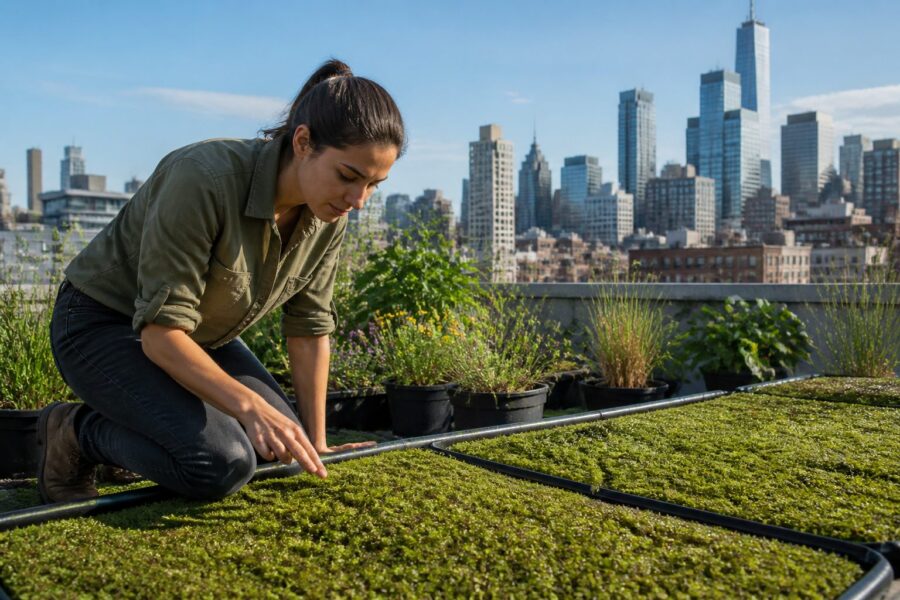
This article focuses on moss dew harvesting urban setups that fit balconies, fire escapes, courtyards, and flat roofs. The goal is practical: build surfaces that condense, guide drips, and stay clean enough that your bryophytes do not pay the price.
Why dew forms in cities (and where it doesn’t)
Dew forms when a surface temperature drops below the dew point of the air touching it. When that happens, water vapor turns into liquid on the surface as condensation.
In cities, the air can stay surprisingly humid because concrete and plants both release moisture after sunset. Even a few irrigated planters or a line of street trees can keep the nighttime air damp enough for dew.
Cities can produce decent dew because humidity often stays higher than people assume, especially near rivers, parks, and irrigated street trees. The problem is that many urban surfaces stay too warm at night, so they never cross the dew point.
The urban heat island effect is real, but it is not uniform block to block. A roof above a bakery vent may stay warm all night while a shaded courtyard two streets away cools fast and drips by sunrise.
You will usually get more dew in a courtyard that sees open sky than under a dense canopy of HVAC units and overhangs. You will also get more dew on a surface that faces the night sky than one pressed against a warm brick wall.

Glass railings, metal handrails, and car roofs are good indicators because they cool quickly and show moisture clearly. If those surfaces are bone dry at dawn, your site may be fighting you that night.
Wind is a mixed bag for moss dew harvesting urban sites. A light breeze refreshes humid air at the surface, but a strong wind strips away the cool boundary layer and can reduce condensation.
In narrow alleys, wind can also be turbulent and warm if it is bouncing off sun-baked walls. That kind of airflow can keep surfaces from stabilizing at a cool temperature long enough to start beading.
Some spots simply do not dew up, like roofs that radiate heat from dark membranes or gravel that holds warmth. If you can touch a surface at 4 a.m. and it still feels warm, it is working against you.
Another dew-killer is a ceiling of reflected heat, like a low overhang that stayed hot from the afternoon. Even if the air is humid, your panel cannot radiate effectively if it cannot see the cold sky.
Pollution can cut both ways because particles can seed condensation while also dirtying the surface that collects it. For moss, you want the dew to happen, but you want the drip path to stay as clean and inert as possible.
Radiative cooling explained in simple terms
Radiative cooling is the reason a clear night can feel colder than the forecast. A surface loses heat by sending infrared energy to the sky, and it can cool below the surrounding air temperature.
This is not the same as a cold wind chill, because radiative cooling can happen even in still air. The surface is basically paying heat to the sky until it hits a new balance point.
Clouds act like a blanket because they send some of that infrared energy back down. On cloudy nights, your condensation surface often stays too warm to reach the dew point.
Thin high clouds can still reduce dew even if you can see stars through them. If your dew harvest seems inconsistent, start by noting sky clarity rather than blaming your materials.
Think of a car roof that is wet at sunrise even though it never rained. That metal skin had a wide view of the sky, cooled fast, and became a condensation surface.
The same thing happens on patio tables, plastic bins, and glass skylights, which is why you can often find dew clues without any instruments. Your job is to turn that random wetness into a controlled drip for moss.
Radiative cooling works best when the surface has high emissivity and low heat storage. Thin materials cool faster than thick slabs, and lighter colors usually store less heat after sunset.
Heat storage is a silent problem because a thick panel might condense late, then dump water all at once when it finally cools. For moss, a steady slow drip is usually better than a sudden pour.
If you remember one rule, make the surface see the sky and avoid heat sinks nearby. This is why a small panel on a stand can outproduce a big warm roof for dew collection.
Even a few inches of air gap behind the panel can matter, because it reduces conduction from warm supports. A panel that is thermally isolated behaves more like a car roof and less like a wall.
Radiative cooling also rewards patience because the best condensation often happens right before sunrise. If you check too early and call it a failure, you may miss the most productive hour.
Choosing condensation surfaces that are safe for moss
For moss, the safest dew is the dew that forms on clean, inert materials and then drips onto your grow area. Avoid surfaces that leach metals or shed oily residues, because moss tissue absorbs whatever arrives with the water.
Moss does not have the same buffering and filtering that many vascular plants do, so small contaminants can show up as slow decline rather than obvious burn. If you are growing sensitive species, assume the drip water is a delivery system for whatever is on the panel.
I prefer food grade plastics, glazed ceramic, glass, and sealed stainless steel for a condensation surface in small urban builds. Painted metals can work, but only if the coating is stable and you trust what is in it.
Food grade plastics are boring in the best way, because they are predictable and easy to rinse. If a panel smells like chemicals when it warms in the sun, do not put it above moss.
Glass is excellent for cleanliness, but it can be heavy and sharp when it breaks. If you use glass, consider tempered glass and mount it so it cannot slide or tip in wind.
Glazed ceramic tile is underrated because it is cheap, stable, and easy to find, and it often sheds water in a smooth sheet. The main risk is using tiles with dusty cuts or gritty grout that can wash into the trays.
Stainless steel is safe when it is actually stainless and not mystery metal that rusts at the edges. If you see orange staining, treat it as a contamination warning and fix the fasteners or replace the sheet.
HDPE and similar plastics can be tuned with surface texture, because a slightly smoother face tends to shed droplets more predictably. A heavily textured plastic can hold beads and delay drip timing, which may or may not help your setup.
| Surface material | Condensation behavior | Moss safety notes |
|---|---|---|
| Glass panel | Forms droplets, sheds quickly when tilted | Inert, easy to rinse, can splash if too steep |
| Glazed ceramic tile | Beads and runs in thin sheets | Generally safe, watch grout dust and chips |
| HDPE sheet | Droplets merge slowly, steady drip line | Good choice, avoid unknown recycled odors |
| Stainless steel (304) | Fast cooling, droplets slide with a lip | Safe if clean, avoid rusty fasteners nearby |
| Unsealed concrete | Soaks moisture, limited dripping | Can raise pH and trap pollutants, skip it |
Whatever you choose, make it easy to remove and wash, because urban dust is constant. A panel that is annoying to clean will eventually stay dirty, and then your moss will show it.
Also think about what happens in heat waves, because some plastics soften and sag, changing your drip line overnight. A stable panel keeps your moss watering consistent, which is the whole point of harvesting dew.
If you are unsure about a material, run a simple test by letting dew drip into a clear cup for a week and checking for odor, film, or discoloration. Moss is a long game, so it is worth being cautious at the start.
Positioning for night sky view and reduced heat storage
Placement matters more than fancy materials, because radiative cooling depends on sky exposure. A panel tucked under an awning sees less sky and usually collects less dew.
Sky view is not just about being outdoors, because a narrow balcony between tall buildings can behave like it has a lid. If you can only see a thin strip of sky, expect lower yields and plan for supplemental watering.
Start by finding a spot that stays shaded after 3 p.m., since late day sun loads heat into your setup. If the surface begins the night hot, it wastes hours cooling instead of condensing.
Shade can come from a neighboring wall, a railing, or even a simple screen, and you do not need total darkness to get benefits. The goal is to avoid the last blast of low-angle sun that bakes surfaces right before evening.
Keep your condensation surface away from warm exhaust, dryer vents, and the top of a refrigerator-like HVAC compressor. That warm airflow raises the local dew point but also keeps the surface warm, which is the wrong combination.
Warm exhaust also carries lint and oils that stick to panels and change how droplets form. If your panel develops a patchy wet pattern, check for a vent plume that is coating it.
Tilt angle is a tuning knob, not a fixed rule. A shallow tilt holds droplets longer and can improve condensation time, while a steeper tilt sheds water faster and feeds moss sooner.
In practice, you are balancing two problems: too flat and water clings and evaporates, too steep and it rushes off in a narrow stream. A small series of adjustments over a week beats guessing once and forgetting it.
If you can, mount the panel on a simple wooden or plastic frame instead of bolting it to masonry. A thermal break keeps stored heat from bleeding into the condensation surface all night.
Even better is a stand that lifts the panel a few inches above the roof or balcony floor, because that reduces heat transfer and keeps the underside ventilated. That air gap can be the difference between damp and dripping.
Try to keep the panel out of direct streetlight glare if possible, because some fixtures warm surfaces slightly and attract insects that leave residue. Light pollution is mostly a sky-view issue, but local heat from fixtures can still matter on small builds.
If you have multiple possible positions, test two for a few nights each rather than committing immediately. Cities are full of microclimates, and a spot that looks perfect in the daytime can be a warm pocket at night.
Guiding drips: edges, channels, and splash control
Dew collection fails when water lands in the wrong place, like a puddle behind the tray or a splash zone that erodes your moss. You want a predictable drip line that delivers small amounts across a wide area.
Predictable also means repeatable, so you can stop thinking about it every morning. If your drip point wanders, the moss will end up with wet corners and dry centers.
Edges do most of the work, so give the panel a clean lower lip. A snapped-on plastic gutter strip or a silicone bead can create a drip edge that stops water from crawling underneath.
Surface tension makes water cling and creep, especially on smooth materials like glass, so the drip edge needs a sharp change in geometry. A simple lip that forces a drop to form is often more effective than adding more tilt.
Channels help when you run multiple trays, because you can split flow without pumps. A shallow V channel cut into HDPE, or a simple rain chain style guide, can direct dew to two or three endpoints.
When you split flow, keep the channels easy to flush, because dust builds up in corners and turns into sludge. A channel that clogs will suddenly reroute water and leave part of your moss dry.
Splash control matters when droplets fall from height onto bare substrate or thin moss sheets. Lower the drop distance, or add a small diffuser strip of synthetic felt where water first lands.
You can also use a narrow strip of smooth stone or washed gravel as a landing zone, which breaks the energy of the drip before it reaches the moss. This is especially helpful for delicate sheet moss that lifts when hit repeatedly in one spot.
Watch what happens during the first few mornings and adjust fast. A one inch change in tilt or lip shape can turn chaotic runoff into a steady, moss-friendly drip.
Do these observations right at sunrise if you can, because later in the morning the water may have already evaporated or soaked in. The drip behavior at the moment of condensation is the behavior you are trying to control.
If your setup is in a windy spot, add side guards or a short baffle so the drip line does not blow sideways. Wind-driven drift can make you think you have uneven condensation when you really have sideways delivery.
Also pay attention to where the drips go after they hit the tray, because water can run under mats and pool against a rim. A small exit path or drain keeps your moss hydrated without turning the tray into a swamp.
Pairing dew surfaces with moss trays and mats
Pairing is where moss dew harvesting urban builds either work or annoy you every day. The moss needs even wetting, and the dew surface needs a target that does not overflow.
Think of the panel and tray as one system, because a great collector feeding a bad tray still fails. Your tray should accept small drips, spread them, and then let excess leave without drama.
Use shallow trays with a drainage outlet, because moss hates stagnant water more than brief dryness. If you want a buffer, add a capillary mat under the moss so dew distributes sideways.
Capillary mats also reduce the risk of one drip point carving a channel through your substrate. They act like a slow sponge layer that turns drops into a gentle, broad wetting front.
Choose tray materials with the same caution you use for panels, because dew water will sit there and extract whatever it can. Food-safe storage bins and inert nursery trays are usually safer than unknown bargain plastics that smell sweet or oily.
If your moss is on bark, stone, or fabric, make sure the backing can handle frequent small wettings without growing slime. Some organic backings stay too wet in urban shade and will start to decompose under constant dew.
Spacing matters because a tray jammed against a wall dries slower and can invite algae. A little airflow around the tray helps the moss cycle between damp and merely humid, which many species prefer.
Overflow planning is not optional, because some mornings will surprise you, especially after a clear night following a humid day. A simple catch cup or secondary tray under the main tray keeps your balcony from becoming a slippery hazard.
- Shallow tray with corner drain hole
- Capillary mat cut to tray footprint
- Thin gravel strip as a splash break
- Adjustable stand for tilt changes
- Removable drip edge or mini gutter
- Overflow catch cup for heavy mornings
If you are growing multiple moss types, group them by how quickly they dry rather than by how they look. Dew delivery is gentle but not perfectly uniform, so matching species to micro-wetness zones reduces stress.
It also helps to keep the moss surface slightly textured rather than perfectly flat, because tiny contours spread water and prevent one glossy sheet from shedding everything to the lowest corner. A little structure makes dew behave like a mist rather than a spill.
When you first set up, resist the urge to add fertilizer, because dew harvesting works best with low nutrient loads. Moss often thrives on clean water and light dusting of minerals, and too much nutrition plus constant dampness is an algae invitation.
If you need supplemental watering, do it in a way that does not undo the dew pattern, like a gentle bottom soak followed by full drainage. That keeps the surface behavior consistent so your logs still mean something.
Measuring dew: quick morning checks and simple logs
You do not need lab gear to measure dew, but you do need consistency. A quick check at the same time each morning tells you whether your surface is crossing the dew point.
Consistency also protects you from false conclusions, because dew can appear and vanish quickly as the sun hits the panel. If you always check at the same time, your comparisons become meaningful.
The easiest method is a small catch cup under the drip edge with milliliter marks. If you hate fiddly measuring, weigh the cup on a kitchen scale and treat grams as milliliters.
Label the cup and keep it dedicated to this job, because kitchen residues can confuse your observations. A clear cup also lets you see sediment, which is a clue about dust and contamination.
Write down sky condition, minimum temperature, and whether the surface was wet, damp, or dry. After two weeks you will see patterns that match radiative cooling nights versus cloudy nights.
Add a note about wind, because a breezy night can look dry even when humidity is high. If you do not want to estimate wind, just write calm, light, or strong based on what you felt on the balcony.
Add one moss observation to the log, like color shift, crisping at edges, or algae film. Dew volume means little if the moss stays too wet and starts to slime.
Also note whether the moss feels cool and springy or cold and soggy, because those are different states with different outcomes. Over time you will learn the moisture range that keeps your mats vivid without encouraging biofilm.
If you already track humidity, include a rough dew point estimate from a weather app. Your notes will teach you the local threshold where your condensation surface starts paying off.
When you see a good dew morning, take a quick photo of the panel and drip line, because visuals capture patterns words miss. A photo also helps you notice if the drip edge has shifted or if a new residue streak is forming.
Do not chase perfect numbers, because dew harvesting is about trend and reliability, not precision. If your setup produces a small but steady amount on clear nights, that is already a useful watering reduction.
Seasonal patterns: when dew helps most
Dew is a shoulder-season friend in many cities, especially in spring and fall. Nights get cool enough for radiative cooling, while humidity stays decent after warm days.
These seasons also tend to have more clear nights between weather systems, which is when panels shine. If you are building your first setup, spring and fall are forgiving times to learn your site.
Summer can be weird because humidity is high but roofs stay hot deep into the night. A thin panel that cools fast can still condense, but a thick terrace slab usually will not.
In summer, dew may show up later and disappear faster, so your drip window can be short. That is still useful for moss, because a short dawn wetting can prevent crisping without keeping the mat soaked all day.
Heat waves can shut dew down entirely if nighttime temperatures stay high and surfaces never cool enough. During those periods, treat dew harvesting as a bonus and switch to a controlled manual routine to avoid stress.
Winter dew depends on your microclimate and whether nights drop below freezing. Frost can hydrate moss when it melts, but repeated freeze-thaw can pop mats loose from their backing.
If you get frequent frost, focus on secure mounting and good drainage so meltwater does not refreeze into a tray of ice. Moss can handle cold, but it struggles when it is trapped in a frozen puddle.
After rain, dew often drops for a night or two because clouds linger and surfaces stay warmer. Then the first clear night after a front can produce a surprising amount of condensation.
That first clear night is also when dust can be lower because the rain washed the air, which can make your dew cleaner. It is a good time to observe moss response and see whether the mats perk up without any manual watering.
Do not assume the city has no dew because you personally did not see it. Check shaded cars, metal railings, and glass balustrades at sunrise, because they tell the truth fast.
If you travel or wake up late, check for dew traces like water spots and damp dust patterns on smooth surfaces. Those clues can help you tune your setup even when you miss the actual dripping moment.
Seasonal wind patterns matter too, because some cities get calmer nights in fall and breezier nights in spring. If your dew yield changes with the season, it may be airflow rather than humidity doing the change.
Preventing contamination from dust and roof debris
Urban dew is clean water, but the surface it lands on might be filthy. Dust, brake residue, roofing grit, and bird droppings can turn your condensation surface into a pollutant collector.
This is why the panel should be treated like a food-contact surface even if it is not, because moss reacts like a sensitive filter. If you would not want the runoff in a drinking glass, do not drip it onto your grow trays.
Start with a washable panel and commit to rinsing it, because wiping can grind grit into scratches. A weekly rinse with clean tap water is usually enough, and a monthly wash with mild unscented dish soap helps.
After washing, rinse more than you think you need, because soap residue can change how droplets form and can irritate moss. Let the panel air dry rather than towel drying, since towels can leave lint and oils.
Keep the panel away from roof edges where granules and leaf bits blow around. If you must mount near an edge, add a simple mesh screen upwind to catch larger debris.
Also avoid placing the panel under trees that drop sticky sap or pollen, because that creates a film that holds water unevenly. A patchy film can turn your drip line into random rivulets that miss the trays.
Avoid copper gutters and old treated lumber above your moss area. Those materials can leach into drips, and moss can show damage as blackened tips or stalled growth.
Even galvanized metal can be a problem if it is old and shedding, so keep unknown metals out of the drip path. When in doubt, route dew from the panel into a clean plastic gutter before it reaches the moss.
If you live near heavy traffic, treat the first few minutes of morning runoff as dirty. You can route initial drips to a small sacrificial cup before the cleaner dew flow reaches the trays.
This first-flush idea sounds fussy, but it can be as simple as a movable cup you place under the drip edge at night and remove after you wake up. It is a practical compromise when your site has unavoidable grime.
Inspect the panel for bird activity, because droppings are not just gross, they are nutrient bombs that can trigger algae and fungi. If birds like your rail, add a deterrent above the panel rather than trying to clean constantly.
If your moss starts showing odd spotting or sudden decline, pause the dew feed and run a few days of clean manual watering as a reset. That break helps you confirm whether the issue is contamination or something else like heat or light.
Troubleshooting: no dew, too much runoff, uneven wetting
No dew usually means the surface never cooled below the dew point, and the fix is almost always placement. Move the panel to a spot with more sky view, less stored heat, and less late sun.
If you cannot move it, you can sometimes improve cooling by increasing the air gap behind the panel and reducing contact with warm supports. Even switching from metal brackets to plastic spacers can reduce heat conduction.
If you get dew on nearby cars but not on your panel, your material may be holding heat. Switch to a thinner sheet, raise it off the mounting frame, or reduce contact points that conduct heat.
Another possibility is that your panel is too sheltered and is not seeing the sky, while the cars are out in the open. A small relocation that improves sky view can outperform a full material swap.
Too much runoff happens when droplets merge into sheets and dump in one place. Reduce the tilt slightly, add a drip edge that breaks surface tension, or split flow with a small channel.
Runoff can also spike if the panel is getting fog condensation rather than dew, which can happen in some coastal or river-adjacent nights. In that case, you may need more overflow capacity rather than trying to reduce collection.
Uneven wetting is common with moss mats because water finds the lowest path and ignores higher spots. Level the tray, add a capillary layer, and make the drip line longer so it spreads water.
Sometimes the moss itself becomes water-repellent when it dries too hard, causing dew to bead and run off instead of soaking in. A one-time gentle soak can reset the mat so future dew actually penetrates.
If algae shows up, you probably have constant wetness and too much nutrient dust in the system. Increase airflow, shorten drip duration by steepening the panel, and rinse the condensation surface more often.
Algae can also mean too much light hitting a constantly damp surface, especially on bright balconies with reflective walls. In that case, a little shade cloth or moving the tray a foot back from the brightest edge can help.
If your moss looks dry even when you are collecting dew, the issue may be delivery rather than collection. Watch the drip line closely, because water might be missing the tray by a small margin due to wind or a crooked lip.
If your panel collects but the tray stays wet for days, the issue is drainage and airflow rather than dew volume. Drill a drain, raise the tray slightly, and remove any saucer that traps water underneath.
Treat troubleshooting as small experiments, because changing three things at once makes it impossible to learn. One adjustment per week, plus a simple log, will get you to a stable system faster than constant tinkering.
Conclusion
Moss dew harvesting urban projects work when you respect the physics and stop fighting your site. Radiative cooling, dew point, and a clean condensation surface do the hard part while you sleep.
Build a panel that sees open sky, cools fast, and sheds water through a controlled edge. Pair it with trays and mats that spread moisture, then log a few mornings so you know what your microclimate really does.
The most useful mindset is to treat dew as a baseline moisture layer rather than a full irrigation replacement. When it works, it reduces your watering frequency and keeps moss from swinging between extremes.
Dew will never replace all watering in every season, and that is fine. When it shows up, it can keep moss hydrated gently, which is exactly what most urban bryophytes want.