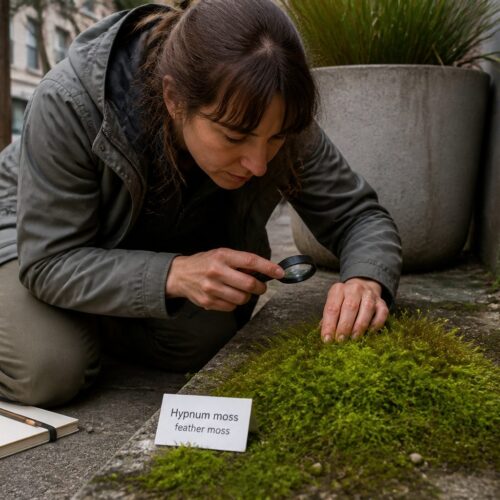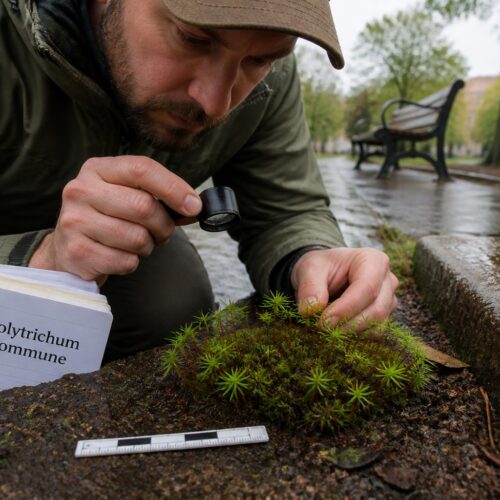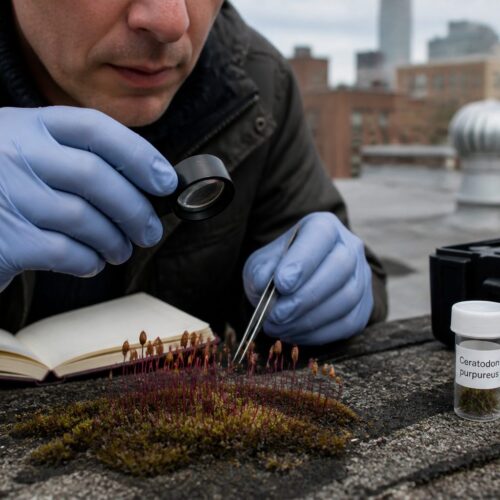


City moss is a constant trickster, and moss look alike identification is where most beginners get humbled fast. I have watched people confidently label a sidewalk patch as “that common moss” and then get surprised when a closer look shows two different plants tangled together.
Urban bryophytes grow in tiny, stressful spots, so they often shrink, bleach, or flatten into forms that erase the traits you see in field guides. That is why moss misidentification happens even to careful observers who are used to identifying wildflower petals and tree bark.
You can separate many similar moss species without a microscope if you stop chasing the perfect name and start collecting repeatable field marks moss. The goal is a short list of candidates you can defend with observations, not a guess that collapses the moment someone asks, “What did you see?”
This article sticks to checks you can do on a curb, brick wall, or planter edge with your eyes and a cheap hand lens. When I say “field marks,” I mean features you can point to in the patch, not vague impressions like “it looks fuzzy.”
Why moss look-alikes are so common in cities
Cities compress habitats into a checkerboard of concrete, mortar, bark, and compacted soil, and mosses respond by growing wherever water lingers. That pushes unrelated species into the same few micro-sites, which makes similar moss species seem identical at a glance.
Urban stress also edits a moss’s appearance in ways that mimic other species. A plant that normally forms neat shoots in the woods can turn into a scruffy, stunted mat on a hot roof tile.
Pollution and dust coat leaf surfaces and mute color cues, especially near roads. If you rely on “bright green” versus “yellow green,” you are asking for moss misidentification.
Maintenance cycles create constant disturbance that favors opportunists, and opportunists often share the same basic growth form. You see the same silhouettes repeated, so your brain starts labeling by habit instead of by evidence.
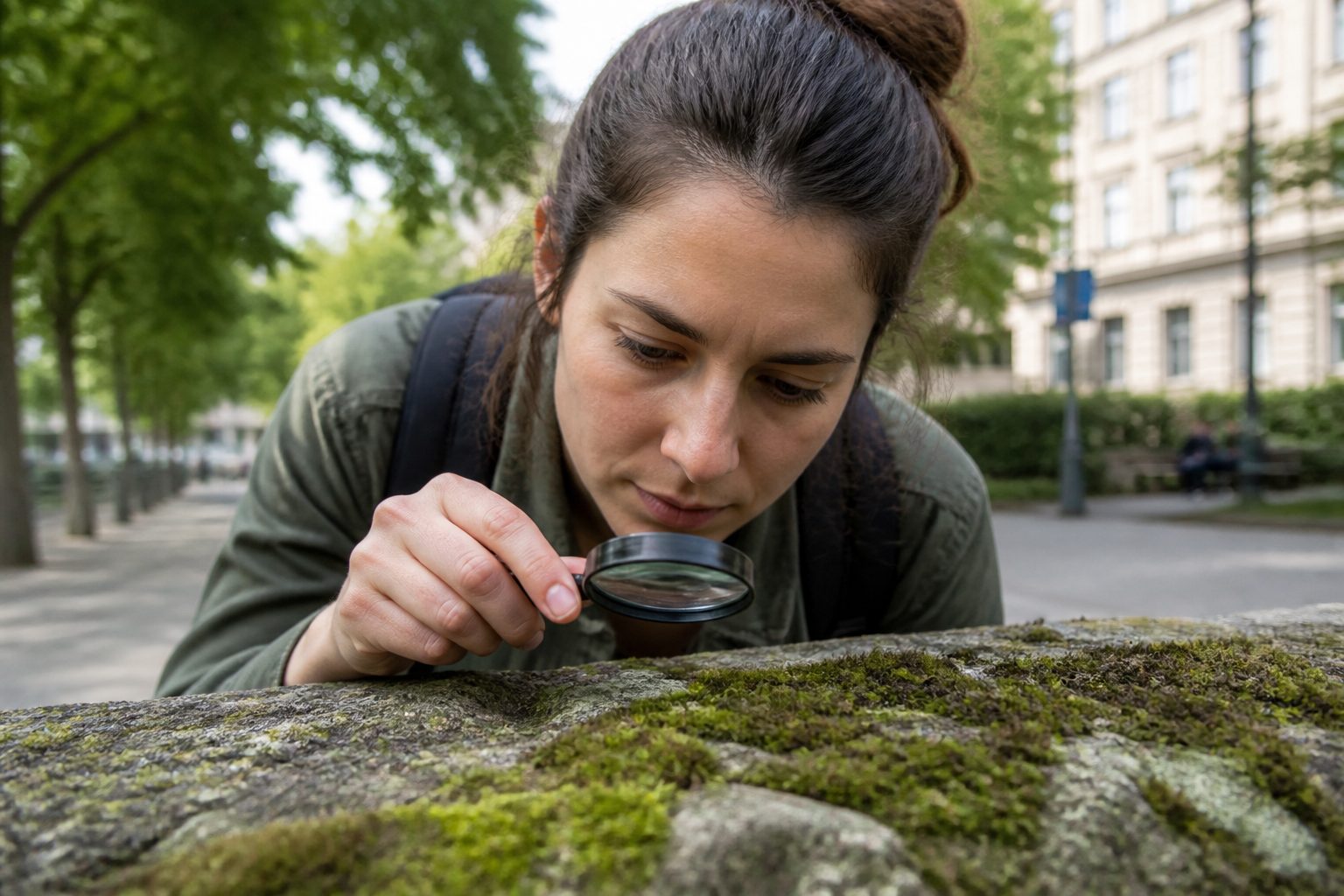
Another problem is scale, because most city patches are small and mixed, so you rarely see a full, mature colony. A thumbnail sized sample can hide the very characters that separate similar moss species, like sporophytes or consistent leaf posture.
Start with substrate: when the surface rules out options
Substrate is the fastest filter you have, and it beats wishful thinking every time. If the moss is glued to mortar seams, you can push acid loving woodland species off your list right away.
Concrete, brick, and mortar often favor calcicolous groups like Tortula, Syntrichia, and Bryum, though you still need field marks moss to go further. Tree bark in cities often favors Orthotrichum and Ulota, and those can look like tiny green buttons until you learn their texture.
Soil and compacted grit at curb edges bring in weedy colonists that tolerate salt and dog urine, and those patches often contain more than one species. If you find moss on pure asphalt, check whether it is actually rooted in trapped dust in cracks, because the “substrate” may be a thin soil film.
Water flow matters as much as the material, because a brick wall under a leaky gutter behaves like a different habitat than the same wall under an overhang. When you log your moss look alike identification notes, write down whether the spot gets splash, drip, or only dew.
Do not ignore human made substrates like old roofing felt, planter fabric, or foam insulation, because they select for a narrow set of tough species. If you keep seeing the same “mystery mat” on these materials, you are probably seeing one of a few repeat offenders rather than a new species each time.
Compare growth form honestly (not just “it’s a mat”)
Growth form is useful only if you describe it with some honesty and a few concrete terms. “Mat” covers everything from a tight, felted carpet to a loose weave of creeping stems that you can pull apart with a fingernail.
Train yourself to name the structure you see, like cushion, tuft, carpet, weft, or dendroid mini shrub, and then add what the stems do at the edges. Those are field marks moss that stay visible even when leaves are too small for confident calls.
| Growth form cue | What it looks like on a sidewalk | Common urban groups it suggests |
|---|---|---|
| Tight cushion | Rounded dome, peels as a unit | Grimmia, some Orthotrichum |
| Flat felted carpet | Velvety sheet, hard to separate stems | Brachythecium, Hypnum |
| Loose creeping weft | Stringy, stems run in one direction | Amblystegium, Calliergonella |
| Tuft with upright shoots | Little spikes, often in cracks | Bryum, Ceratodon |
| Rosettes on soil crust | Starry heads, opens when wet | Syntrichia, Tortula |
Leaf tip and margin: small differences that matter
Leaf tips are where many urban look alikes finally separate, even without a microscope. You can often see whether the tip is blunt, acute, hair tipped, or broken into a tiny point with a 10x lens.
Hair points are a classic trap because dust and lime can make a leaf tip look pale and “hairy” when it is not. Check multiple leaves on multiple shoots, because a single abraded tip is not a trait.
Margins give you another set of field marks moss, especially if they roll under or lie flat. Many Tortula and Syntrichia species have strongly recurved margins that make the leaf look thicker and more rigid than it really is.
If you can see teeth on the margin with a hand lens, write that down, because it narrows the list fast in common urban genera. If the margin looks perfectly smooth, confirm it by looking near the tip where teeth, if present, often show up first.
Leaf shape matters too, but only when you compare leaves from the same position on the stem. A stem leaf and a branch leaf can look different enough to cause moss misidentification if you do not notice which you picked.
Costa and leaf arrangement: quick checks with a hand lens
The costa is the midrib, and it is one of the best microscope free characters if you learn what to look for. With a hand lens you can often tell whether the costa is strong and reaches the tip, fades out halfway, or ends before the apex.
Many sidewalk rosette mosses have a costa that ends in or just below the tip, and that can separate them from softer carpet mosses where the costa is weak. When you do moss look alike identification, sketch the costa length as a fraction of the leaf, like half, two thirds, or to the tip.
Leaf arrangement on the stem is another quick check, and you do not need perfect terminology to use it. Ask whether leaves spiral evenly around the stem, press into two ranks, or cluster into a starry head near the tip.
Some similar moss species differ mainly in how the leaves sit when dry, like appressed and tidy versus twisted and messy. That “messy” look is not a moral failing, it is a field mark moss you can trust when it repeats across the patch.
When you pull a tiny shoot, look at it from the side and from above, because the top view can hide leaf overlap. If you only ever look straight down, you will miss whether the plant builds a little tower of leaves or a flat fan.
Wet/dry behavior: using rehydration response as a clue
Rehydration is a free experiment you can run in a bottle cap, and it exposes differences that dry patches conceal. Some mosses uncurl in seconds and turn glossy, while others stay rigid and only soften slowly.
This is where many moss misidentification stories begin, because people judge a species by its dry posture and never check what it does when wet. If you mist a patch and the leaves spread into clear star heads, you are probably in the rosette forming groups rather than the feathery carpets.
- Mist one corner of the patch, leave the other dry
- Time the uncurling, fast or slow
- Watch for star heads forming at shoot tips
- Check if leaves twist into spirals when drying
- Note color change, dull to glossy or barely changing
- See if the patch swells thicker or stays flat
Sporophytes as tie-breakers: capsule shape and position
Sporophytes are the easiest “microscope replacement” you will ever get, and city mosses often fruit more than woodland species. If you see capsules, stop and take photos, because you just found a shortcut through a lot of similar moss species.
Start with position, because capsules can sit upright, tilt, or hang, and that alone can split a group. Then look at the seta length, because some urban Bryum have long stalks that lift capsules above the leaves, while others keep them tucked in.
Capsule shape is another solid field mark moss, even with a hand lens, and you can describe it in plain language like pear shaped, cylindrical, or squat. If the capsule has a distinct neck, write that down, because it often points you toward a smaller set of candidates.
Operculum shape can help too, since some species have a long beak and others have a low lid. If the lid is gone, check whether the mouth looks wide and clean or ragged, because peristome teeth can sometimes be visible as a pale fringe.
Do not trust a single sporophyte if the patch is mixed, because the capsule might belong to a minority species hiding under the dominant mat. When you collect a sample for closer viewing, keep the sporophyte attached to its shoot so you can match it to the right plant.
Mixed patches: how to tell if you’re seeing two species
Urban moss often grows in mosaics, and mixed patches are the main reason moss look alike identification goes sideways. A green carpet can hide a second species that is browner, smaller, or only visible when wet.
Look for texture shifts, because two species rarely build the same surface. One part may look velvety and uniform, while another looks wiry with tiny upright shoots poking through.
Color boundaries matter, but do not treat them as species boundaries without checking structure. A sun baked edge can bleach and mimic a different taxon, so confirm by pulling a few shoots from both zones and comparing leaf posture.
Sporophytes can betray a hidden species, since one moss fruits and the other does not, and the capsules stand out like little matchsticks. If you see sporophytes clustered only in one corner, sample there and compare it to the capsule free area.
I also watch how the patch peels, because some mosses lift as a sheet while others crumble into threads, and mixed patches do both. If your sample falls apart into two textures in your fingers, treat that as evidence of two species until proven otherwise.
A side-by-side comparison template you can copy into notes
Good notes beat good memory, especially when you are sorting similar moss species in the same neighborhood week after week. I keep a simple side by side template so I can compare Patch A and Patch B without rewriting the same questions every time.
This format also protects you from moss misidentification, because it forces you to write what you saw instead of what you wanted to see. If you cannot fill a line, that blank tells you what to check next time.
Start with location and substrate, then add exposure, like full sun on a south wall or shade under a parked car. Add a quick moisture note, like “stays damp from sprinkler” or “only wet after rain.”
Then record growth form with a real description, like tight cushion that peels in one piece or loose weft that pulls into strings. Add a line for wet behavior, because rehydration response is one of the most consistent field marks moss you can test.
Finish with leaf traits you can see, like hair point present, margin rolled, costa to tip, and any sporophyte details. If you take photos, label them with the same Patch A and Patch B tags so you can match images to notes later.
When to stop and call it “uncertain” (and still learn something)
Calling a moss “uncertain” is not failure, it is good practice, and it keeps your records usable. Some groups truly need microscope characters, and pretending otherwise is how moss misidentification spreads through community science apps.
Stop when the remaining options differ by cell papillae, lamellae height, or peristome details you cannot see with a hand lens. You can still log the genus, the growth form, and the key field marks moss that got you that far.
Uncertain IDs are still valuable if you attach clear photos and note the substrate, moisture, and neighborhood context. A later visit during fruiting season can turn an uncertain patch into an easy call when capsules appear.
If you cultivate urban moss at home, “uncertain” also protects your growing trials from bad assumptions. Two similar moss species can want different light and water, so your care notes make more sense if you admit you might be growing a mix.
I also like uncertainty because it pushes you to build a personal key for your city, not a fantasy key for the whole continent. Over time you learn which look alikes actually occur on your blocks, and moss look alike identification gets easier because your candidate list shrinks.
Conclusion
You do not need a microscope to get better at moss look alike identification, but you do need a habit of checking the same traits every time. Substrate, growth form, leaf tip and margin, costa, wet behavior, and sporophytes can take you surprisingly far with similar moss species.
The main enemy is speed, because quick labeling invites moss misidentification in the exact places where mosses grow weird and mixed. Slow down, write down field marks moss, and you will end up with IDs you can defend and revisit.
When you hit a wall, keep the patch in your notes as “uncertain” and treat it like a long term project. City moss rewards repeat visits, and the same curb crack can teach you more than a one time hike if you pay attention.