
Moss on a bonsai pot can look perfect for about two days, then it turns into a bumpy sponge that slides around when you water. If you want that calm, thin green skin that stays put, you have to grow it for the job, not grab whatever is closest to the sidewalk.
This article focuses on moss propagation for bonsai topdressing, with the goal of making thin moss mats that hug the soil and read as “in scale” with the tree. The trick is to treat moss like sheet material you manufacture, then install, rather than a random clump you press down and hope for the best.
I like moss topdressing when it supports the tree instead of stealing the show, and that means even texture, clean edges, and predictable thickness. You can get there with patient propagation, careful surface prep, and a watering style that respects how easily moss floats and dries.
What makes bonsai moss different: thinness, texture, and stability
Bonsai moss has to stay thin, because a thick pad looks like a bath mat and hides the nebari. Thin moss mats also let you read surface roots, soil contours, and the pot’s rim without a green blob taking over.
Texture matters more than people admit, because coarse stems can make a refined tree look sloppy fast. I aim for a tight, low carpet that looks like it belongs next to small leaves and fine branching.
Stability is the hard part, since topdressing sits on loose particles and gets blasted by watering cans. If the mat lifts at the corners, water gets underneath and the whole sheet starts skating.
Bonsai pot humidity swings quickly, especially in shallow containers in summer heat. A thin mat buffers those swings without turning the surface into a constantly wet sponge that encourages algae and fungus gnats.
Good topdressing moss also has to accept grooming, because you will trim it. If a species turns brown when you clip it or forms tall tufts after every flush, you will fight it forever.
Selecting moss types that form tight, low mats
Look for pleurocarpous mosses that creep and knit, rather than upright acrocarps that build little towers. Creeping types tend to form thin moss mats that behave like fabric when you transplant them.
In many cities, you can find usable sheet forming moss on shaded brick, old concrete, and compacted soil in parks. I avoid anything that grows in greasy runoff channels or right next to roads with heavy salt use.
For bonsai, I prefer moss that naturally grows in low light but still keeps decent color with morning sun. If it only looks good in deep shade, it often fades on a bench unless you manage light carefully.
Test your candidates in a tray before committing, because “good in the wild” can mean “weird in a pot.” Some mosses stay flat outdoors but puff up indoors or under frequent fertilizing.
When you collect, take thin slices with as little substrate as you can, and keep different types separated. Mixed species can look charming on rocks, but on bonsai they usually grow at different speeds and create lumpy patches.
Growing moss in flats for harvesting thin sheets
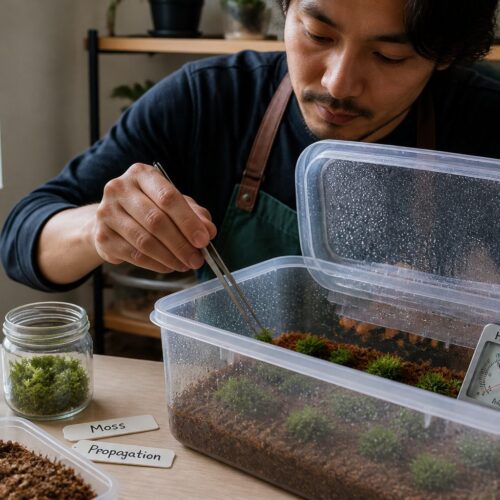
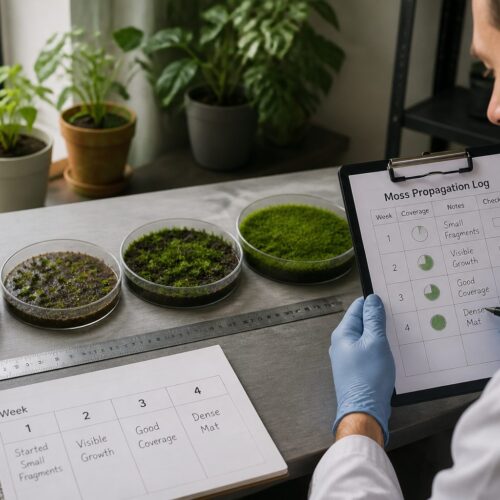
Growing in flats is where moss propagation for bonsai topdressing becomes reliable, because you control thickness and you can harvest sheets like sod. I use shallow nursery trays or cafeteria style bus tubs so I can move them for rain, shade, or cold snaps.
Start with a firm, fine base, then press fragments in hard so they contact the surface everywhere. If you leave air gaps, the moss bridges them and you end up with a thicker, springy mat that tears when you lift it.
| Flat setup choice | Why it helps thin sheet growth | What to watch for |
|---|---|---|
| 2 to 3 cm layer of sifted akadama fines or pumice fines | Firm, gritty surface encourages tight attachment | Too dry turns into crust and stalls growth |
| Misted start, then gentle bottom watering | Reduces float off while moss knits | Standing water invites algae films |
| Plastic dome for 7 to 14 days with daily venting | Holds humidity while fragments recover | Stale air can trigger mold on debris |
| Very thin top dusting of chopped sphagnum or coco coir | Helps fragments grab without adding bulk | Too much makes a fluffy layer and uneven thickness |
| Harvest with a thin spatula after full knit | Lets you lift sheets without tearing | Harvesting early causes ragged seams |
Preparing bonsai soil surfaces for moss attachment
Most moss failures start with the soil surface, not with the moss. If the top layer is loose, chunky, or dusty, your patch has nothing consistent to grip.
I begin by removing old moss, algae skin, and loose organic bits, because they rot under a new mat. A chopstick and a small brush do better work than blasting the surface with water.
Next I level the top layer with a thin dressing of fines that match the bonsai mix, usually akadama fines or sifted pumice. The goal is a flat, firm plane so the moss can sit flush without rocking on particles.
Pay attention to drainage slopes and watering channels, because moss will expose every low spot by growing thicker there. If you want an even look, you have to build an even base.
Right before application, I moisten the surface so it is damp but not muddy. If water puddles, you will trap a slick layer under the sheet and it will lift within a week.
Applying moss: patch placement and seam blending
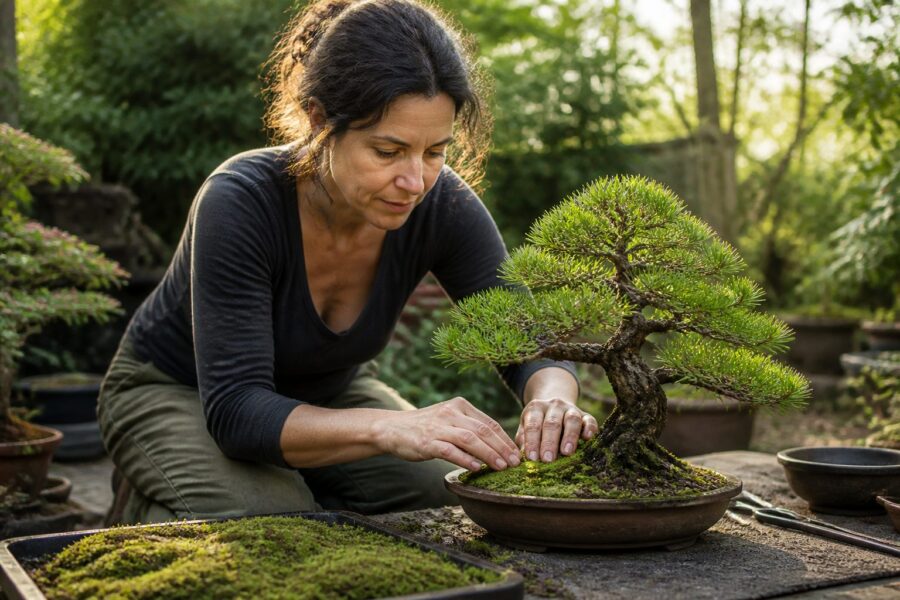
Use multiple small patches instead of one giant sheet, because a single piece telegraphs every wrinkle. Smaller pieces let you follow roots, trunk flare, and the pot’s curve without buckling.
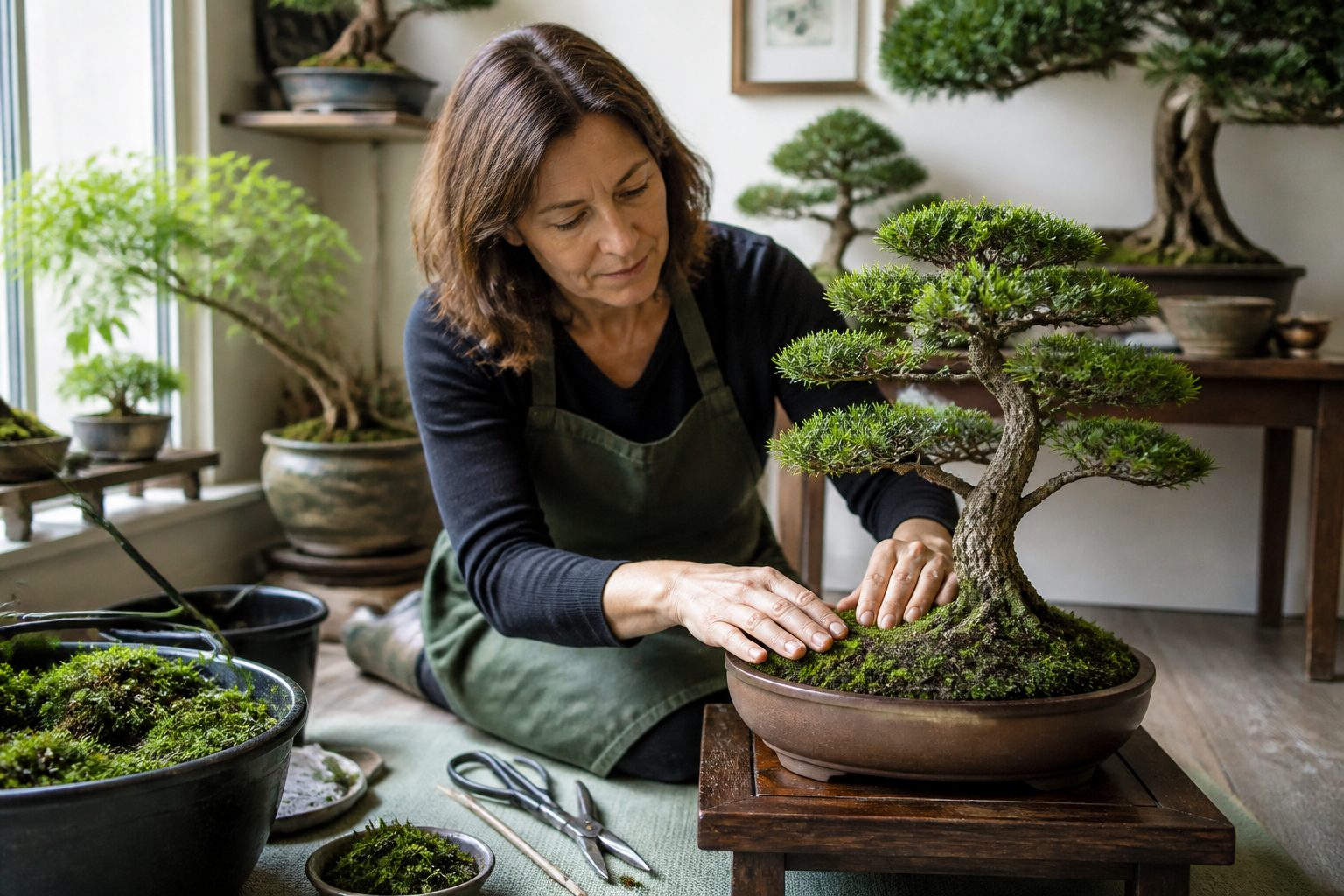
I place the first patches where they will anchor, usually near the trunk and along stable edges that do not get disturbed by watering. Then I fill outward, keeping the grain direction consistent so texture does not look patched together.
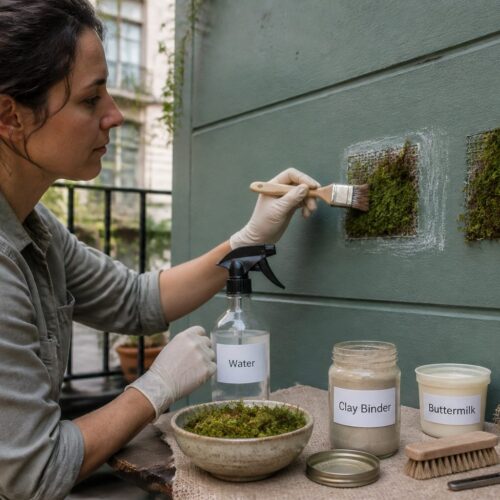
Seams disappear when the edges overlap slightly, then get pressed down with a flat tool like a plastic plant label. If you butt edges hard together, they dry apart and you get a visible crack that catches fertilizer salts.
Keep moss away from the trunk itself, because constant moisture at the bark line can cause rot on some species and invite pests. I leave a narrow bare ring and let it green in naturally over time.
After placement, I press the whole surface gently but firmly, like setting tile. If you skip this, the mat looks fine until the first real watering, then the corners start to curl.
Watering approach: avoiding float-off and dry crusts
Watering is where most topdressing moss gets ruined, because a hard stream gets under the sheet and lifts it like a raft. I use a fine rose on a watering can, or a pump sprayer for the first week.
At the same time, you cannot baby it with mist forever, because the soil below still needs real saturation. The balance is to wet the moss first, then water the pot slowly so the surface never becomes a slick, floating layer.
- Pre-wet moss with a fine mist before full watering
- Water from the side of the pot, not straight down
- Use a fine rose or shower wand on lowest pressure
- Pause between passes to let water soak, then repeat
- Skip foliar fertilizer sprays until the mat knits
- Top water early in the day so the surface dries slightly by evening
Light management: keeping color without scorching
Moss that looks great in shade can bleach fast in direct afternoon sun on a bonsai bench. I aim for bright shade or morning sun, then protection when the heat ramps up.
The biggest mistake is moving a freshly installed mat straight into high light, because it has not attached yet and it dries from the edges inward. Give it a week of gentler light so it can knit to the soil surface.
Color is a useful signal, because pale green often means too much light or too little water, while dark slimy green points to constant wetness. I would rather see slightly lighter moss than a glossy algae sheet that smothers it.
Indoor growing under LEDs can work, but the airflow has to be strong enough to prevent surface slime. If you grow indoors, keep the light moderate and run a small fan so the mat dries between waterings.
Seasonal shifts matter, because winter sun angles can hit benches differently and roast what was safe in summer. I reposition pots a few inches at a time, since sudden changes show up as crispy edges within days.
Trimming and grooming: maintaining scale and preventing lumps
Moss trimming techniques are where a clean topdressing turns into a bonsai detail instead of a fuzzy afterthought. I trim for thickness first, then I refine the surface texture like I am leveling a lawn.
Use sharp scissors and take off tiny amounts, because moss bruises and browns if you hack it. I keep a small pair of bonsai scissors just for moss so I do not crush stems with dull blades.
Lumps usually form where water and fines collect, which is often near the trunk or in low spots. When I see a hump starting, I lift that small patch, scrape the base level, then reinstall the same piece thinner.
After trimming, I remove clippings right away, because they rot and create dark spots. A soft paintbrush works better than fingers, since fingers pull up attached edges.
I also groom edges along the pot lip, because moss loves to climb and make a thick rim. A crisp edge makes the whole planting look intentional, and it keeps the mat from drying into a curled collar.
Repairing bare spots and edges over time
Even well grown thin moss mats develop bare spots, usually after repotting, heavy rain, or a missed watering in heat. Repair goes faster when you treat it like patching drywall, small pieces and clean edges.
I keep a propagation flat running all season so I always have matching material. Trying to match a pot with random moss from a different microclimate often looks like a bad dye job.
For small holes, I use tiny plugs pressed into damp fines, then I mist lightly for a few days. If you flood a plug repair, it floats and you lose it in the first watering.
Edges fail when they dry first, so I take extra care to press them down and keep them evenly moist during hot spells. If an edge keeps lifting, I trim it back to firmly attached moss and rebuild with a new strip.
When a whole area refuses to hold moss, I look at what changed, usually fertilizer strength, shade pattern, or soil particle size. Fixing the cause beats reapplying the same patch every two weeks.
Common problems: lifting corners, uneven thickness, and algae
Lifting corners almost always come from poor contact, a loose top layer, or a watering stream that hits one spot hard. I fix it by lifting the corner, adding a pinch of damp fines, then pressing it flat and changing how I water.
Uneven thickness is usually self inflicted, because we press thick clumps into place and expect them to flatten later. The better method is to harvest thin sheets from a flat, then use trimming to keep the whole surface at the same height.
Algae shows up when the surface stays wet and nutrient rich, especially if you fertilize heavily for the tree. If you see slick green film, reduce surface wetness, increase airflow, and back off sprays until the moss regains control.
Hard water leaves crusty deposits that make moss look dirty and can slow growth at the seams. If your tap water is mineral heavy, occasional watering with collected rainwater helps keep the surface cleaner.
Sometimes the real issue is bonsai pot humidity that stays too high at night, especially on crowded benches with little air movement. Spacing pots, watering earlier, and keeping mats thin usually solves more problems than any product does.
Conclusion
Good moss propagation for bonsai topdressing is mostly about control, control of species, thickness, and how the sheet attaches to the soil. When you grow moss in flats and harvest thin moss mats on purpose, installation stops being a gamble.
Prep the surface, press patches firmly, and water like you are trying to avoid lifting paint with a hose. Then use moss trimming techniques to keep the mat in scale, because a little grooming does more than endless reapplication.
If you keep a tray of backup moss and patch small failures quickly, the topdressing starts to look steady month after month. The end result is simple, a clean green surface that supports the tree and stays put when you water.