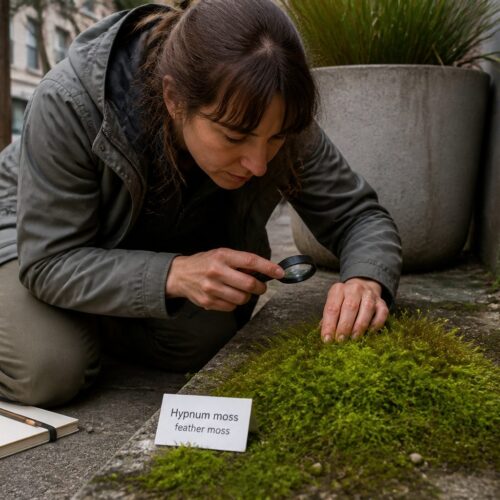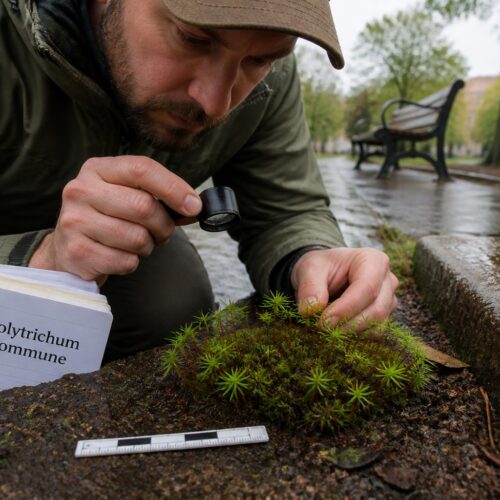


If you garden in a city, you have probably found a green patch in a pot, between pavers, or on a damp wall and called it moss. Half the time it is a liverwort, and the other half it is a moss that looks nothing like the moss in your imagination.
I like both groups, but I do not like guessing because the care and the cleanup are different. This guide is for anyone who wants to identify moss vs liverwort in urban gardens using traits you can actually see with a phone camera and a cheap hand lens.
The trick is to stop relying on color and start looking at growth pattern, leaf arrangement, and how the plant attaches to the surface. Once you learn a few cues, liverwort vs moss becomes a quick call even on a shady balcony.
Why moss and liverwort get confused in city plantings
Urban garden conditions push both mosses and liverworts into the same places, damp, compacted, and low light. When they are young or stressed, they can both look like a thin green film that spreads fast.
Most people learn “moss” as a fuzzy carpet, but many common city mosses are not fuzzy at all. Some are glossy and flat, and some grow as tiny upright tufts that you only notice after a rain.
Liverworts add to the confusion because they come in two main body plans, leafy and thalloid. A leafy liverwort can mimic a small moss shoot, while a thalloid liverwort can mimic algae or a flattened moss mat.
Container mixes and nursery flats make the problem worse because they stay evenly moist near the surface. That steady moisture favors fast colonizers like Marchantia and small weedy mosses such as Bryum and Funaria.
If you want to identify moss vs liverwort in urban gardens, ignore the word “weed” and treat it like a mini field ID. City populations are often mixed, so you may have both growing in the same pot, and that is normal.
Growth pattern differences you can see at a glance
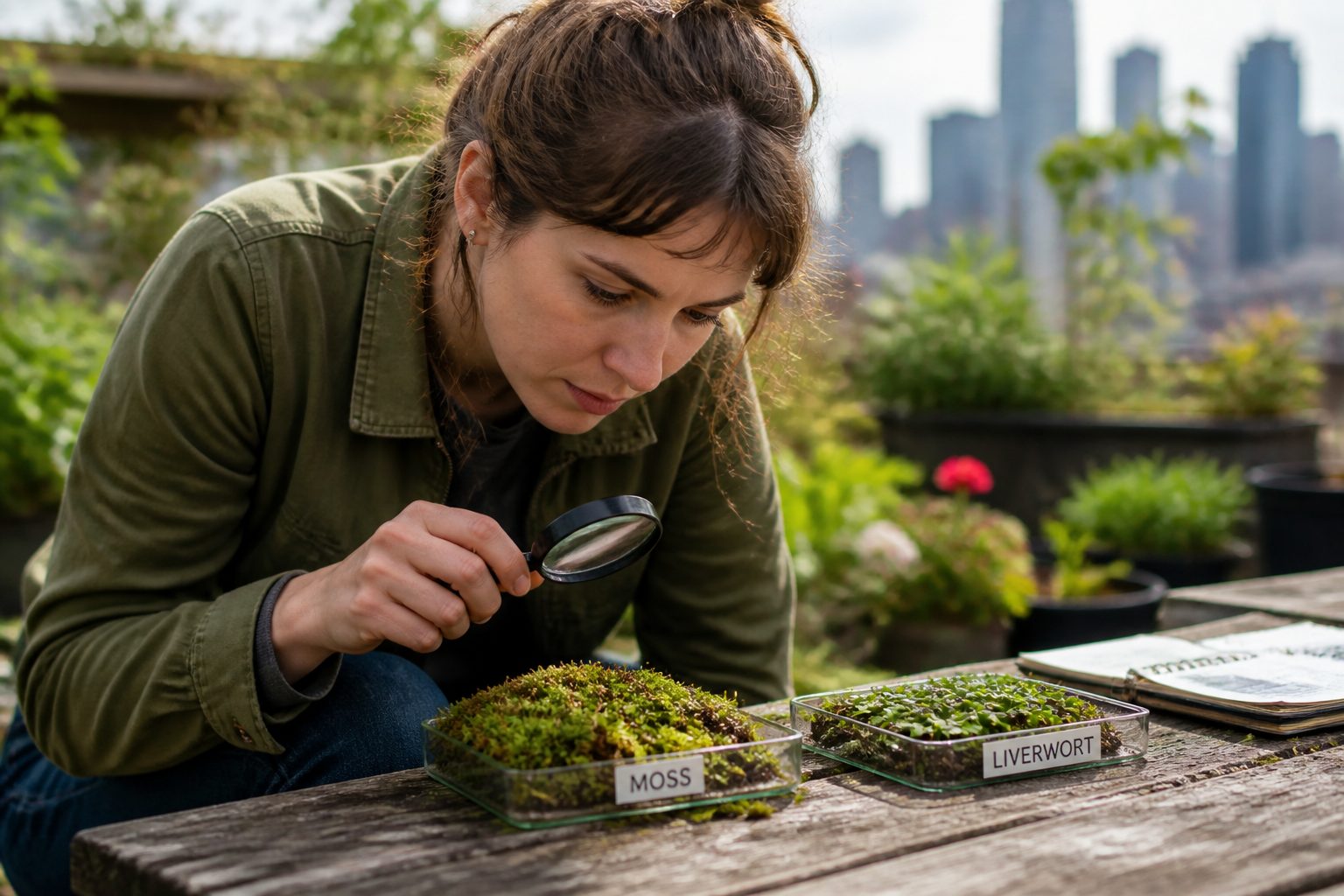
Mosses usually organize themselves into shoots, even when they form a mat. You can often see tiny stems with little leaves radiating around them, or at least a clear “upright” direction to the growth.
Many liverworts spread as a sheet that creeps outward, especially thalloid types. The edge of the patch looks like it is advancing as a smooth front rather than sending up lots of separate shoots.
Look for the way the patch handles obstacles like bark cracks or grit on a paver. Moss tends to grow over and around as a pile of shoots, while thalloid liverwort tends to flow around obstacles like a green pancake.
When moss dries, it often shrinks and becomes wiry or crisp, then rehydrates quickly after watering. Thalloid liverwort often stays flatter when dry, and it can look dull or slightly leathery until it gets fully wet again.
In pots, moss often starts as scattered points that later knit together, like little islands merging. Liverwort often starts as a small flat rosette or a lobed patch that expands outward in a more continuous way.
Leafy liverwort vs. moss: leaf arrangement and “two-rows” clue
Leafy liverwort traits are easiest to see when you stop looking at the patch and start looking at one shoot. Moss leaves usually spiral around the stem, while leafy liverwort leaves often sit in two obvious ranks along the stem.
That “two-rows” look is not subtle once you notice it, and it is the fastest leafy liverwort ID trick I know. Many leafy liverworts also have an extra row of tiny underleaves on the underside, which mosses do not have.
| Feature to check | Typical moss | Typical leafy liverwort |
|---|---|---|
| Leaf arrangement on stem | Spiral or radial around the stem | Two main rows along the stem |
| Leaf shape under a hand lens | Often narrow, with a midrib in many species | Often rounder, no midrib, may look folded |
| Underleaves on underside | Absent | Often present as tiny extra leaves |
| Overall shoot look | More bristly or tufted, shoots stand up | More flattened, shoots hug the surface |
| Common urban example | Bryum on pot rims and brick | Frullania on bark and shaded masonry |
Thalloid liverwort: what a flat thallus looks like up close
Thalloid liverwort ID starts with one word, thallus, which means a flat plant body without obvious stems and leaves. In urban gardens, the classic is Marchantia, the one that forms flat lobes with a faintly patterned surface.
Up close, many thalloid liverworts show a network of tiny air pores that look like pinpricks or a dotted texture. Moss does not have that same pore pattern on a flat sheet because most moss tissue is organized into leaves.
Marchantia often grows in broad, forked ribbons with a midline, and the tips can look like they are splitting. If you see little cup-like structures holding green discs, you are looking at a thalloid liverwort, not moss.
Thalloid liverwort patches often have a slightly translucent edge where new growth is thin. That edge can lift a bit from the substrate, especially on potting soil that crusts after watering.
Do not confuse a flat thallus with algae or cyanobacteria slime, which wipes away easily and lacks clear lobes. A real thalloid liverwort has a firm body, a defined outline, and it tears rather than smears when you disturb it.
Rhizoids and attachment: subtle but useful hints
Both mosses and liverworts use rhizoids, but they behave differently when you try to lift a small piece. Moss mats often peel up as a felted sheet, with many fine rhizoids anchoring along the stems.
Thalloid liverwort can attach strongly in spots and weakly in others, so it may come up in rubbery flakes. You may also see a faint purplish tint on the underside in some thalloid liverworts, especially when stressed.
If you have a hand lens, look for rhizoids that appear in bundles versus a more even fuzz. Many liverwort rhizoids are single celled and can look like smooth threads, while moss rhizoids often look more branched or matted.
On vertical surfaces like brick, moss usually anchors at many points and forms small cushions or streaks that resist sliding. Thalloid liverwort on masonry often forms flat patches that can shear off after a freeze or a hard dry spell.
Attachment also connects to management in pots, because moss can protect soil from splash and crusting. Thalloid liverwort can seal the soil surface and slow water penetration, which is why growers complain about it in seed trays.
Reproductive structures you might actually spot
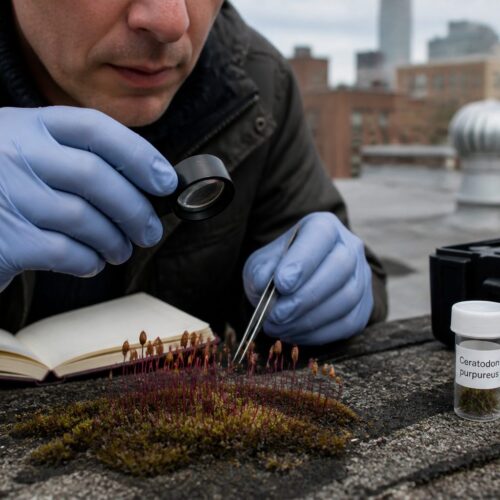
You do not need capsules and stalks to identify moss vs liverwort in urban gardens, but they can make the call instant. Moss often produces sporophytes that look like thin stalks with a capsule on top, like tiny matchsticks.
Thalloid liverwort often produces gemma cups, which are shallow cups filled with little green pellets. Those pellets splash out with rain or watering, so a pot under a drip line can turn into a Marchantia factory fast.
- Moss sporophyte stalks with capsules
- Marchantia gemma cups on flat lobes
- Umbrella-like reproductive heads on Marchantia
- Starry rosettes on some small thalloid liverworts
- Clusters of tiny perianths on leafy liverwort tips
- Spore dust on nearby pot rims after drying
Typical urban habitats: pots, pavers, mulch, and green roofs
In pots and nursery trays, thalloid liverwort loves constant moisture, high light, and bare soil surfaces. You will see it first on the north side of the pot or in the flat where irrigation hits every day.
Moss in containers often shows up on the pot rim, on compacted soil, or in the drip zone under a dense canopy. If you top dress with fine compost, expect moss to colonize the crust where water beads and evaporates.
Between pavers, moss usually wins when the joint stays damp but drains, like sand set pavers in partial shade. Thalloid liverwort shows up more in muddy joints that stay wet and get nutrient input from runoff.
Mulch beds can host both, but the pattern differs, moss often grows on the mulch itself and on exposed soil patches. Liverwort often forms flat patches on the soil surface under the mulch edge where water drips and light still reaches.
On green roofs, you can find a mix of small mosses and liverworts in thin substrate, especially near drains and shaded parapets. If you are cultivating moss intentionally, you should learn liverwort vs moss early so you do not accidentally propagate the wrong one.
Texture and shine: when surface finish helps
Texture is a better clue than color, because both groups swing from bright green to brown depending on water and sun. Many thalloid liverworts have a smooth, slightly glossy surface that looks like it was pressed with a fingertip.
Moss often looks more fibrous, even when it is short, because you are seeing many tiny leaves and stems. When wet, moss can sparkle with droplets caught among the leaves, while a thallus tends to sheet water and shine evenly.
Run your eyes along the edge of the patch, because edges show structure. Moss edges look like frayed fabric or tiny bristles, and thalloid liverwort edges look like a clean outline with lobes.
Some leafy liverworts are glossy too, so do not stop at shine alone. Use shine as a nudge, then confirm with the two-row leaf arrangement or the presence of underleaves.
If you mist a patch and watch it for one minute, the differences pop. Moss leaves often uncurl and change posture fast, while thalloid liverwort mostly just darkens and swells a bit.
Photo and note checklist for confident separation
Your phone can do most of the work if you take the right shots, and you do not need a macro lens. Take one overhead photo for growth pattern, then one low angle photo to show whether the patch has upright shoots.
Next, take a close photo of a single “branch” or lobe, with a coin or fingernail for scale. If you can capture leaf rows, pores, or gemma cups, you will be able to identify moss vs liverwort in urban gardens later even if the patch dries up.
Write down where it is growing, because habitat narrows the options quickly. A flat patch on bare potting mix under daily irrigation screams thalloid liverwort, while a tuft on brick in a windy spot screams moss.
Note the watering pattern and the season, since some mosses fruit in spring and some liverworts explode in fall when nights cool. I also jot down whether the surface is acidic, like pine bark mulch, or alkaline, like concrete splash zones.
If you are cultivating moss, record how it responds to drying, because that is a practical ID tool. Moss that rebounds after a dry weekend often belongs in your moss tray, while thalloid liverwort that turns mushy after heat is better removed.
Common mistakes and how to correct them
The biggest mistake is calling every flat green patch “algae” and treating it with harsh measures. If the patch has lobes, a defined edge, and a firm body, you are likely dealing with thalloid liverwort, not slime.
Another common mistake is assuming that “fuzzy” equals moss and “smooth” equals liverwort. Many mosses are smooth when short, and many leafy liverworts look textured once you see the leaf edges.
People also miss mixed colonies, where moss shoots poke through a thalloid liverwort sheet. When that happens, pull back and ID each growth form separately, because management depends on which one is dominating the soil surface.
Do not rely on one trait like shine or color, because both groups change fast with moisture and light. Use a stack of clues, growth pattern, leaf rows, thallus pores, and any reproductive structures you can spot.
If you keep getting stuck, focus on the third H2 test, leafy liverwort vs moss, because leaf arrangement is a clean divider. Once you can recognize leafy liverwort traits, the remaining “flat sheets” are usually thalloid liverworts by elimination.
Conclusion
City gardens create perfect conditions for both groups, so confusion is normal and it does not mean you are missing something obvious. The good news is that you can identify moss vs liverwort in urban gardens with a few repeatable checks that work on pots, pavers, and roofs.
Start with growth pattern, then confirm with leaf arrangement for leafy forms and thallus texture for flat forms. After you do it a few times, liverwort vs moss stops being a debate and becomes a quick habit.
If you want one takeaway, train your eye on structure, not greenness. A two-row shoot points to leafy liverwort, a flat lobed sheet points to thalloid liverwort, and a field of tiny shoots points to moss.