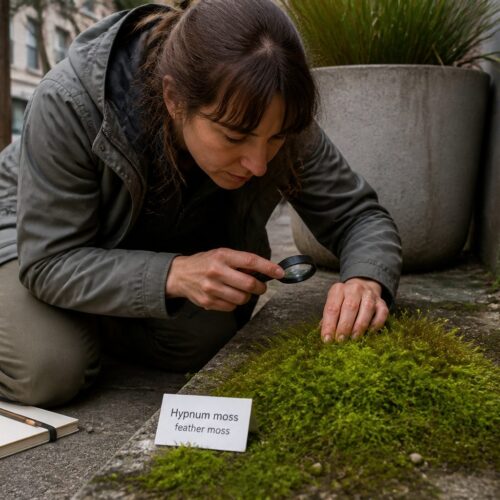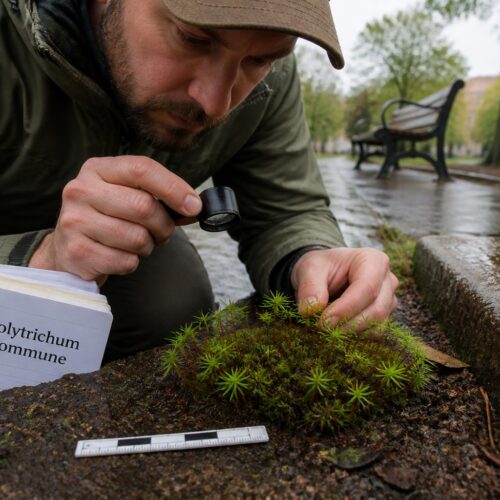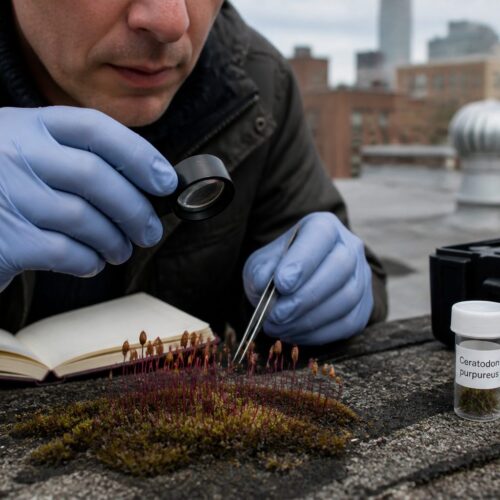

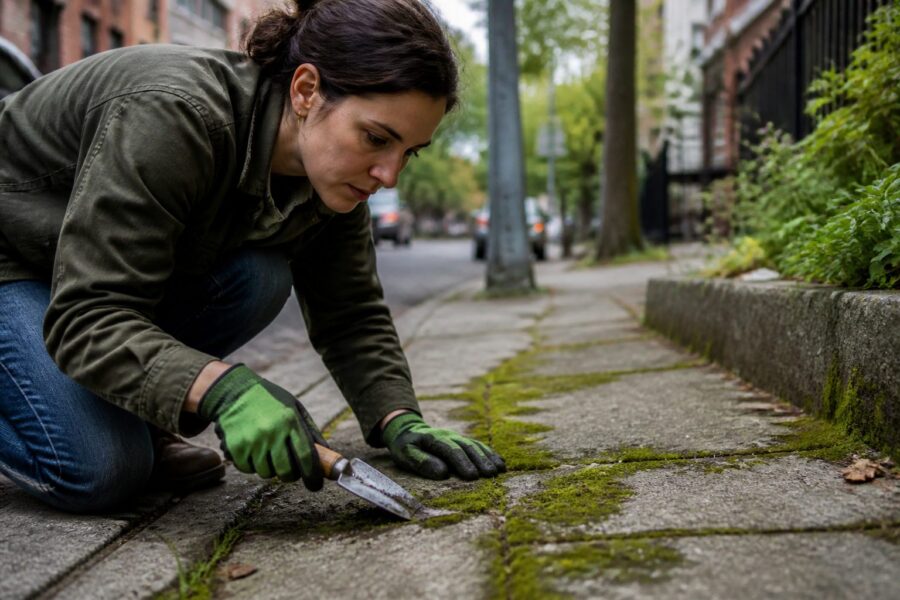
Concrete and sidewalks look dead until you get down at eye level and notice the green haze clinging to pores and cracks. If you want how to identify moss on concrete, you need a few reliable visual habits, not a long species list.
I like concrete moss because it is honest about what it can tolerate, heat, salt splash, foot traffic, and long dry spells. The downside is that those same stresses make colonies small and scruffy, which can confuse sidewalk moss identification.
This guide focuses on field marks you can see with a phone camera and a cheap hand lens. You will learn how to sort common concrete moss types, spot alkaline substrate moss traits, and avoid mistaking algae for moss.
Why concrete selects for certain moss species
Fresh concrete and many mortars are alkaline, and that chemistry filters out lots of woodland mosses fast. If you keep seeing the same few little tufts on sidewalks, it is because only certain species handle that pH and the ions that come with it.
Concrete also dries unevenly, with tiny wet pockets around pits, seams, and the shaded side of a curb. Moss that can restart photosynthesis quickly after a soak wins, while slower species lose their chance between rain events.
Urban concrete gets dusted with soil, tire grit, and organic crumbs that collect in micro cracks. Many concrete moss types start on bare mineral, then thicken as trapped particles make a thin soil skin.
Heat is another filter, since sunlit pavement can run far hotter than the air for hours. Look for moss that stays low, hugs the surface, and avoids tall shoots that would desiccate like a wet paintbrush left in the sun.
Road salt and deicers add a nasty seasonal pulse of stress, especially near sidewalks by parking lots. When you find moss thriving there, you are looking at a tough subset that often overlaps with alkaline substrate moss specialists.
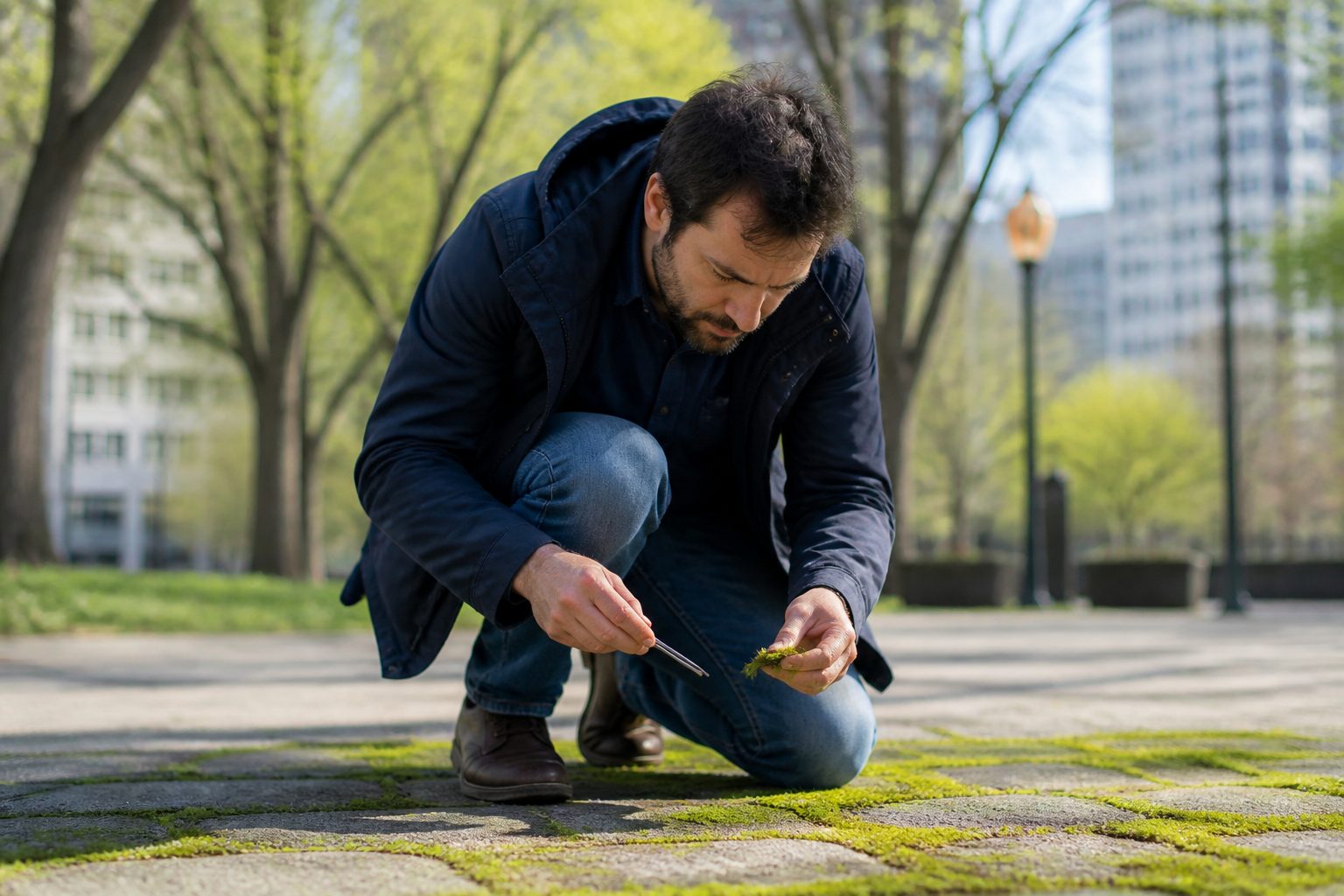
Safety and ethics: observing without damaging colonies
Moss on concrete can look abundant from standing height, but up close many colonies are only a few centimeters wide. Step around them and keep your shoes off the patch, because one scuff can shear the whole mat off the surface.
If you want to handle a sample, take it only where it is legal and where the patch is clearly extensive, like a long retaining wall. For sidewalk moss identification, photos and a hand lens usually beat collecting anyway.
Use water sparingly if you mist a patch to see leaf shape, since runoff can wash away the fragile soil film that helps it persist. A couple drops from a bottle cap is enough to wake up texture without turning the colony into a mud smear.
Watch for hazards that have nothing to do with plants, like traffic, broken glass, and treated surfaces. Some sidewalks have herbicide residues or pressure washing chemicals, so wash your hands after you kneel and shoot close ups.
When you post photos online, avoid naming exact locations for rare finds on niche walls or historic masonry. Moss collectors are usually respectful, but a single enthusiastic person can strip a small colony in minutes.
First sort: thin films vs. cushions vs. patchy mats
The fastest way to start how to identify moss on concrete is to sort growth form before you worry about species. On sidewalks, most things fall into thin films, small cushions, or patchy mats that creep along cracks.
Thin films often look like green paint when wet, then nearly vanish when dry, and they can be true moss or something else. Cushions are obvious little pillows, while patchy mats spread in low sheets with ragged edges and mixed densities.
| Growth form | What it looks like on concrete | Where it usually sits |
|---|---|---|
| Thin film | Green sheen when wet, dull and hard to see when dry | Flat slabs, lightly pitted concrete, mortar faces |
| Small cushion | Tight tuft or dome, often 0.5 to 3 cm across | Expansion joints, bolt holes, rough aggregate |
| Patchy mat | Low sheet with irregular edges, sometimes mixed with grit | Cracks, curb seams, shaded side of steps |
| Crack line runners | Stringy or feathery strips following a fissure | Long sidewalk cracks, masonry joints, edges near soil |
Color and texture clues after rain vs. during dry spells
Rain changes everything, which is why I always check the same patch both wet and dry. Many concrete moss types go from gray brown to bright green within minutes, and that shift is a real identification clue.
After rain, look for whether shoots stand up or stay plastered down. Upright shoots often belong to cushion forming species, while mats tend to look slick and flattened like a tiny green rug.
During dry spells, some sidewalk colonies look dead but feel springy if you touch the edge gently. Others turn brittle and crumble, which can mean you are seeing algae crusts or dried cyanobacteria instead of moss.
Pay attention to gloss, because some moss has a satin shine when wet while other species stay matte. That shine often comes from leaf cell structure and how the leaves overlap, not from slime.
Color can tip you toward alkaline substrate moss, since several concrete dwellers show yellow green or olive tones on high pH surfaces. Deep emerald can happen too, but I treat bright neon green on perfectly flat concrete as a warning sign for algae.
Leaf and costa features common in concrete-dwelling mosses
Once you have the growth form, the next step in sidewalk moss identification is leaf shape under a hand lens. You do not need a microscope to notice whether leaves are narrow and spear like or broader and spoon shaped.
The costa is the midrib, and on many concrete moss types it is thick and easy to see as a pale line. A strong costa often pairs with a tough, upright habit that handles drying and rewetting on exposed slabs.
Check whether leaf tips end in a clear hairpoint, since that feature shows up in some sidewalk species and can trap dew. Hairpoints can also make a colony look slightly frosted when dry, especially in angled morning light.
Look at how the leaves sit on the stem when dry, because some twist, some press flat, and some curl inward like tiny claws. Those dry posture differences are more stable than color, which can change with shade and pollution dust.
If you can see leaf margins, note whether they look smooth or slightly toothed. A few minutes of careful phone macro shots can capture these traits well enough to compare against local keys for alkaline substrate moss.
Capsule and peristome hints when sporophytes are present
Sporophytes are the stalks and capsules, and they can turn a frustrating patch into an easy call. When you find them on a sidewalk, photograph them first, because they snap off fast from foot traffic and wind.
Start with capsule position, since some sit upright while others droop or angle out. On concrete, you often see short stalks that keep capsules close to the cushion, which makes sense in windy, exposed spots.
Capsule shape matters too, with common sidewalk moss types showing oval, pear shaped, or more cylindrical forms. A hand lens can also reveal whether the capsule has a beak, a clear neck, or a smooth rounded lid.
If the lid has popped, look for peristome teeth at the mouth of the capsule. You might not count teeth accurately in the field, but you can often see whether there is a neat ring of teeth or a ragged opening.
Time of year helps, since many urban mosses fruit in cool, wet seasons and go sterile in summer heat. If your patch never shows sporophytes, you can still do solid sidewalk moss identification with leaves and growth form.
Distinguishing moss from algae and cyanobacterial crusts
A lot of what people call moss on concrete is algae, especially in splash zones and shaded north sides of walls. If you want how to identify moss on concrete correctly, you need a quick test for structure.
Moss has stems and leaves, even when tiny, and you can usually see a leafy texture with a hand lens. Algae films look smooth, gelatinous when wet, and they do not resolve into little leaf shapes no matter how close you get.
Cyanobacterial crusts can form dark, almost black patches that swell when wet and shrink when dry. They often smell earthy or pond like when you rewet them, while true moss smells mostly like damp stone.
Try the edge test, where you look at the boundary between the green patch and bare concrete. Moss edges often show individual shoots or tiny tufts, while algae edges fade gradually like watercolor.
Be skeptical of bright green slime in constantly wet spots under leaky sprinklers. That stuff can be beautiful, but it is not one of the concrete moss types you can key with leaf and costa traits.
Concrete look-alikes: small liverworts and lichens
Some tiny liverworts show up in protected crevices and can fool you at first glance. They often form flat, ribbon like thalli or very small leafy shoots that look different once you notice the branching pattern.
Lichens are the other big impostors on sidewalks, especially the crusty gray, orange, or yellow ones on old concrete. Lichens do not have true leaves, and they sit like a paint layer that is glued to the surface.
A simple clue is how the patch reacts to a drop of water. Many lichens darken and saturate in color but still keep a hard, crusty outline, while moss plumps up and shows obvious shoot texture.
Another clue is where the patch grows, since lichens often dominate the driest, most sun baked faces where moss struggles to persist. Moss usually prefers at least occasional wetting, even if it survives long dry spells.
If you are doing sidewalk moss identification for cultivation, treat lichens as off limits. Lichens grow slowly, and they do not transplant or propagate like moss does in urban moss projects.
Photo checklist: angles and close-ups that actually help ID
Most failed IDs happen because the photos are too far away or too glossy from flash. A useful set shows context, scale, and leaf detail, and you can do that with a phone if you shoot patiently.
Start with a habitat shot that shows the slab, crack, curb edge, and nearby soil or mulch. Concrete chemistry and moisture sources matter, so that context helps narrow concrete moss types later.
Then take a straight down shot that fills the frame with the colony, since growth form is the first big sorting step. Include a coin, key, or fingernail edge for scale, because tiny cushions and broad mats can look the same without it.
After that, shoot from the side at a low angle to show whether shoots stand upright or lie flat. This angle also reveals whether the patch is on a raised grit mound or directly on bare concrete.
Finish with close ups of leaf tips and any sporophytes, and take several because wind and hand shake ruin macro shots. If you can capture the costa line and a hairpoint clearly, your sidewalk moss identification success rate jumps.
Troubleshooting: when your concrete moss won’t key out
Sometimes you do everything right and the patch still refuses to match your guidebook photos. Concrete pushes moss into weird, stunted forms, so you may be looking at a stressed version of a familiar species.
Start by checking whether you mixed multiple species in one photo, which is common in cracks. Patchy mats often hide tiny cushions inside them, and that mashup can scramble how to identify moss on concrete using a key.
Next, revisit the same colony after a good rain and again after two dry days. Some traits only show when hydrated, while others, like twisting leaves, are easiest to see when the plant is dry and contracted.
If your moss sits on mortar, stucco, or old concrete with exposed aggregate, treat those as different substrates. Alkalinity and texture vary a lot, and an alkaline substrate moss on mortar can differ from what grows on a smoother sidewalk slab.
When you get stuck, use a genus level goal instead of forcing a species name. A clean genus ID plus good photos is more honest, and it still helps you learn the recurring concrete moss types in your neighborhood.
Conclusion
Sidewalk moss identification gets easier once you stop chasing names and start sorting by growth form, wet versus dry behavior, and leaf structure. Concrete is harsh, so the winners repeat, and you will start recognizing them like familiar street trees.
If you remember one rule for how to identify moss on concrete, it is to confirm you are seeing leaves and stems rather than a smooth film. After that, small details like costa strength, hairpoints, and capsules can narrow down alkaline substrate moss candidates fast.
Take careful photos, avoid damaging colonies, and accept that some patches will stay unnamed until you catch them fruiting. Over time you will build a personal catalog of concrete moss types that fits your city better than any generic chart.