
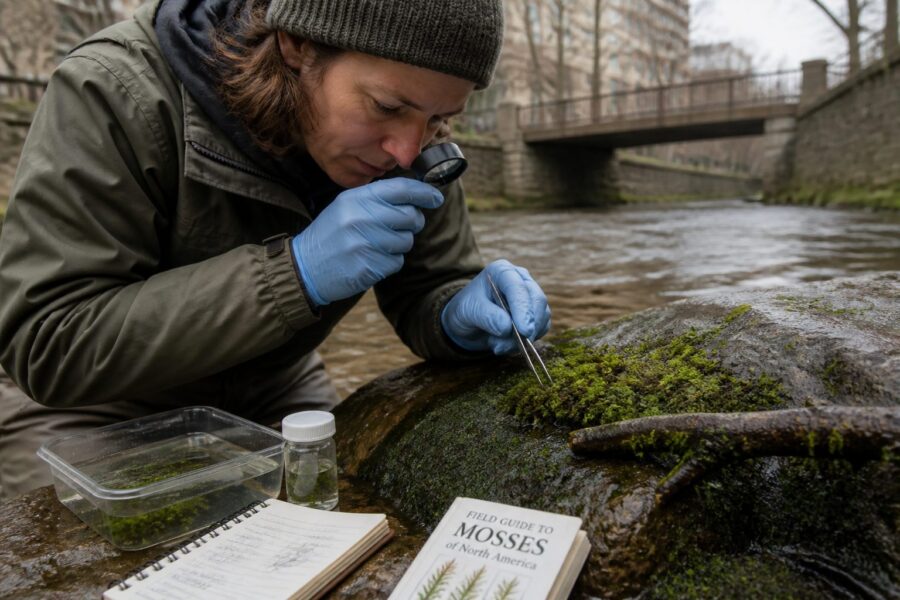
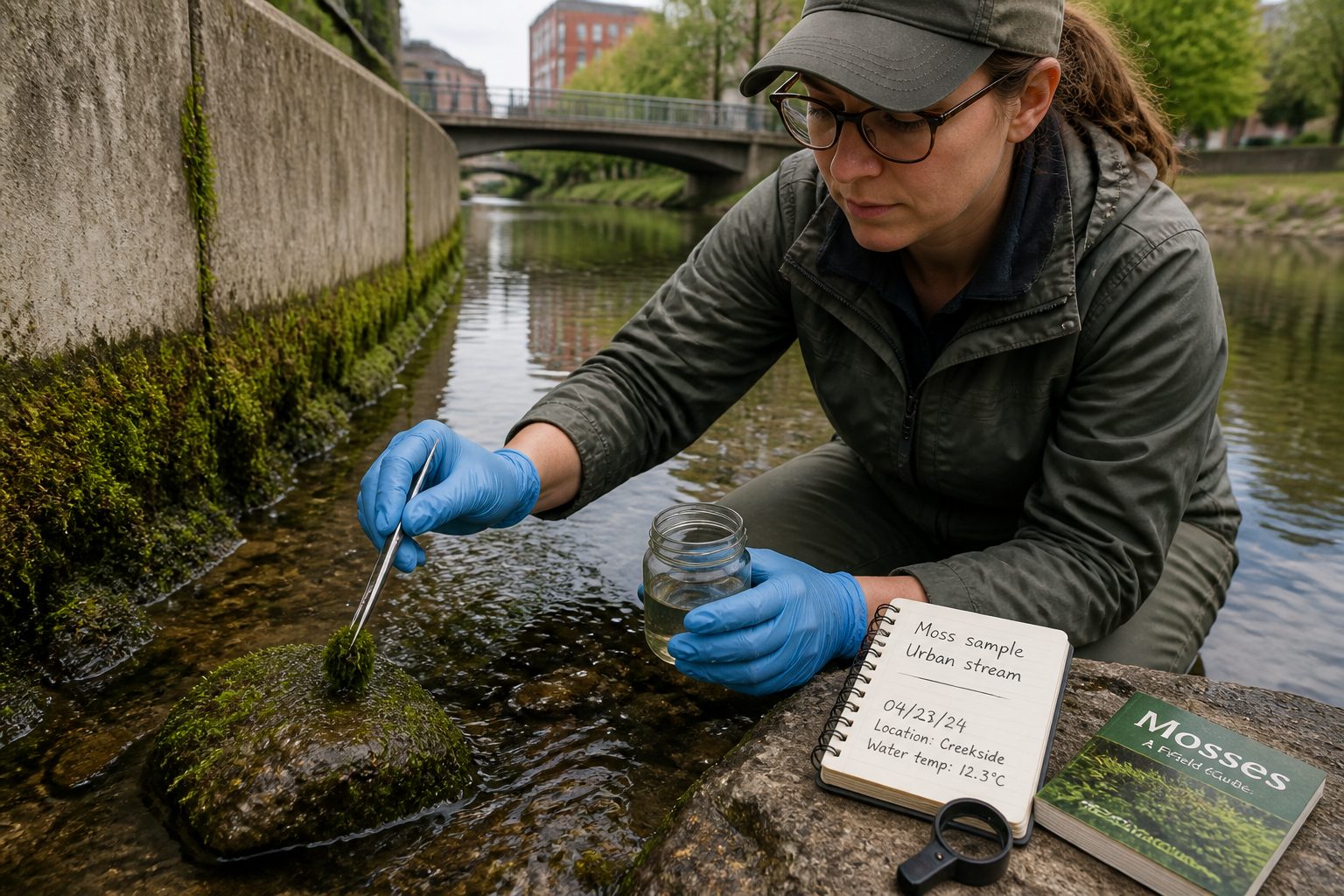
Urban waterways often host a hidden world of green: aquatic and semi-aquatic mosses. These unassuming plants cling to rocks, concrete, and submerged debris, quietly filtering water and providing microhabitats. Adapting to fluctuating water levels and varying water quality, these bryophytes showcase remarkable resilience, adding a fascinating layer to urban nature observation and opening up a new appreciation for the biodiversity thriving right under our noses.
This article will guide you through the distinctive features of water moss identification, focusing on common species found in urban aquatic environments. We will explore their unique adaptations, preferred habitats, and practical tips for identifying them with confidence. Get ready to see your local streams and ponds in a completely new light.
How Aquatic Mosses Differ From Terrestrial Species Structurally
Aquatic mosses possess distinct structural adaptations for thriving underwater or in saturated conditions. Unlike terrestrial cousins with delicate rhizoids, aquatic species have robust attachment mechanisms to resist strong currents. Their leaves are often thinner and more delicate, maximizing surface area for nutrient absorption directly from the water column, contrasting with terrestrial mosses’ thicker cuticles for desiccation prevention.
Aquatic bryophytes frequently exhibit a streamlined growth form, especially in fast-flowing water, with stems and leaves lying flat or trailing to minimize drag. This morphology helps them withstand constant water force. A key adaptation is the absence of a thick, waxy cuticle, which would impede direct uptake of water and dissolved gases; their entire permeable surface functions as an absorptive organ.
Gas exchange is challenging underwater due to lower oxygen and carbon dioxide concentrations. Aquatic mosses efficiently capture these dissolved gases through permeable leaf surfaces; some even produce air bubbles during photosynthesis. Their cellular structure features larger, thinner-walled cells for efficient diffusion, and flexible stems allow them to bend with currents rather than breaking.
While terrestrial mosses adapt to periods of drying, aquatic mosses are built for constant hydration, often unable to survive prolonged dry air exposure. Their dependency on water shapes every aspect of their physical form, driving their unique structural features.
Observing these structural differences provides valuable clues for water moss identification. Fine, flowing strands and translucent leaves, for instance, indicate a preference for fully submerged or frequently inundated habitats, clearly signaling a specialized aquatic lifestyle.
Key Species to Know: Fontinalis, Fissidens, and Cinclidotus
For aquatic bryophyte urban environments, three genera stand out: Fontinalis, Fissidens, and Cinclidotus. These are among the most common and recognizable water mosses in urban streams and ponds. Knowing their distinct characteristics and basic identification features will significantly improve your aquatic semi-aquatic mosses urban streams identification efforts, serving as excellent starting points for any amateur bryologist.
| Genus | Key Identification Feature | Typical Urban Habitat |
|---|---|---|
| Fontinalis | Triangular, keeled leaves arranged in three ranks on trailing stems | Fast-flowing streams, attached to rocks, submerged wood |
| Fissidens | Leaves arranged in two flattened ranks, creating a distinctive fan-like appearance | Shaded, damp banks, submerged rocks in slow currents, often emergent |
| Cinclidotus | Robust, often dark green to blackish cushions or mats with stiff, pointed leaves | Concrete banks, stone walls, submerged rocks in moderate to fast flow |
| Amblystegium | Small, irregularly branched stems, often forming loose mats; short, ovate leaves | Edges of ponds, muddy banks, slow-moving water, often emergent |
Fontinalis, or “willow moss,” is common in Fontinalis moss streams and rivers, forming feathery plumes. Its distinctly triangular, often keeled leaves arrange neatly along the stem, efficiently capturing nutrients from flowing water.
Fissidens species are known for their unique flattened, fern-like appearance. Their leaves, arranged in two rows along the stem, create a distinctive profile, making water moss identification straightforward. They are found both submerged and emergent along stream banks.
Cinclidotus mosses, or “water fringe moss,” typically form dense, dark cushions or mats on hard surfaces. Their sturdier, pointed leaves cling well to concrete or rocks in strong currents, making them excellent colonizers of artificial urban waterway substrates.
Amblystegium is another common genus in urban aquatic settings, often found in disturbed or nutrient-rich waters. It forms loose, sprawling mats, and its adaptability makes it prevalent in various pond and stream margins.
While distinguishing individual species often requires a microscope, recognizing the genus is a significant step in aquatic semi-aquatic mosses urban streams identification. Focus on the overall growth habit and leaf arrangement for initial classification.
Reading the Habitat: Flow Speed, Substrate, and Light
Environmental conditions in urban waterways provide invaluable clues for aquatic semi-aquatic mosses urban streams identification. Mosses are sensitive to their surroundings; their presence, absence, and growth form reveal much about the habitat. Factors like water flow, substrate, and light exposure are critical, with flow speed being particularly significant. Some species, like Fontinalis moss streams varieties, prefer fast, oxygen-rich water, developing trailing forms to reduce drag, while others favor slower currents or stagnant water, forming compact mats.
Observing water movement helps narrow down water moss identification. A moss tightly appressed to a rock in a swift current indicates adaptation to high-energy environments, contrasting with loose, feathery mosses in calm pools. The physical stress of the current profoundly shapes the plant’s architecture.
Substrate type also plays a major role. Many aquatic mosses are epilithic, growing on rocks or concrete with specialized holdfasts. Others prefer submerged wood, decaying leaves, or fine sediment. Urban environments offer diverse substrates, from natural stones to concrete culverts. A moss on a smooth, vertical concrete wall indicates tolerance for artificial surfaces and fluctuating water levels, helping anticipate findings.
Light availability is another crucial factor, especially in urban settings with buildings or tree cover. Some aquatic bryophyte urban species need ample sunlight, while others adapt to low-light conditions under bridges or in shaded ravines; water depth also dictates penetration. Mosses in brightly lit, shallow sections differ from those in shaded, deeper channels. Color can indicate light exposure (lighter greens) or shade/mineral content (darker hues). Always assess the light environment.
Water quality, though harder to assess visually, also influences moss distribution. Some species are pollution-sensitive, while others tolerate nutrient-rich or slightly contaminated urban runoff. Certain mosses can even act as bio-indicators, offering insights into a stream’s health.
Small changes in these habitat parameters can lead to different moss communities within a single stream. Noting details like water flow speed or sunlight exposure makes identification more informed, helping build a mental profile of preferred conditions for various mosses.
Identification Challenges: Submerged vs. Emergent Growth Forms
A significant hurdle in aquatic semi-aquatic mosses urban streams identification is phenotypic plasticity: a single species can look dramatically different submerged versus emergent. This adaptability allows survival in fluctuating water levels but confuses observers. Submerged forms are typically more delicate, elongated, with thinner, translucent leaves and longer, less branched stems, optimized for nutrient absorption and minimizing drag.
When the same species grows emergently, exposed to air along water edges or on damp rocks, its appearance changes. Emergent forms are usually more compact, robust, and densely branched. Their leaves can be thicker, darker, and shaped differently to cope with desiccation and direct sunlight.
This difference means relying solely on characteristics observed in one state can lead to misidentification. For example, a Fontinalis moss streams species might have long, flowing strands submerged but form tight, bushy clumps along the bank, appearing very distinct despite being the same plant.
The challenge for water moss identification is recognizing these variations as part of the same species’ range. It requires looking beyond superficial appearance, focusing on stable features, or ideally, observing the moss in both submerged and emergent states. Transitional forms at the waterline can also be helpful.
Careful habitat observation provides clues; if a moss grows in a regularly flooding and drying zone, expect adaptations for both conditions. Mosses in an urban waterfall’s splash zone, for instance, often show this dual nature. Their flexibility testifies to their survival skills.
Color variation is another challenge. Submerged mosses might appear brighter green due to constant hydration, while emergent forms can be duller green, yellowish, or brownish. These color shifts respond to light intensity and hydration, not necessarily species differences.
To overcome these challenges, consult field guides illustrating both submerged and emergent forms. Collecting a small, ethical sample for observation under different conditions, like placing a submerged piece in shallow water, also helps. This hands-on approach builds familiarity with their adaptability.
Using Photography to Capture Useful Identification Details
Accurate aquatic semi-aquatic mosses urban streams identification relies on detailed visual information. Photography is an indispensable tool for documenting finds and sharing them with experts. Modern smartphone cameras, especially with macro lenses, are capable for water moss identification. The key is focusing on specific details botanists use to differentiate species; clear, well-lit images are essential.
- Capture overall growth habit
- Take close-up shots of individual leaves
- Show stem branching patterns clearly
- Photograph the moss in its habitat context
- Document color variations and textures
- Include a scale reference (e.g., a coin)
- Photograph both wet and dry forms if possible
When photographing individual leaves for aquatic bryophyte urban species, isolate a few and ensure sharp focus. Leaf shape, margin details (smooth or toothed), and midrib presence are critical features. These microscopic details often decide between similar-looking mosses.
Documenting the overall growth habit is also important. Does the moss form dense cushions, loose mats, or long, trailing strands, like many Fontinalis moss streams species? This indicates its adaptation to flow speed and substrate. A wider shot showing the moss in its environment helps.
Including a scale reference (e.g., a ruler or coin) in at least one photo is incredibly helpful for determining size. This allows others to gauge the true dimensions of the moss and its structures, which is difficult without a scale.
If the moss is semi-aquatic, capture both submerged and emergent forms if present. This illustrates phenotypic plasticity and provides a more complete picture of the plant. Such comparative photos are extremely valuable for thorough identification.
Where to Find Aquatic Mosses in Urban Environments
Despite concrete and human activity, urban environments are surprisingly rich in microhabitats for aquatic semi-aquatic mosses urban streams identification. You don’t need pristine wilderness; many common city features provide the consistent moisture and substrate these fascinating plants require.
Urban streams and rivers, even modified with concrete channels, are prime locations. Look for mosses clinging to rocks, submerged concrete slabs, and banks where water regularly splashes or flows. Even small trickles can host various aquatic bryophyte urban species.
Park ponds and artificial lakes also offer excellent opportunities. Check edges where water meets the bank, submerged logs, and rocky outcrops. Mosses often thrive in shallow zones with light penetration and plentiful attachment points, creating lush green carpets.
Stormwater drainage systems, culverts, and overflow channels are often overlooked but can bustle with aquatic moss life. These areas provide consistent moisture and steady flow, mimicking natural stream conditions. Though human-made, they offer suitable niches for water moss identification.
Leaky pipes, old fountains, and constantly dripping walls create micro-environments resembling miniature waterfalls or springs. These perpetually wet surfaces are ideal for certain aquatic moss species, even with artificial water sources, yielding interesting finds.
Look under bridges and in shaded ravines where streams flow. These areas often have cooler temperatures and consistent humidity, providing stable conditions for moss growth. Reduced light also favors species adapted to lower light levels, adding to the diversity.
Any area with a consistent water source and stable substrate can host aquatic mosses. This includes splash zones around dams, bases of old stone walls wetted by groundwater seepage, and even neglected gutters. Keep an eye out for any perpetually damp or wet surface.
The resilience of species like those in Fontinalis moss streams means they adapt to surprisingly harsh conditions. They might grow in places with fluctuating water levels or even some pollution, demonstrating tenacity. This makes urban moss exploration particularly rewarding.
Exploring these urban aquatic habitats encourages a different way of seeing your city, highlighting persistent pockets of nature. With practice, you’ll recognize prime locations for water moss identification effortlessly. The city becomes a living laboratory for bryology.
Can You Cultivate Aquatic Mosses in Garden Ponds or Containers?
Cultivating aquatic semi-aquatic mosses urban streams species in your garden pond or container is appealing and possible, but success depends on understanding their specific needs and replicating natural habitat conditions. Not all species are equally easy. The most critical factor is consistent access to clean, oxygenated water. Garden ponds with good filtration and aeration are suitable; for containers, regular water changes prevent stagnation and nutrient buildup.
Appropriate substrate is also important for many aquatic bryophyte urban species. Mosses often prefer attaching to hard, non-organic surfaces like rocks, ceramic, or submerged wood. Simply placing them in mud might not work, as they lack true roots for anchoring and nutrient uptake from soil.
Some species, particularly from Fontinalis moss streams, thrive in moving water. A gentle current from a small pump or bubbler in your pond or container can be beneficial, providing necessary water movement and oxygenation. Stagnant water quickly leads to algae growth, which outcompetes mosses.
Light levels need careful management. Too much direct sunlight encourages algae, while too little hinders moss growth. Partial shade or diffused light often works best. Observe mosses for stress signs like browning or excessive algae, and adjust light accordingly.
Source aquatic mosses ethically. Never remove large quantities from wild urban streams, as this harms local ecosystems. Look for reputable aquatic plant suppliers or nurseries. You might also propagate small fragments naturally dislodged from urban waterways.
When starting cultivation, begin with small amounts and observe adaptation. Patience is key, as mosses grow slowly. Providing the right conditions from the start improves chances of establishing a thriving aquatic moss colony in your garden.
Cultivating these mosses offers a unique opportunity to observe their growth habits and adaptations up close. It’s a rewarding experience that deepens your understanding of these resilient plants, allowing you to create a miniature aquatic ecosystem in your backyard.
Experiment with different species and conditions to find what works best. With care, you can enjoy the quiet beauty of water mosses in your urban oasis, bringing a touch of wild nature to any aquatic feature.
Conclusion
The world of aquatic semi-aquatic mosses in urban streams and ponds is surprisingly rich and accessible, offering unique nature observation opportunities. By paying attention to their structural adaptations, habitat preferences, and distinct growth forms, you can significantly improve your water moss identification skills. These tiny plants are vital components of urban aquatic ecosystems. Learning to identify common genera like Fontinalis, Fissidens, and Cinclidotus provides a solid foundation for exploring your city’s bryophyte diversity, making the identification process more informed.
Whether documenting them with photography or cultivating them responsibly, engaging with these aquatic bryophyte urban species enriches your appreciation for urban nature. They remind us that even in built environments, life thrives in unexpected and beautiful forms. So, next time you’re near an urban waterway, take a closer look; you might just discover a hidden world.