
Walk through any city, glance at the cracks in the pavement, and you’ll likely encounter a shimmering, silvery-green carpet. This common sight is often Bryum argenteum, affectionately known as the silver sidewalk moss, a resilient bryophyte that thrives in the most unexpected urban corners.
Its distinctive appearance makes Bryum argenteum identification relatively straightforward, even for the casual observer. Understanding this tiny plant offers a fascinating glimpse into bryophyte science and its surprising adaptability to human-altered environments.
This article aims to help you recognize this ubiquitous silver moss identification challenge and appreciate its unique place in our urban ecosystems. We will explore its characteristics, typical habitats, and even its potential for cultivation in your own miniature moss gardens.
The Silver Sheen: Why Bryum argenteum Looks Different From Other Mosses
The most striking feature of Bryum argenteum is its characteristic silvery-green color, which truly sets it apart from other moss species. This metallic sheen isn’t due to pigments but rather a clever adaptation to harsh, sunny environments.
Each tiny leaf has hyaline, or transparent, cells at its tip that lack chlorophyll, reflecting sunlight and giving the moss its signature appearance. This reflective quality helps prevent excessive water loss and protects the chlorophyll-containing cells lower down the leaf from intense UV radiation.
When dry, this effect becomes even more pronounced, making the patches almost white or highly reflective. Many other common pavement crack moss species retain a darker green or brownish hue whether wet or dry, offering a clear visual distinction.
The compact growth habit of Bryum argenteum also contributes to its unique look, forming dense, cushion-like mats or widespread, thin carpets. These tight formations help it conserve moisture and withstand physical disturbance from foot traffic or vehicle vibrations.
Observing a patch of what you suspect to be Bryum argenteum urban moss when it is both wet and dry can provide excellent clues for accurate identification. The change in its silvery luster is a telltale sign that you are likely looking at this particular species.
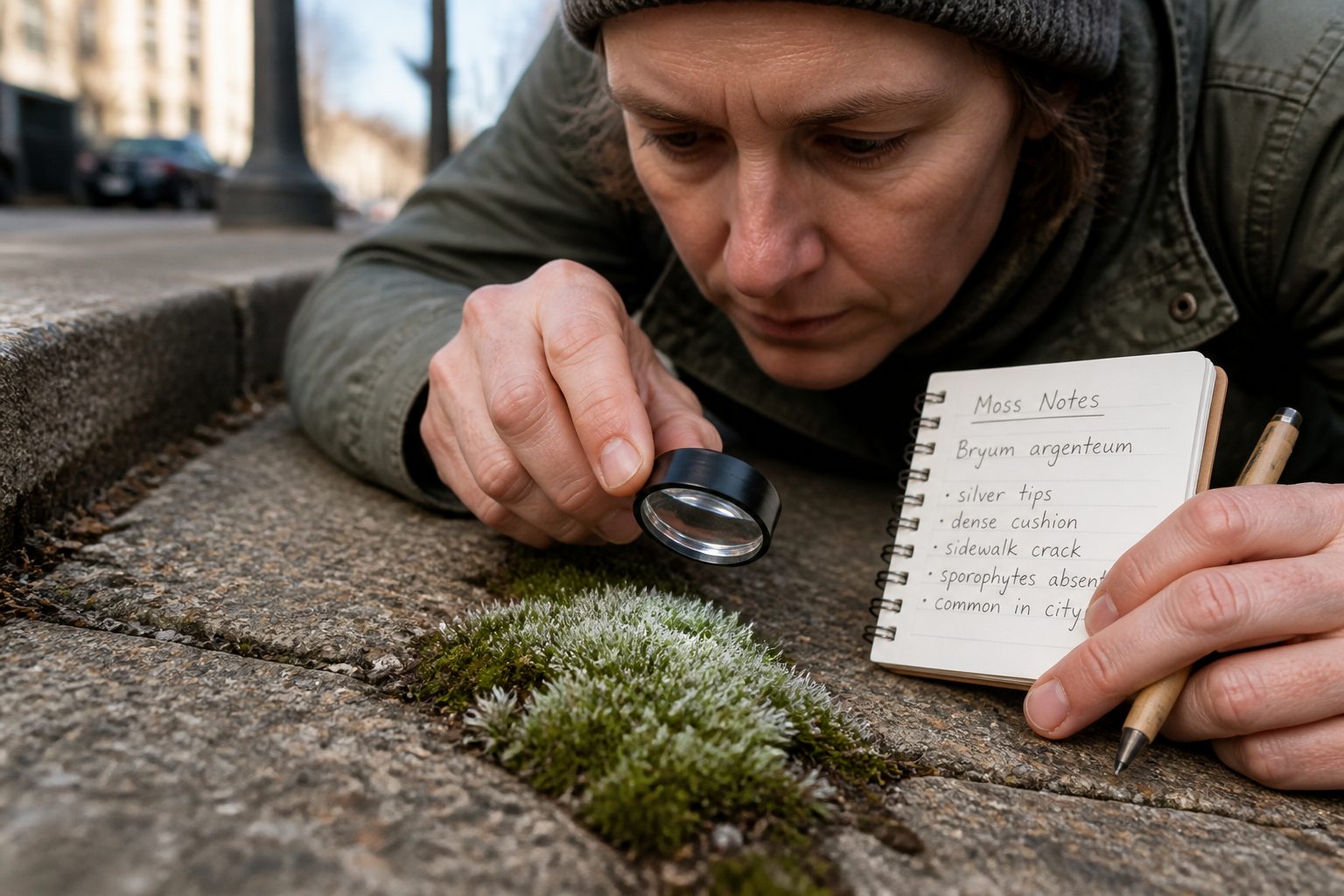
Its ability to quickly transition from a desiccated, silvery state to a vibrant green upon rehydration is a testament to its incredible resilience. This rapid recovery is essential for survival in the unpredictable moisture conditions of city environments.
No other moss in urban settings consistently displays such a bright, almost polished silver appearance. This visual cue is usually your first and best indicator for Bryum argenteum identification silver sidewalk moss in the field.
Leaf Shape and Stem Structure Under a Lens
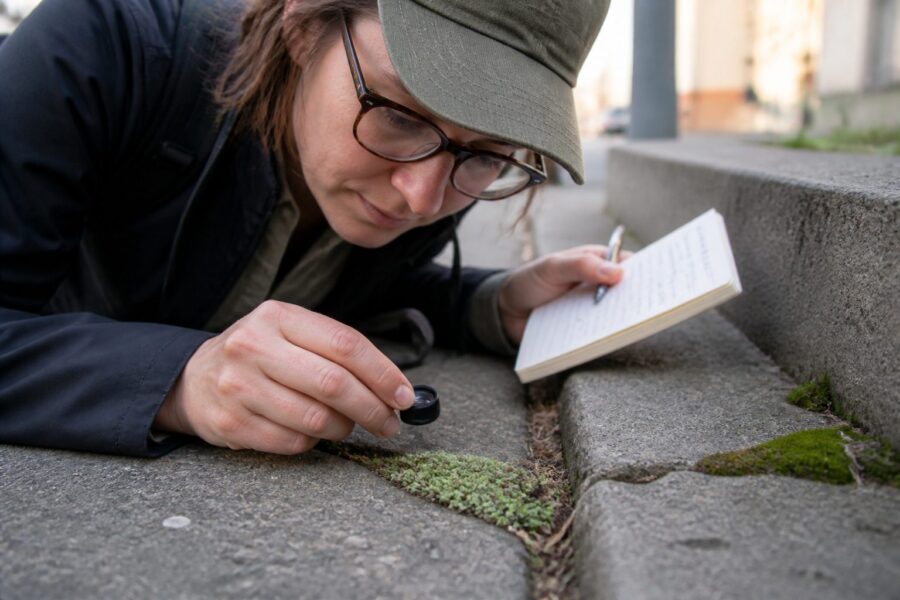
While the silvery color is a great first hint, a closer look with a hand lens reveals the specific microscopic features that confirm Bryum argenteum identification. The leaves are small, typically less than 1 millimeter long, and tightly appressed to the stem when dry, giving the shoot a worm-like appearance.
When wet, these leaves splay outwards, revealing their characteristic ovate to broadly spatulate shape. Each leaf features a nerve, or costa, that extends almost to the leaf tip but rarely projects beyond it.
The most distinguishing feature under magnification is the arrangement of the cells at the leaf apex. These apical cells are characteristically hyaline, meaning they are clear and lack chlorophyll, which directly causes the silvery appearance we observe.
Lower down the leaf, the cells become rectangular and contain chlorophyll, performing photosynthesis for the plant. This sharp contrast between the colorless tips and green bases of the leaves is a definitive trait for silver moss identification.
The stems themselves are short, typically only a few millimeters tall, and often branched, forming dense cushions. These stems are usually reddish or brownish, providing a subtle contrast to the silvery foliage.
The overall structure of the plant is acrocarpous, meaning it grows upright with sporophytes emerging from the tips of the main stems, a detail we will discuss later. Examining these minute details ensures accurate identification and helps distinguish Bryum argenteum from similar-looking bryophytes.
Understanding these microscopic features is crucial for anyone serious about bryophyte study or urban moss cultivation. A simple 10x hand lens can unlock a world of detail that confirms your Bryum argenteum identification silver sidewalk moss suspicions.
Typical Urban Habitats: Pavement Gaps, Rooftops, and Gutters
Bryum argenteum is a true urban pioneer, perfectly adapted to the harsh, fragmented environments found in cities worldwide. You’ll find this resilient pavement crack moss thriving where few other plants dare to grow, often forming extensive mats in seemingly sterile locations.
Its preference for disturbed, open, and often nutrient-poor substrates makes it a common sight across nearly every continent. This widespread adaptability solidifies its reputation as a cosmopolitan species and a champion of urban colonization.
| Habitat Type | Typical Characteristics | Why Bryum argenteum Thrives Here |
|---|---|---|
| Pavement Cracks & Sidewalks | Compact soil, intermittent moisture, high foot traffic, direct sun | Tolerates desiccation, compaction, and physical disturbance; thrives on mineral surfaces |
| Rooftops & Gravel Paths | Exposed to sun and wind, limited soil, temperature extremes | Resistant to UV radiation, rapid drying, and wide temperature fluctuations |
| Gutters & Drainpipes | Intermittent water flow, accumulation of fine silt, nutrient runoff | Benefits from periodic moisture and nutrient deposition, can grow on various substrates |
| Compacted Soil & Bare Ground | Poor aeration, high mineral content, often roadside verges | Withstands soil compaction and low nutrient availability, outcompetes vascular plants |
| Wall Bases & Mortar | Alkaline conditions, sheltered from direct rain but exposed to runoff | Tolerates alkaline pH, utilizes capillary action for moisture, benefits from runoff |
How to Confirm It’s Bryum argenteum and Not a Close Relative
While Bryum argenteum identification silver sidewalk moss is usually straightforward due to its distinctive color, other mosses can occasionally be confused with it, especially in less typical growth forms. Careful observation of several key features helps distinguish it from close relatives or other silvery-looking species.
The silvery sheen, while a strong indicator, is not entirely unique to Bryum argenteum; some species of Tortula or even other Bryum species can appear somewhat silvery under certain dry conditions. However, the consistent, almost polished silver appearance of Bryum argenteum is rarely matched.
The most reliable method for confirming silver moss identification involves examining the leaf tips under magnification. Bryum argenteum leaves consistently show hyaline, chlorophyll-free cells at their apices, a feature not typically found in other mosses that might appear silvery.
Look for the costa, or midrib, of the leaf; in Bryum argenteum, it usually ends just before the leaf tip, never extending into a long hair-point. Some other Bryum species, like Bryum capillare, have a much longer, excurrent costa that projects beyond the leaf blade.
The overall growth habit also offers clues; Bryum argenteum forms very dense, often convex cushions or flat mats, while many other mosses, even those in the genus Bryum, tend to have looser, more upright stems or different branching patterns. Always compare the specific habitat conditions, as Bryum argenteum thrives in highly disturbed urban settings where others might struggle.
Another helpful distinguishing feature is the presence of gemmae, small reproductive structures, which Bryum argenteum sometimes produces in the leaf axils. These gemmae are typically small, spherical to ovoid, and can be observed with a good hand lens, further aiding in confirming Bryum argenteum urban specimens.
Remember that the combination of multiple characteristics – the silvery color, the specific leaf cell structure, the costa’s length, and the growth form – provides the most accurate identification. Relying on just one feature can sometimes lead to misidentification, so always cross-reference your observations.
Capsule and Sporophyte Features When Present
While Bryum argenteum often reproduces vegetatively, producing sporophytes with capsules is a common occurrence, especially in favorable conditions. Observing these reproductive structures offers definitive clues for Bryum argenteum identification silver sidewalk moss when they are present.
The sporophyte consists of a seta, which is the stalk, and a capsule, which contains the spores. These structures emerge from the tips of the gametophyte stems, showcasing the acrocarpous growth habit characteristic of this moss.
- Seta: Slender, reddish-brown, typically 1-2 cm tall
- Capsule shape: Pendulous (hanging), pear-shaped or ovoid
- Capsule color: Green when immature, turning reddish-brown or dark brown when mature
- Peristome teeth: Double peristome, outer teeth yellow-brown, inner teeth paler
- Operculum: Conical, often with a small apiculus (point)
- Calyptra: Small, hood-like, falling off early
- Spore release: Occurs when capsules dry and operculum detaches
Pollution Tolerance and Why It Thrives in Heavy Traffic Areas
Bryum argenteum is not just tolerant of urban environments; it actively thrives in them, particularly in heavy traffic areas, which speaks volumes about its incredible resilience. This moss has developed a suite of adaptations that allow it to withstand conditions that would kill most other plant life.
One of its key strengths is its remarkable tolerance to various pollutants, including heavy metals, sulfur dioxide, and nitrogen oxides commonly found in vehicle emissions. It can absorb these compounds without experiencing significant physiological damage, unlike more sensitive species.
The compact growth form and small size of Bryum argenteum help it withstand physical disturbances like vehicle spray, exhaust fumes, and the constant vibrations from traffic. Its ability to quickly dry out and rehydrate is also critical, as urban areas often experience flash drying after rain events.
Its superficial rhizoids, which are root-like structures, allow it to anchor securely to bare concrete or asphalt surfaces, preventing it from being dislodged. This firm attachment is essential for any pavement crack moss that faces constant environmental assault.
Furthermore, Bryum argenteum can tolerate wide fluctuations in temperature and intense sunlight, conditions prevalent in exposed urban settings like sidewalks and rooftops. The silvery leaf tips, as discussed earlier, play a significant role in mitigating heat stress and UV damage.
The moss also benefits from the nutrient runoff that accumulates in urban cracks, such as dust, grit, and organic detritus, which it can efficiently absorb. This ability to scavenge nutrients from seemingly barren environments gives Bryum argenteum urban an edge over competitors.
Its prolific vegetative reproduction through fragmentation and gemmae allows it to quickly colonize new disturbed areas, ensuring its continued dominance in these challenging habitats. This rapid colonization strategy makes Bryum argenteum identification silver sidewalk moss such a common sight in our cities.
Using Bryum argenteum in Container and Tray Cultivation
Given its hardiness and attractive silvery appearance, Bryum argenteum is an excellent candidate for urban moss cultivation in containers and trays. Its ability to thrive in challenging conditions makes it surprisingly easy to grow, even for beginners.
Starting with Bryum argenteum identification silver sidewalk moss collected from local pavement cracks is a simple way to begin your cultivation project. Just ensure you collect from areas free of heavy chemical contamination, as this can affect your cultivated patch.
For substrate, replicate its natural urban habitat by using a mix of sand, fine gravel, and a small amount of coco coir or peat moss. This combination provides good drainage while retaining some moisture, mimicking the compacted, mineral-rich environments it prefers.
Spread a thin layer of your collected Bryum argenteum fragments over the prepared substrate. Gently press them down to ensure good contact with the surface; mosses absorb water and nutrients directly from their environment, so good contact is crucial.
Maintain consistent moisture by misting daily or every other day, depending on your climate and the container’s evaporation rate. The moss should be damp but never waterlogged, as excessive moisture can lead to rot.
Place your container in a location that receives bright, indirect light or even a few hours of direct morning sun. Bryum argenteum tolerates full sun but can look its best with a bit of afternoon shade to prevent extreme drying.
Consider using shallow trays or bonsai pots to create miniature urban landscapes with your Bryum argenteum urban specimens. Its compact growth habit and vibrant color make it an ideal ground cover for tiny dioramas or terrariums.
You can experiment with different substrates, such as crushed brick or concrete chips, to see how the moss responds and to enhance its silvery appearance. This hands-on approach offers fascinating insights into bryophyte ecology and cultivation techniques.
Incorporating other small urban plants or even tiny rocks and pebbles can create an engaging display that celebrates the beauty of overlooked city flora. Cultivating Bryum argenteum is a rewarding way to bring a piece of the urban wild into your home or garden.
Conclusion
Bryum argenteum, the silver sidewalk moss, is far more than just a common pavement crack moss; it is a marvel of adaptation and resilience. Its striking silvery appearance, unique cellular structure, and remarkable tolerance to urban pollution make it a fascinating subject for study and appreciation.
Learning Bryum argenteum identification silver sidewalk moss opens your eyes to the hidden botanical world thriving beneath our feet in cities everywhere. This ubiquitous bryophyte challenges our perceptions of where life can flourish and how plants can adapt to extreme conditions.
Whether you are a seasoned bryologist or a curious urban explorer, taking the time to observe and understand Bryum argenteum urban offers a rewarding connection to nature. Its presence reminds us that even in the most built-up environments, life persists and finds a way to shine, quite literally, with a silver sheen.
Embrace the challenge of silver moss identification and consider cultivating this hardy species, bringing a piece of the urban wild into your own space. Its story is one of survival, beauty, and the quiet triumph of the small.
This widespread moss stands as a testament to the incredible diversity and tenacity of bryophytes, proving that even the most unassuming organisms hold profound ecological lessons. Keep an eye out for its distinctive shimmer; once you know what to look for, you’ll see it everywhere.