
Color is the first thing you notice when you look at moss on a brick wall, a sidewalk crack, or a roof shingle. It is also the first thing that can send you confidently in the wrong direction.
This guide focuses on moss identification by color and sheen, because those two cues are useful when you treat them like clues, not answers. I care about them because urban moss cultivation usually starts with whatever colonizes your surfaces, and color is what you can record fast.
If you have ever photographed a patch that looked emerald in person and neon on your phone, you already know the problem. Moss color changes, glossy reflections, and wet vs dry moss color can make the same clump look like three different species in one week.
Still, you can learn to read greens, yellows, and shiny surfaces correctly if you control a few variables. The goal is not perfection, it is repeatability so your notes mean something a month later.
Why color can help (and why it often tricks you)
Color helps because many common urban mosses cluster into recognizable palettes when conditions are stable. Once you have seen a few patches of yellow-green sidewalk moss versus deep green wall moss, your eye starts to sort them quickly.
Color tricks you because moss is basically a thin, living sponge that reacts fast to water, light, and temperature. A patch can shift from gray-green to rich green in minutes after misting, so a single glance can lie.
Another trap is that the same “green” can come from different structures. Some moss looks dark because it is dense and shadowed, while another looks dark because the leaves have pigment and a thicker cell layer.
Urban surfaces add their own tint, especially red brick, rusty metal, and tan concrete. If you are practicing moss identification by color and sheen, you have to notice the background color bleeding into your perception.
I also see people confuse algae films with moss when they rely on color alone. If it wipes off like paint and has no obvious stems or leaflets, treat the green as a warning sign, not an ID point.
Setting a baseline: lighting, phone camera settings, and white balance
Start with lighting, because shade can make a yellow-green moss look blue-green and “healthy” when it is actually sun-stressed. If you can, photograph at the same time of day, or at least avoid the harsh hour when sun hits at a low angle.
Your phone’s auto white balance loves to “fix” greens, and it usually overdoes it. Lock your exposure and white balance if your camera app allows it, or use a manual mode app so the moss does not change color between shots.
Cloudy bright light is the easiest condition for honest color. Direct sun creates shiny hotspots that mimic glossy moss, and deep shade pushes everything toward cool gray.
Use a simple reference in the frame, like a gray card, a white plastic plant label, or even a piece of plain printer paper. You can correct the photo later, but you cannot correct a photo with no reference point.
Keep your distance consistent so the camera is not switching lenses or applying different sharpening. The same patch shot at 1x and 3x zoom can look like different textures, which then changes how you interpret sheen.
Greens that matter: blue-green, yellow-green, and deep emerald
Green is not one color in moss, it is a range that often tracks water content and light exposure. When you get serious about moss identification by color and sheen, you start naming greens the way painters do.
Blue-green often shows up in shaded, consistently damp spots, especially on north-facing masonry or under dripping AC lines. Yellow-green is common on more exposed concrete and mortar, where the plant is coping with brighter light and faster drying.
| Green type you see | Common urban setting | Quick check to avoid misreads |
|---|---|---|
| Blue-green, cool cast | North wall, under ledges, near downspouts | Compare dry and re-wet, look for rapid darkening |
| Yellow-green, lime cast | Sidewalk seams, sunny mortar, curb edges | Look for sun bleaching on tips versus bases |
| Deep emerald, saturated | Shaded soil line, planter edges, irrigated brick | Check density and leaf overlap, not just color |
| Gray-green, dusty | Roof shingles, dry stone, windy corners | Mist lightly and watch for color rebound in 2 minutes |
Browns, reds, and bronze tones: stress colors vs. normal traits
Brown does not automatically mean dead moss, even though people treat it that way. Many patches look bronze in summer, then flip back to green after a few cool wet days.
Red and rusty tones can come from pigments that protect against intense light and drying. In cities, that often shows up on south-facing walls, rooftop edges, and the top lip of retaining walls.
Some mosses carry a naturally warm cast in the stems or older leaf bases, and that can be a real trait worth noting. The problem is that the same warm cast can also come from dust, soot, or iron-rich runoff staining the patch.
If you see a bronze sheen in only the exposed tips while the shaded bases stay green, I treat it as stress first. If the entire cushion is evenly bronze across multiple weeks and weather swings, then I start treating it as a stable character.
When you document moss color changes, write down what the weather did in the last 48 hours. A hot dry wind can brown a patch fast, and a single rain can make it look “revived” even if it is still stressed.
Sheen and gloss: what makes some moss look shiny
Glossy moss is real, and it is not always just water on the surface. Some species have leaf shapes and cell surfaces that reflect light like tiny tiles when they are aligned.
In the city, gloss often pops on smooth mats growing flat to stone, especially where water runs thinly over the surface. The leaves overlap like shingles, and the reflection comes from that layered geometry as much as from moisture.
Angle matters more than people expect, so move your head a few inches and watch the shine change. If the shine disappears when you change viewing angle, you are seeing reflection, not a different pigment.
Do not confuse gloss with slime, because algae and biofilm can make a patch look shiny in a gross way. If the surface looks like it has a clear coat and the texture is hard to resolve, inspect for actual moss leaves with a hand lens.
For moss identification by color and sheen, I treat persistent gloss in dry conditions as more informative than gloss right after rain. A patch that stays shiny when dry often has a naturally reflective leaf surface or a very smooth, pressed growth form.
Matte textures: how “dull” surfaces can still be distinctive
Matte moss can look boring in photos, but it can be easier to read because it does not throw glare. Many cushion-forming mosses on soil and gritty mortar stay matte even when damp.
A dull surface often means the leaves are not lying flat, so light scatters instead of reflecting. That scattering can signal a tufted growth form, tiny hair points, or a roughened leaf surface.
Matte patches also show dust and grit clearly, which is useful information in urban settings. If a patch stays matte and looks “dirty” even after rain, it may be trapping particles because of its leaf spacing and upright stems.
When you compare glossy moss to matte moss, do it under the same light, because shade can make everything look matte. I prefer to compare two patches on the same wall plane, then I move closer and check whether the leaves lie flat or stand up.
Matte does not mean weak, and it does not mean “dry” as a permanent state. Some of the toughest sidewalk mosses look dull most of the time, then briefly darken and plump up after misting.
Wet vs. dry appearance: what changes fast after rain or misting
Wet vs dry moss color is the single biggest source of confusion when beginners try to ID by photos. A dry patch can look pale, gray, or even slightly brown, then turn deep green as the leaves rehydrate and spread.
If you want honest comparisons, take two photos of the same patch, one dry and one after a controlled misting. That pairing teaches your eye what is structural color and what is hydration behavior.
- Photograph dry first, then mist lightly for 30 seconds
- Wait 2 minutes, then shoot the same frame again
- Note whether leaves uncurl or simply darken
- Watch for gloss that appears only when wet
- Record temperature and wind, since drying speed changes color fast
- Check edges versus center, since edges rehydrate first on thin mats
Sun exposure and shade: how the same species shifts color across a wall
On a single wall, you can see a moss patch shift color from top to bottom because sun and runoff differ by a few feet. That is why I distrust single-sample IDs taken from one corner of a building.
Sun-exposed parts often look smaller, tighter, and more yellow-green, even when they are the same species as the shaded part. The shaded parts stay looser, darker, and sometimes a little glossy because they hold water longer.
Heat from masonry matters too, especially dark brick and stone that bake in afternoon sun. You can get a “heat line” where moss below the line stays green and moss above it bronzes out.
Shade under ledges can create a misleading deep green that reads like a different moss. Before you call it a new species, check whether the stems and leaf shapes match the sunnier section.
When I scout for urban moss cultivation candidates, I pick patches that stay reasonably green across exposure gradients. If a patch collapses into brown on the sunny edge every week, it may survive, but it will be harder to keep attractive in a display tray.
Age and growth stage: bright tips, darker bases, and mixed patches
Moss rarely grows as a perfectly uniform carpet, so mixed color is normal. Bright tips often mean active growth, while darker bases can mean older tissue, trapped dust, or constant dampness.
You can use that pattern as a clue, but do not overread it. A patch with pale tips might be actively growing, or it might be sun-bleached at the surface while the interior stays darker.
Look for repeated patterns across multiple tufts in the same patch. If every tuft has greener centers and bronzier tips, that suggests a consistent exposure effect rather than random damage.
Older mats on concrete often collect fine grit that dulls the color and makes the base look brownish. If you gently rinse a small corner and the base color returns, the “browning” was mostly dirt.
Mixed patches also happen when two species intergrow, which is common in city cracks. When you practice moss identification by color and sheen, train yourself to spot boundaries where texture changes, not just where color shifts.
Using color safely: pairing it with one structural trait to confirm
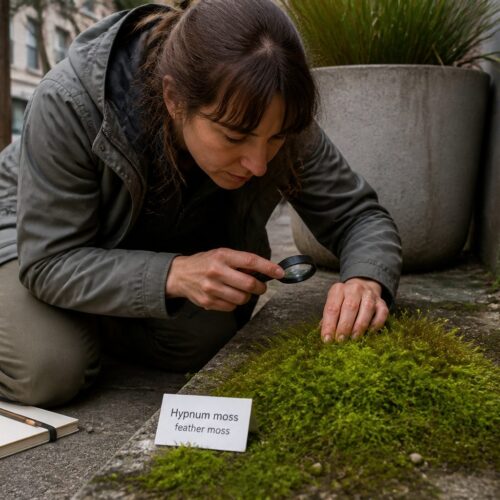
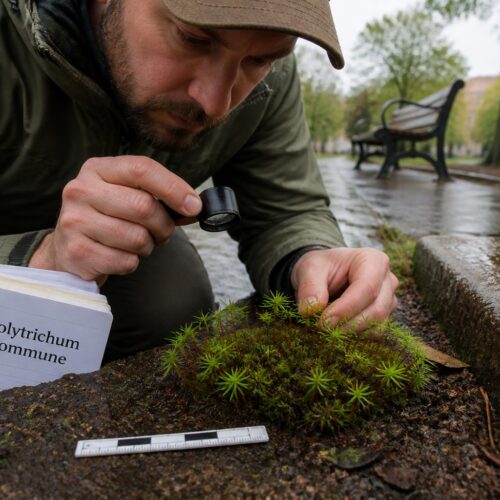
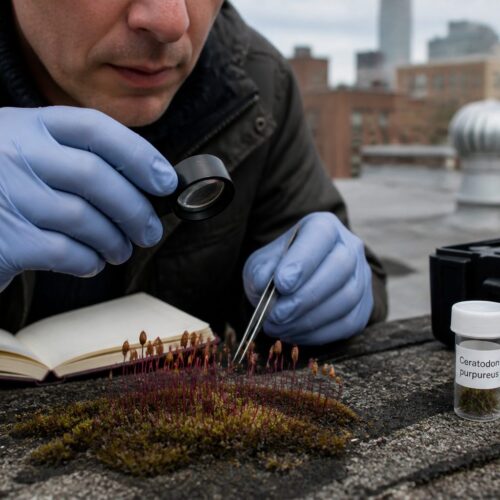
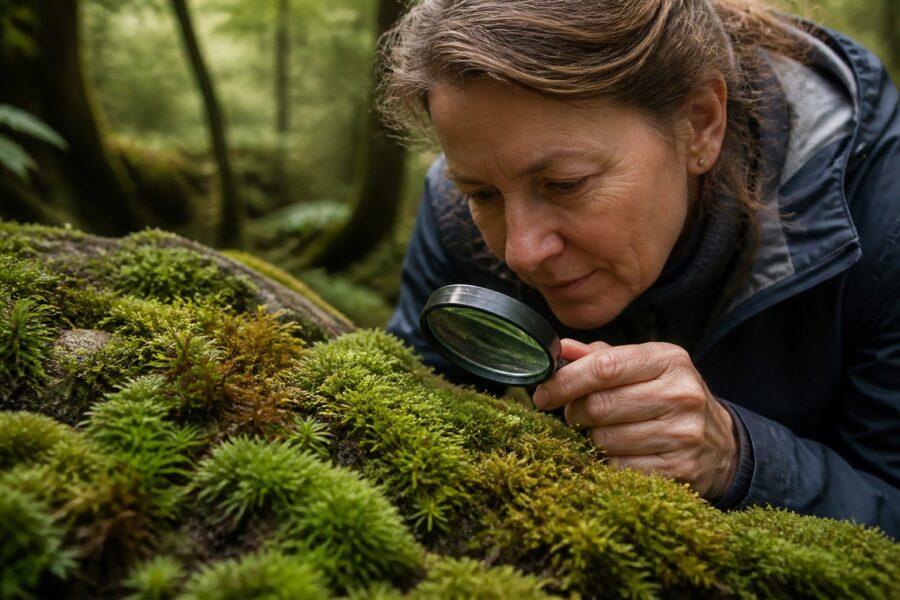
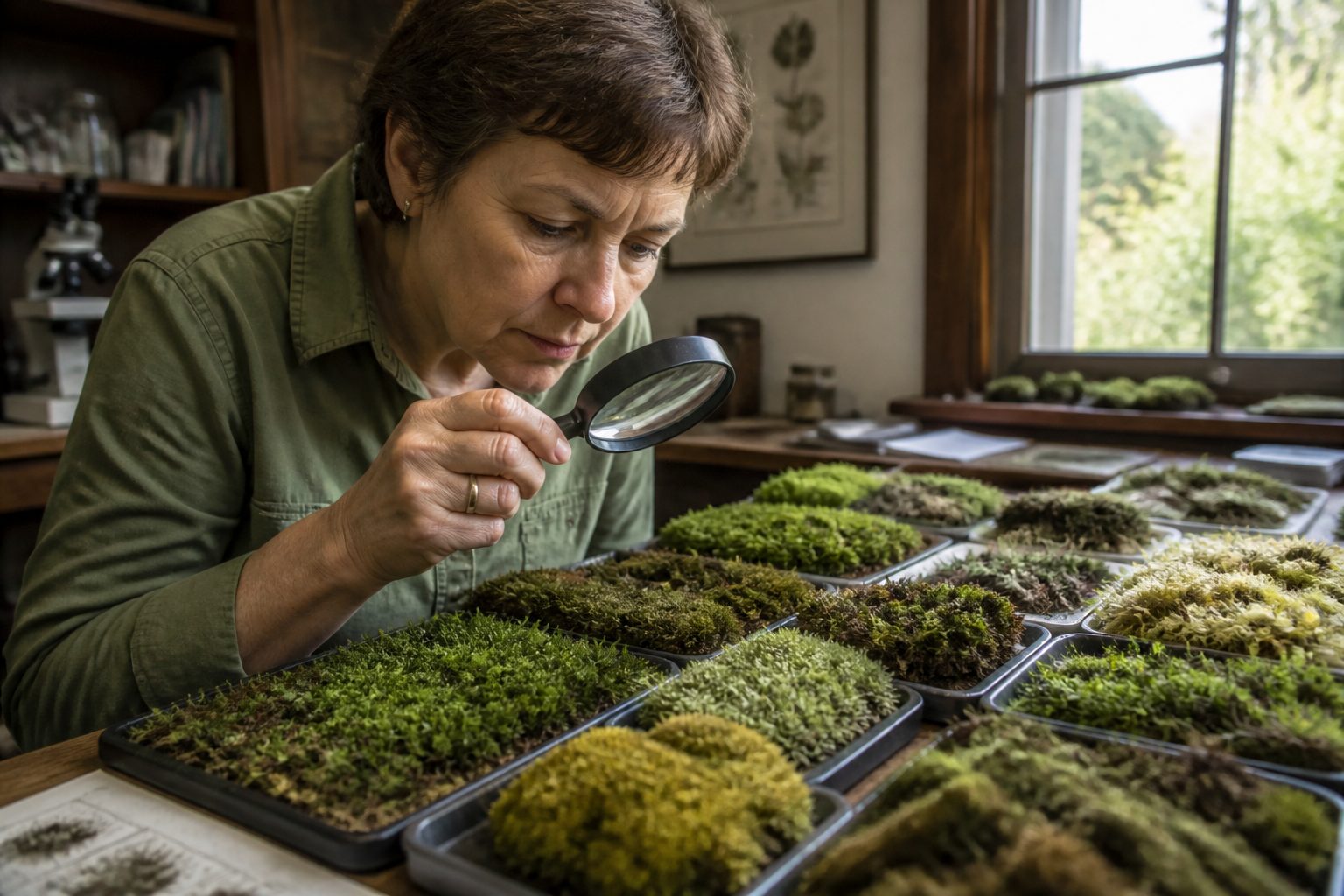
Color is safest when you treat it like a first filter, then confirm with one structural trait you can see with a cheap hand lens. You do not need a microscope to make smarter calls than “green equals this species.”
Pick one trait to focus on per observation, because stacking five traits in your head gets messy fast. I like leaf posture when dry, growth form (mat versus tuft versus cushion), or the presence of obvious hair points.
If your patch is glossy moss when dry, check whether it grows as a pressed, creeping mat with flattened shoots. If it is matte and tufted, check whether the leaves curl inward when dry, because that behavior often tracks certain common urban genera.
When moss color changes dramatically with moisture, that hydration response itself becomes a trait. Some mosses darken without much leaf movement, while others visibly uncurl and expand like a tiny accordion.
I also use the substrate as a practical tie-breaker, even though it is not a true diagnostic feature. A moss that thrives on acidic bark behaves differently in a planter than one that loves alkaline mortar, so your cultivation results can confirm your field guess.
Practical documentation: consistent photos and notes you can compare later
If you want your records to help with moss identification by color and sheen, consistency beats artistry. Take the same three shots every time: a wide context shot, a close shot, and a macro shot where you can see leaf direction.
Name your photo sets with the date, location, and whether the patch was wet or dry. “WallA2026-05-03dry” is boring, and boring is exactly what makes it searchable later.
Write down the light condition in plain language, like “bright overcast” or “late sun glare,” because your camera metadata will not capture what your eyes saw. If you changed phone settings, note that too, because auto HDR can fake sheen.
Add a quick note about recent weather and irrigation, especially if you are tracking wet vs dry moss color. A patch that looks dull today might look glossy tomorrow, and the reason is often just a sprinkler cycle.
For urban moss cultivation experiments, keep one “control photo” of a known patch you visit often. That reference patch becomes your reality check when seasonal light shifts make everything look a little different.
Conclusion
Moss color and sheen are worth paying attention to, but they work best when you treat them like weather-dependent signals. If you control lighting, document wet and dry states, and watch for gloss versus matte texture, your IDs get more reliable fast.
The best habit is simple: record what you saw in a repeatable way, then confirm with one structural trait before you label anything. Over time, moss identification by color and sheen becomes less about guessing and more about recognizing patterns that hold up across rain, sun, and seasons.