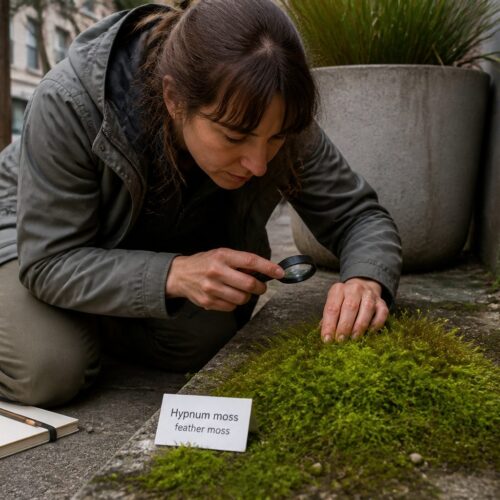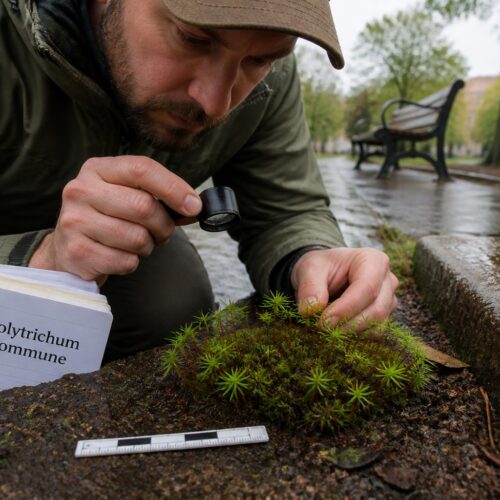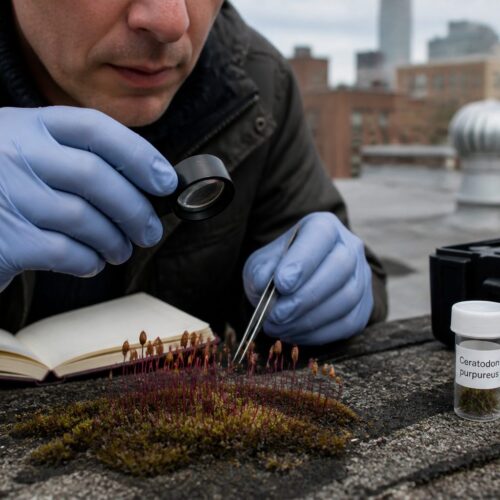

If you want faster moss IDs in the city, stop staring at the whole plant and start with the leaf tip. Moss identification by leaf tip works because the apex is small, repeatable, and often more consistent than color or overall growth form.
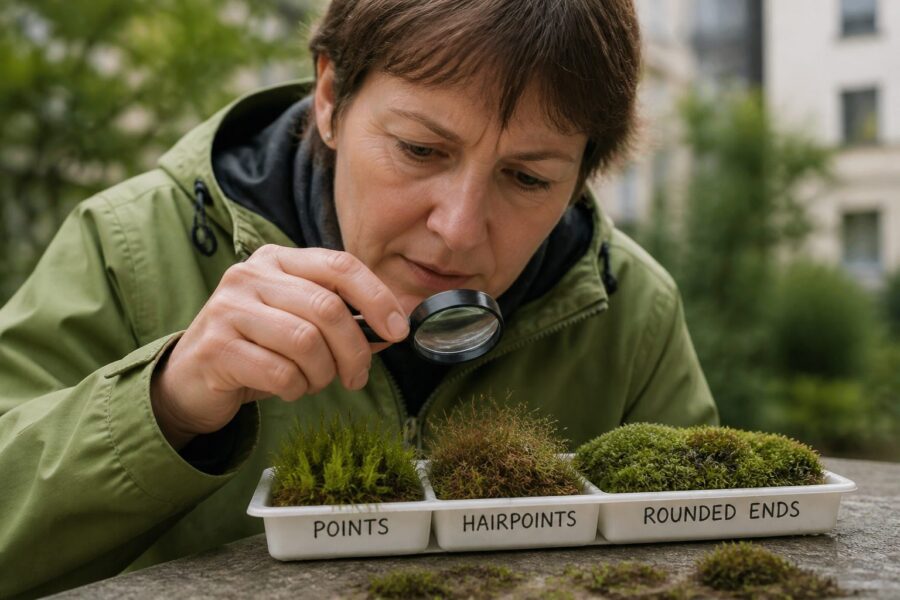
Leaf tips sound like a fussy detail until you try it on a mixed wall of sidewalk mosses after rain. Once you train your eye for points, hairpoints, and rounded ends, you start sorting patches into “maybe this genus” buckets in seconds.
This article sticks to tip traits you can actually see with a hand lens, not lab-only characters. I will also call out the common traps, because moss leaf tip clues are easy to misread when leaves are wet, old, or damaged.
Why leaf tips are one of the fastest ID clues you can use
The leaf apex shape is one of the few characters that stays useful across many urban habitats, from tree bark to brick to compacted soil. When you are doing moss identification by leaf tip, you are looking at a single feature that many species “commit” to genetically.
Color shifts with sun, pollution, and hydration, and growth form changes when a patch gets mowed or stepped on. A pointed tip usually stays pointed, and a true moss hairpoint usually stays a hairpoint even when the plant looks beat up.
Leaf tips also let you work fast without pulling large samples, which matters in public planters and sensitive green roofs. You can tease up one stem, check several leaves, and put it back with minimal disturbance.
In practice, I use the tip as an early filter, then confirm with two other traits like costa length and capsule position. That keeps the tip from becoming a single-trait obsession, which is how people end up “identifying” everything as the same sidewalk species.
Tip traits also play well with photos, but only if you control angle and focus. A phone shot taken straight down can make a blunt tip look sharp, so you still want a quick lens check before you lock in an ID.
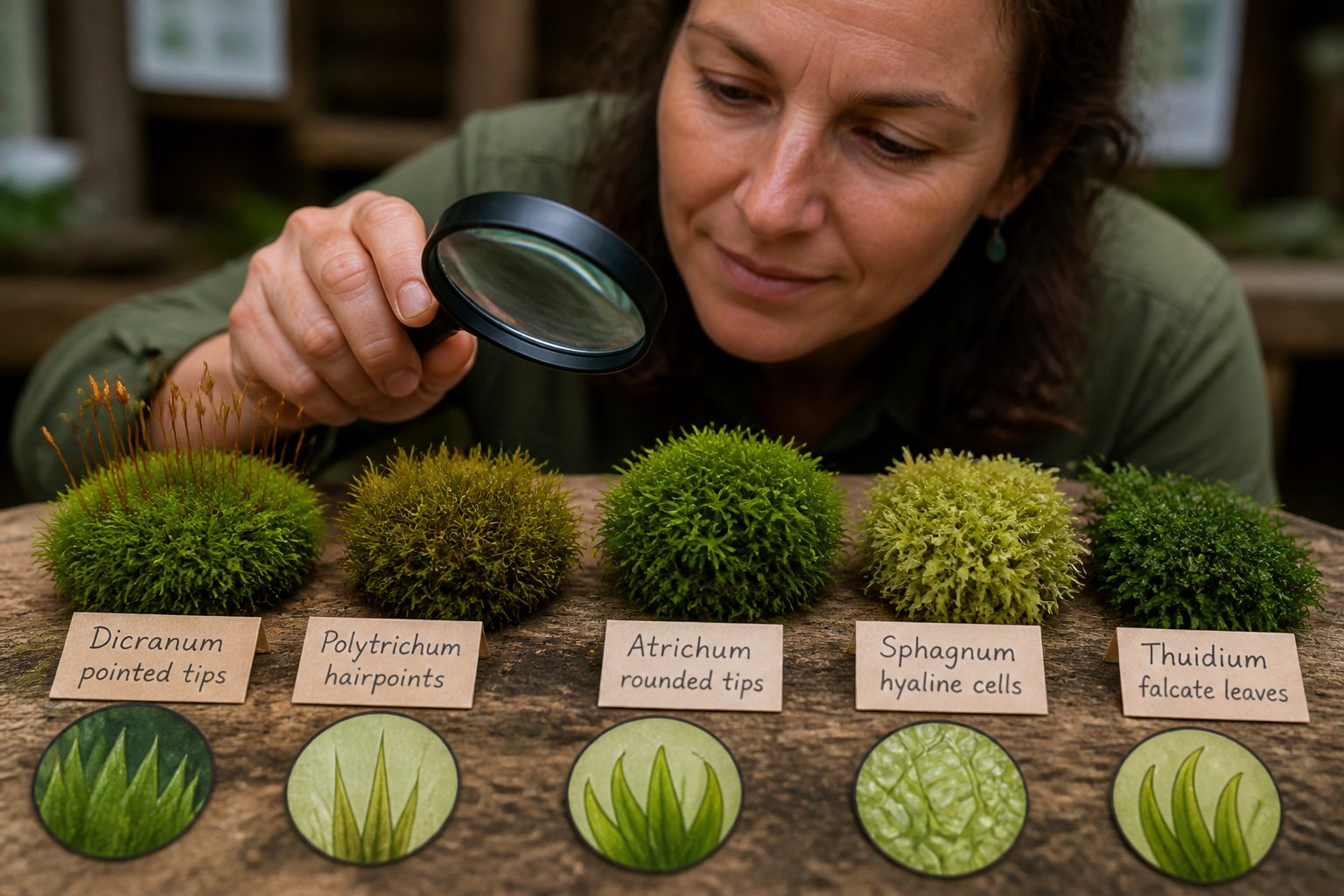
Tools and setup: hand lens, light angle, and how to hold the stem
A 10x hand lens is enough for most moss identification by leaf tip, and 20x is nice if you already own one. The real upgrade is lighting, because leaf tips are tiny, glossy, and easy to wash out.
I like a headlamp or small LED held low to the side so the apex throws a shadow. Side lighting makes a short point or a tiny notch show up when overhead light makes everything look smooth.
Hold the stem with fine tweezers or pinch it lightly, and rotate it rather than bending it. Bending makes leaves splay and twist, and then you end up judging a distorted leaf apex shape.
Check three to five leaves, not just the topmost one, because the newest leaves can be unusually narrow or still unfolding. If every leaf on the stem tells the same story at the tip, you can trust the character more.
If the moss is bone dry, breathe on it or mist it lightly and wait a minute. Many tips look “ragged” when the leaf is folded tight, and hydration often reveals whether the margin is truly intact.
Pointed vs. blunt tips: what to check before you decide
Pointed and blunt sounds simple, but the decision gets messy when a leaf ends in a short mucro, a worn stub, or a folded apex. Good moss identification by leaf tip starts by asking whether you are seeing the true end of the lamina or a trick of angle.
A blunt tip can be genuinely rounded, or it can be a broken point that snapped off on concrete grit. Before you call it blunt, look for a clean, continuous margin that curves into the end without a fracture line.
| What you see at the tip | Common cause | Quick check |
|---|---|---|
| Long, even taper to a sharp point | True acute or acuminate apex | Rotate the stem, the point stays centered |
| Short “spike” only visible from one angle | Folded leaf or twisted apex | Moisten and flatten gently with a needle |
| Blunt end with a tiny clear nub | Small mucro or beginning of awn | Look for a costa ending at the nub |
| Flat, chopped looking end | Mechanical breakage | Compare several leaves, damage varies leaf to leaf |
Rounded and spoon-like tips: when “smooth” is the key feature
A truly rounded apex is often the easiest call because it reads as calm and finished under the lens. For moss identification by leaf tip, that smooth curve can narrow you toward groups that favor obtuse to rounded ends, especially in moist, shaded urban corners.
Spoon-like tips show up when the leaf apex shape is not only rounded but also slightly concave, like a tiny scoop. You usually notice it when side light catches a bright rim and the center stays darker.
Be careful with very wet samples, because surface tension can pull the leaf tip into a cupped shape that vanishes when it dries. If the spoon shape persists across several leaves and after a gentle blot, it is more likely real.
Rounded tips often pair with other “soft” characters, like margins that look less toothed and leaves that spread rather than spear upward. That combination is a better clue than the rounded end by itself, since some pointed species get worn into rounded stubs.
In urban moss cultivation, rounded-tipped species can be forgiving on vertical surfaces because they hold a thin water film without shredding. That does not make them better mosses, but it does make them easier to keep looking neat on a misted wall.
Hairpoints (awn tips): how to spot them and avoid false calls
A moss hairpoint is a narrow extension beyond the green blade, and it can be glassy, white, or pale brown depending on age and dirt. When it is real, it is one of the strongest moss leaf tip clues you can use, because it is hard for random damage to imitate perfectly.
False calls happen when a leaf margin rolls into a thread, when a strand of algae sticks to the tip, or when a torn strip of lamina looks like an awn. The trick is to watch where the hairpoint begins, since a true awn usually starts cleanly at the apex and stays centered.
- Check if the awn starts exactly at the apex
- Rotate the stem, the hairpoint stays aligned
- Look for multiple leaves with the same awn length
- Confirm the “hair” is part of the leaf, not debris
- Note whether the costa runs into the awn base
- Compare wet vs. dry, rolled tips can fake an awn
Notched and ragged tips: damage vs. real leaf-tip traits
A notched apex can be a real trait, but city mosses also get sandblasted by foot traffic and grit. If you want moss identification by leaf tip to work, you have to separate “built that way” from “got scraped that way.”
Real notches tend to repeat, so you see the same shallow V or tiny indentation on many leaves of similar age. Damage looks random, with one leaf torn deep, the next leaf intact, and the next leaf shredded on one side only.
Ragged tips also show up after drought, when the very end of the leaf desiccates and breaks off during rehydration. In that case the plant may look healthy overall, but the tips tell a rough story from last week’s heat.
Look at the margin texture right below the tip, because real traits often come with consistent marginal teeth or consistent smoothness. A “notch” that interrupts otherwise perfect margins is more suspicious than a notch that matches the rest of the leaf edge.
If you are collecting for a moss tray or propagation, avoid using heavily ragged stems as your reference. They can still grow fine, but they will teach you the wrong leaf apex shape when you later try to key the patch out.
Tips that curl, twist, or hook: what that behavior can indicate
Some mosses behave at the tip, and that motion is part of their identity when you see it consistently. A curled or hooked apex can be a stable moss leaf tip clue, especially in dry-adapted urban species on mortar and sunny concrete.
Dry leaves often twist, and the tip may look like a little claw when the plant is stressed. Rehydrate the stem and watch whether the tip relaxes into a straight point, because a true hooked apex often stays hooked even after wetting.
Twisting can also be a whole-leaf trait rather than a tip trait, so do not over-credit the apex. If the entire leaf spirals, the tip is simply following the leaf’s shape, and the apex itself might still be blunt or rounded.
Hooked tips can trap dust and fine soil, which is one reason those patches look darker in traffic corridors. That grime can hide a small moss hairpoint or make a rounded tip look pointed, so a rinse in clean water can save you time.
In cultivation, curled tips often mean your humidity swings are too wide, even if the moss survives. If you want a tidy surface, stabilize moisture and light, then see what the apex does when the plant is not constantly bracing for drought.
Tip color changes (clear, white, brown): what’s meaningful and what’s not
Tip color is tempting because it jumps out, but it is a slippery character in cities. For moss identification by leaf tip, color should support shape, not replace it.
Clear or whitish tips often come from hyaline cells or an actual awn, and those can be useful when they are consistent. The problem is that dried slime, lime dust, and salt spray can coat tips and fake a pale end.
Brown tips can mean age, sun scorch, or pollution exposure, and you will see them on otherwise green plants along roads. If only the exposed side of a patch has brown apices, you are reading microclimate, not taxonomy.
If you suspect a real pale hairpoint, look for a sharp boundary where green tissue stops and the hair begins. A gradual fade from green to tan is more typical of stress than of a clean structural moss hairpoint.
When you photograph tips for later comparison, include a wet and a dry shot if you can. Some species look “white tipped” only when dry because the leaf surface reflects light differently, and that can mislead you when you review photos at home.
How leaf tips vary along the same plant (top vs. base leaves)
The top leaves near the growing point often look sharper and cleaner than the older leaves below. If you do moss identification by leaf tip using only the newest leaves, you can overestimate how pointed the species really is.
Basal leaves can be shorter, more worn, and sometimes more rounded because they have taken months of abrasion. That wear matters in sidewalk colonies where grit gets kicked into the mat and acts like sandpaper.
Some species also change tip form with leaf size, so the smallest lower leaves look blunt while the upper leaves look acute. When that pattern repeats across several stems, it is a real growth pattern, not random damage.
Check multiple stems from the same patch, because one stem may be shaded and another may be sun baked. I trust tip traits most when I see them repeat across microhabitats within the same colony.
If you are building a small ID reference for your neighborhood, label photos by stem position. A “top leaf tip” photo and a “mid stem leaf tip” photo keep you from arguing with your own notes later.
A simple field workflow: narrowing candidates using tip traits plus two backups
I use a three-step workflow that starts with moss identification by leaf tip, then checks two backup traits before I name anything. This keeps the process fast while still respecting how often tip characters get distorted by city stress.
First, decide the broad tip bucket, pointed, rounded, hairpointed, notched, or obviously damaged. Second, confirm with costa behavior, like whether the midrib reaches the tip, ends below it, or runs out into a short mucro.
Third, use one habitat or growth trait as a reality check, such as whether the plant is on bark, soil, brick, or concrete, and whether it forms cushions or mats. Habitat does not “prove” an ID, but it does catch the obvious mismatches before you waste time.
If you have capsules, use them, because they settle arguments fast. A leaf apex shape that suggests one group and a capsule position that screams another group means you need to slow down and re-check your tip call.
Write your observations in plain language, like “short clear awn on most upper leaves” rather than a single label like “hairpoint.” Those notes stay useful even when you later learn that your first guess at genus was wrong.
Conclusion
Moss identification by leaf tip is a practical skill because it turns a messy patch into a set of repeatable, visible choices. Points, rounded ends, and a true moss hairpoint are often enough to narrow your options before you ever open a key.
The best results come when you treat leaf apex shape as an anchor trait, then back it up with costa length and one other feature you trust. If you keep your lighting consistent and check several leaves, moss leaf tip clues stop feeling like guesswork and start feeling like pattern recognition.