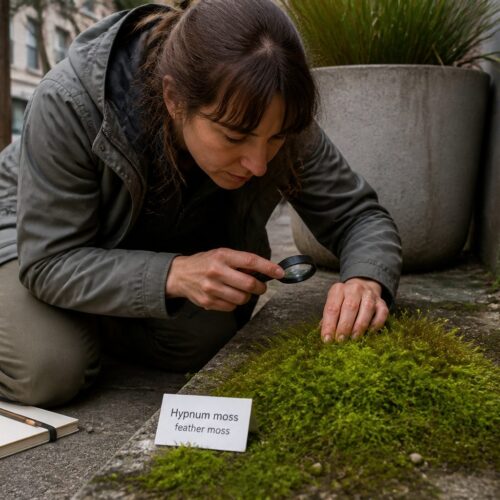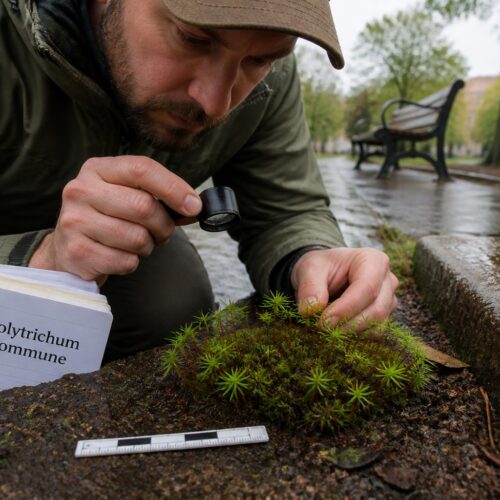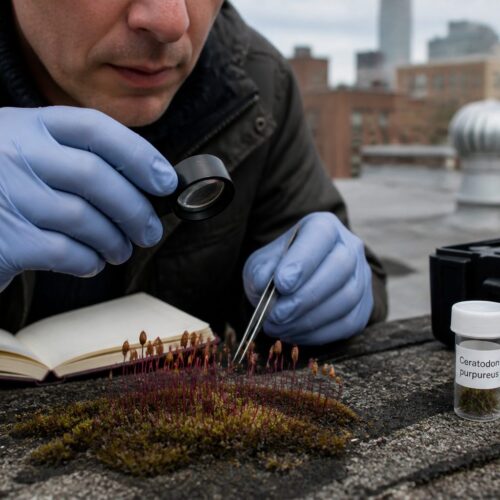


If you want moss identification by growth habit to stop feeling like guesswork, start by ignoring leaf details for a minute. The shape of the colony, how it sits on the surface, and how the stems grow tells you more, faster, than most beginners expect.
I keep a hand lens in my pocket, but I do not pull it out right away. First I look at the patch the way a bird would, because moss growth forms show up at that scale.
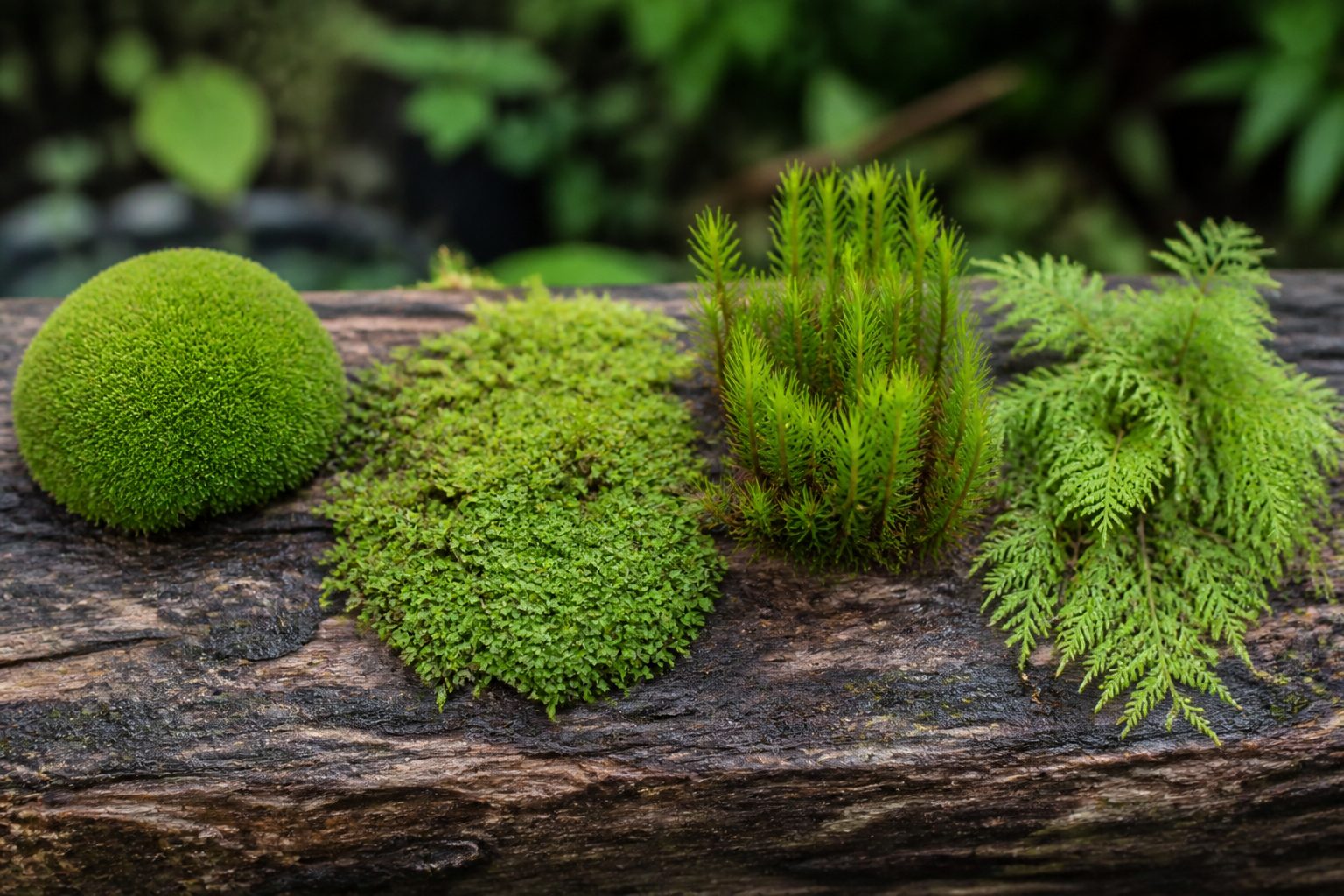
This moss habit guide focuses on four common growth habits you can spot on sidewalks, roofs, tree bases, and garden soil. Once you can name cushion, mat, tuft, and feather types with confidence, the acrocarp vs pleurocarp split becomes much easier to apply.
Why growth habit is the fastest starting point for moss ID
Most new identifiers start with leaf shape, then get stuck because wet leaves look different than dry leaves. Growth habit stays readable in both states, so it is a steadier first filter.
Habit also survives abuse in cities, where mowing, foot traffic, and roof runoff shred delicate features. A battered patch can still show whether it grows upright in tufts or creeps as a mat.
When people say “moss is just green fuzz,” they are usually standing too close. Step back and you will see architecture, little domes, low carpets, sprays, and shaggy fringes that repeat across species.
For urban moss cultivation, growth habit matters because it predicts how a moss handles drying and disturbance. Cushions shed water differently than mats, and feather forms snag windblown grit that can smother them in planters.
Using moss identification by growth habit also keeps you honest about uncertainty. You can label a patch “pleurocarpous mat” today, then come back later for capsules and leaf cells when you have time.
Acrocarpous mosses: upright tufts and cushions
Acrocarpous mosses grow mostly upright, with stems that end in the reproductive structures when they show up. In plain terms, the colony builds height first, then spreads by making more shoots.
In a sidewalk crack, acrocarps often look like tiny bottle brushes or clustered pins. Many of the classic “cushion” and “tuft” looks are acrocarpous, even when the patch spreads wide.
Dry acrocarps can look dead, and that tricks people into scraping them off. Give them a misting and a few minutes, and you can watch the shoots relax and regain color.
Acrocarps handle sun better than many pleurocarps because their form reduces exposed surface area. That does not mean they love heat, it means they can pause and restart without falling apart.
If you are comparing acrocarp vs pleurocarp in the field, look for the “upright forest” effect. The stems stand like bristles, while pleurocarps tend to lie down and weave across the substrate.
Pleurocarpous mosses: creeping mats and feather forms
Pleurocarpous mosses spread sideways, sending stems along the surface and branching as they go. Their reproductive structures often appear on short side branches, so the main stem keeps creeping.
This growth strategy builds mats that can cover a brick, a log, or a whole planter rim in a single sheet. In moss growth forms, pleurocarps are the ones that look like carpets, braids, and little ferny sprays.
| Trait to check | Common in pleurocarps | What you see in the field |
|---|---|---|
| Main stem direction | Mostly horizontal | Stems run along bark, soil, or stone |
| Branching | Frequent, often pinnate | Featherlike side branches form a flat spray |
| Colony shape | Mats and sheets | Continuous cover with fuzzy edges |
| Attachment | Many rhizoids along stems | Patch peels as a thin layer when lifted |
| Typical moisture preference | Moderate to moist | More common on shaded walls and damp soil |
Cushion moss traits you can confirm in minutes
A cushion moss patch looks like a tight dome or a cluster of domes, usually with a clean edge. If you press it gently, it springs back, because the shoots pack together like a sponge.
Cushions usually point to acrocarpous growth, though the size can range from pea sized bumps to hand sized mounds. In cities, you often see cushions on thin soil over concrete, old mortar, and compacted planter beds.
One quick check is to mist the cushion and watch how the surface changes. Many cushions shift from dull and tight to glossy and open, and the dome shape stays intact.
Another fast check is the “edge test,” where you look for upright shoots right at the margin. A mat has runners and loose strands at the edge, while a cushion ends more abruptly.
For moss identification by growth habit, cushions tell you something about water handling. They shed water from the top but hold moisture inside, so they often survive exposed spots that bake in afternoon sun.
Mat-forming moss traits (and what often confuses people)
Mat-forming mosses spread as a low layer that hugs the surface, and the patch often looks wider than it is tall. When you follow a stem, it tends to run sideways and branch, which is the pleurocarpous pattern.
The common confusion is that a dry mat can shrink and look tufted from above. After a light spray, the same patch flattens again and the creeping stems become obvious.
Mats often trap dust, sand, and leaf fragments, especially along sidewalks and curb edges. That trapped grit can make the moss look “dirty” or brown, even when the plants are healthy underneath.
People also confuse liverwort mats with moss mats, because both can make smooth green sheets. Moss mats still have stems and leaves if you tease up a corner, while many thalloid liverworts lift as a flat strap.
In a moss habit guide, mats are the best sign that your ID work should shift toward pleurocarp genera. If you later see capsules, they often rise from short side branches rather than from the tip of a tall stem.
Tufted moss traits: when “tuft” isn’t enough
“Tuft” is a useful field label, but it is sloppy if you stop there. A tuft can be a young cushion, a disturbed mat that got shredded, or a true acrocarp clump that never forms domes.
Start by checking whether the shoots all rise from a tight base or whether they sprawl outward. True tufted acrocarps look like many tiny stems packed together, while broken pleurocarp mats have sideways stems hiding under the top fuzz.
- Check the patch edge for creeping runners
- Mist and watch whether the patch flattens
- Look for a single dense base versus many attachment points
- Scan for upright stems of similar height
- Note whether the patch breaks into clumps when lifted
- Search for capsules rising from stem tips
Feather moss traits: branching patterns that give them away
Feather mosses look like tiny fern fronds, with a main stem and side branches that line up in a plane. That regular branching is the giveaway, even when the patch is small.
Most feather forms are pleurocarpous, and they build soft mats that you can peel up in thin sheets. In a damp courtyard or shaded retaining wall, feather moss often dominates because it spreads fast across stable surfaces.
Use your phone camera as a quick lens and look for “pinnate” structure, where branches come off like the barbs of a feather. Some species branch irregularly, but they still show a creeping main stem underneath.
Feather moss patches can look messy when covered in leaf litter, and that is normal. The stems keep growing under the litter, then pop up through gaps after rain.
For moss identification by growth habit, feather types narrow your search to a smaller slice of moss growth forms. Once you have “feather pleurocarp” in your notes, you can focus later on leaf curvature, costa length, and capsule position.
Mixed colonies: how two species can share one patch
Urban moss patches often contain more than one species, and the mix can fool you if you assume one habit equals one name. A cushion can have a mat creeping through it, and the mat usually wins over time.
Look for changes in texture within the same patch, like a tight dome next to a looser fringe. That boundary usually marks a species shift, not a weird mood swing in one plant.
Mixed colonies show up a lot on tree bases, where bark texture changes with height and water flow. You might see a pleurocarp mat on the shaded side and an acrocarp tuft on the side that dries faster.
If you collect for cultivation, mixed colonies can frustrate you because one species takes over the tray. I separate pieces by habit first, then grow them in different containers until I know what I have.
When you write notes, record two habits if you see them, even if you cannot name the species yet. That simple habit note keeps your later microscope work from turning into a pile of contradictions.
Habitat matching: using substrate and moisture to refine IDs
After you sort by growth habit, match the moss to where it lives, because habitat often rules out half your options. A feather mat on a wet log points you one way, while a cushion on mortar points you another.
Substrate matters more than most people admit, especially in cities where stone types vary block by block. Concrete, brick, limestone, and granite hold water and minerals differently, and mosses react to that.
Moisture patterns are not the same as “wet area” versus “dry area,” they are about timing. A wall that gets daily sprinkler mist at 6 a.m. grows a different community than a wall that only gets rain once a week.
Light also interacts with habit in predictable ways, since mats and feather forms often prefer shade that slows evaporation. Many acrocarp tufts tolerate brighter spots, but they still grow best where dew lasts into morning.
For a practical moss habit guide, I write down four habitat notes every time: substrate, shade level, how water arrives, and how fast it dries. Those notes make acrocarp vs pleurocarp calls cleaner when the colony shape sits on the fence.
A practical mini-key you can use on your next walk
This mini-key is meant for quick field sorting, not final species names. It works best when you pair it with a mist bottle and a two minute pause to watch the patch respond.
First, decide if the colony is mostly upright or mostly creeping, because that is the core acrocarp vs pleurocarp split. Then decide if the colony makes domes, sheets, clumps, or feather sprays, which maps to common moss growth forms.
If the patch forms tight domes with crisp edges, call it a cushion and assume acrocarpous until proven otherwise. If the patch forms a low sheet that peels like fabric, call it a mat and assume pleurocarpous.
If it forms upright clumps without clear domes, label it tufted and check the edges for runners after misting. If it shows a main stem with regular side branches in one plane, label it feather and treat it as pleurocarpous.
Finally, use habitat as a tie breaker, because some forms show up in odd places after disturbance. This is moss identification by growth habit at its best, fast enough for a walk, but structured enough to make your photos and notes usable later.
Conclusion
Growth habit is the cleanest entry point into moss ID, especially when you are learning in the messy reality of streets, parks, and planters. Once you can separate cushion, mat, tuft, and feather types, you stop treating every green patch like a new mystery.
I still check leaves and capsules when I can, but I trust colony shape first because it rarely lies. Use this moss habit guide as a field shortcut, then refine your calls with substrate, moisture timing, and a careful look at stems.
If you keep a simple log of habit plus habitat, your IDs improve fast without turning walks into homework. That habit based approach also makes urban moss cultivation easier, because you can pick species that match the conditions you can actually provide.