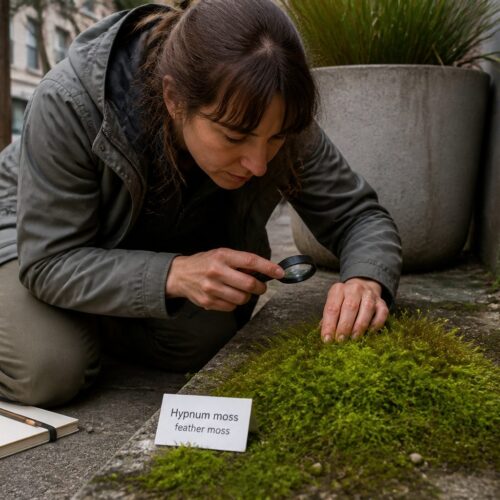


If you want reliable moss ID in a city park or on a balcony moss tray, start with leaf arrangement before you get distracted by color. For moss identification by leaf arrangement, you are reading the plant’s architecture, not its mood.
I have watched the same patch swing from bright green to olive to almost black after one hot week, and the species did not change. Leaf arrangement stays readable through those swings, especially when you train your eyes to rotate the stem and keep your viewing angle consistent.
This article breaks down the common “looks” you will see, like a moss leaf spiral, a two-ranked moss pattern, and shoots that seem combed to one side. You can use these looks in the field, with a hand lens and a phone camera, and still have something solid to compare later.
Why leaf arrangement is easier to trust than color alone
Color is the first thing people notice, and it is also the first thing that lies to you in urban moss. Sun, dust, road salt spray, and even algae films can shift color fast.
Leaf arrangement is built into how the plant grows at the stem apex, so it tends to stay consistent across seasons. Even when leaves shrink and curl during drought, you can usually still tell whether the shoot was spiral, two-ranked, or strongly one-sided.
City moss often grows in mixed mats where two or three species braid together, and color blends into one green-brown blur. Arrangement gives you a way to separate stems one by one, which is the real trick behind moss identification by leaf arrangement.
Think of arrangement like a haircut, while color is like lighting in a room. Lighting changes all day, but the haircut still shows you the style when you look closely.
When you see a stem that looks like a tiny fern frond, that “flat fan” look points you toward a two-ranked moss group right away. When you see leaves wrapping evenly around, the moss leaf spiral pattern becomes the more likely starting point.

How to view arrangement: rotate the stem and use consistent angles
Most beginners make the same mistake, they look at a stem from one angle and decide it is “flat” or “spiraled.” Rotate the stem between two fingers or with tweezers and watch what the leaves do as the view changes.
Use a hand lens at 10x if you have it, but a phone macro clip works too. The goal is to see where each leaf inserts on the stem, not just the outline of the shoot.
Pick a reference point like the stem tip or a branch junction, then rotate one full turn. If the “front” keeps changing because leaves appear on every side, you are leaning toward spiral.
If the shoot keeps presenting the same “face” and the back stays relatively bare, you are leaning toward a two-ranked moss or a strongly complanate habit. That difference is easier to see when you keep the stem at the same tilt, instead of wagging it around.
Try to look at both wet and dry material if you can, because some mosses hide their true arrangement when crisp. A quick mist from a spray bottle can open leaves enough to show the pattern without soaking your whole sample.
Spiral arrangement: what you should see as you roll the stem
Spiral arrangement means leaves attach around the stem in a helix, so no single side owns the leaf bases. When you roll the stem, new leaves keep coming into view in a steady sequence.
This is the pattern many people picture when they hear “moss,” and it is common in cushion and tuft growers. A moss leaf spiral can still look messy if the leaves twist or shrink, but the insertion points still wrap around.
| What you do | What spiral looks like | Common confusion |
|---|---|---|
| Rotate stem 360 degrees | Leaves appear continuously on all sides | Complanate shoots that were pressed flat |
| View from above the tip | Starburst or pinwheel outline | Wet leaves spreading makes the star look bigger |
| Check leaf bases with lens | Insertions staggered, not in two lines | Leaves clustered on short internodes look “ranked” |
| Compare main stem vs branch | Both show wraparound attachment | Branches sometimes look more one-sided |
Two-ranked (distichous) arrangement: the “flat fan” look
A two-ranked moss has leaves in two opposite rows, so the shoot looks flattened like a tiny ribbon. When you rotate the stem, the “face” stays broad and the edge view looks thin.
In the field, this reads as a flat fan or a small fern-like spray, especially on creeping stems. Once you see a true two-ranked moss, it is hard to unsee it.
Distichous arrangement can show up on main stems, branches, or both, and that detail matters. Some species keep two ranks on the stem but let branches go more spiral, so check more than one shoot.
Two-ranked does not mean “perfectly symmetrical,” because leaves can be slightly different sizes on the two sides. Urban wear and tear can also break off one side and fake a one-sided look.
If you are doing moss identification by leaf arrangement, treat distichous as a strong filter, not a final answer. It narrows your candidate list fast, but you still need leaf shape, costa length, and habitat to land the ID.
Complanate vs. twisted: separating naturally flat from pressed flat
Complanate leaves are arranged in a single plane, so the whole shoot looks naturally flattened even when it grows freely. You see this in many pleurocarpous mosses that creep over bark, brick, and old concrete.
The trap is that any moss can look complanate if it was pressed under a shoe, under a rock, or under a dense mat. A pressed-flat spiral shoot often springs back when wetted, while true complanate leaves keep their flat presentation.
Check the stem by lifting it gently with a pin and seeing whether it wants to twist. If the stem rotates easily and the leaf “face” keeps changing, you are probably looking at a spiral plant that got squashed.
True complanate leaves often show consistent left-right layering, almost like shingles laid in a sheet. That layering stays stable along several millimeters of stem, not just at one damaged spot.
When you photograph complanate leaves, take one image straight down on the “face” and one from the side. Those two views make later comparisons much easier than a single pretty top shot.
Leaves that all point one way: “combed” shoots and what they suggest
Some moss shoots look combed, with leaves swept to one side like hair after a windy bike ride. This can happen because of growth habit, gravity on hanging stems, or repeated drying in one direction.
A combed look can suggest certain pleurocarps, but it also shows up when water runs down a wall and repeatedly pulls leaves into a lean. Before you treat it as a diagnostic trait, check whether nearby stems lean the same way because of the site.
- Check multiple stems from the same patch
- Mist and wait two minutes for leaves to relax
- Compare sheltered side vs exposed side of the colony
- Look for consistent one-sided insertion, not just bent tips
- Inspect for flow marks, drip lines, or splash zones on the substrate
- Note whether branches also comb the same direction
Overlapping patterns: tight vs. loose imbrication as a field clue
Imbrication means how much the leaves overlap like roof shingles, and it changes the whole silhouette of a shoot. Tight imbrication makes stems look thick and corded, while loose imbrication makes them look airy and bristly.
This is not strictly “arrangement” in the ranked-versus-spiral sense, but it pairs with it in practice. A spiral stem with tight overlap can look like a smooth rope, while a spiral stem with loose overlap looks like a bottle brush.
Urban moss on sunny concrete often shows tighter overlap when dry, because the leaves clamp down to save water. The same species in a shady gutter can stay looser and more spread, so compare shoots from similar micro-sites when you can.
Imbrication also changes with age, because older basal leaves can erode or get buried in silt. When you see a “naked” base and a leafy tip, do not assume it is a different plant.
As a quick field clue, tight imbrication plus a strong two-ranked look often points toward creeping sheet-formers. Loose imbrication plus a clear moss leaf spiral often points toward tuft species that stand up off the substrate.
How moisture changes arrangement: dry curl vs. wet spread
Dry moss is a different organism visually, and that is why beginners misread arrangement in summer. Leaves can twist, roll inward, or clamp to the stem until the rows are hard to see.
When wet, many species spread their leaves and show the true spacing between ranks or spirals. A quick wetting can turn “random mess” into a readable pattern in under a minute.
Watch for species that twist when dry, because twisting can mimic a two-ranked moss even when the insertion points are spiral. The twist is a leaf behavior, while the insertion pattern is the arrangement you want for ID.
Complanate leaves can look less flat when wet, because the leaf blades soften and droop. That can trick you into thinking the plant is spiral, so check the bases where they meet the stem.
If you cultivate moss in trays, try to photograph the same patch dry and then again after misting. Those paired images teach your eye faster than any written description of moss identification by leaf arrangement.
New growth vs. old growth: why tips can look different from bases
Moss tips are where the action is, and the newest leaves often sit closer together. That tight clustering can make a spiral shoot look “ranked” right at the apex.
Older parts of the stem stretch, get abraded, and collect grit, especially on sidewalks and roof edges. Those changes can open gaps and make the base look looser than the tip even on the same plant.
Some species also change leaf posture with age, with younger leaves held more upright and older leaves reflexed or drooping. If you only look at the tip, you may miss a two-ranked moss pattern that becomes obvious a few millimeters down.
Branching complicates it too, because branches can carry a different “look” than the main stem. When you sample, grab a piece that includes a tip, a mid-stem section, and at least one branch.
I trust arrangement most on healthy mid-stem sections that are not crushed and not brand new. That is where complanate leaves, two ranks, or a moss leaf spiral usually reads cleanest.
Using arrangement with habitat and substrate to narrow candidates
Arrangement tells you “what kind of moss,” while habitat tells you “which of the likely ones.” In a city, substrate is often the biggest clue you get, because brick, mortar, bark, and asphalt each favor different groups.
A two-ranked moss with complanate leaves creeping on tree bark after rain points you toward certain pleurocarps that like humid boundary layers. The same two-ranked look on compacted soil in a sports field points you toward a different shortlist.
If you see a moss leaf spiral forming tight tufts on exposed concrete, you should consider drought-tolerant acrocarps first. Those plants handle heat and wind well, and their spiral arrangement stays readable when the tuft is upright.
Combed shoots on a vertical wall often show you where water runs, because the colony grows with the drip line. That is a habitat cue, and it can matter more than the combed look itself.
Write down the boring details, like “north side of brick,” “under sprinkler overspray,” or “on decaying pine bark.” Those notes turn moss identification by leaf arrangement from guessing into a repeatable process.
Simple photo notes to capture arrangement for later comparison
A single overhead photo of a moss mat rarely preserves arrangement, because it hides stems under a canopy. You need a few consistent shots that show stems as three-dimensional objects.
Take one photo of the patch in place to record substrate and moisture context. Then take a close photo of a single stem on a plain background, like a fingernail, a white plastic lid, or a piece of paper.
Photograph the same stem from the face view and then rotate it 90 degrees for an edge view. That pair is the fastest way to confirm two-ranked moss versus spiral when you review images later.
If you suspect complanate leaves, include a shot where the stem is slightly lifted with a pin so the camera sees the plane of the leaves. If you suspect a moss leaf spiral, include a tip shot that shows the pinwheel pattern.
Add a scale cue, even a cheap millimeter ruler or the edge of a coin, because leaf density affects how arrangement reads. When you compare species later, scale keeps you from mixing up a small tight species with a larger loose one.
Conclusion
Leaf arrangement is one of the few moss traits you can trust on a gritty sidewalk or a rooftop planter, because it survives weather and grime better than color. When you practice moss identification by leaf arrangement, you start seeing stems as organized structures instead of green fuzz.
Spiral shoots reveal themselves when you roll the stem, and two-ranked moss keeps that flat fan look even when you change angles. Complanate leaves, combed shoots, and imbrication patterns add extra texture to your ID notes when you treat them as clues, not verdicts.
Use wetting to reveal hidden patterns, and compare tips to mid-stems so new growth does not fool you. Pair arrangement with substrate notes and a few consistent photos, and you will build a personal reference library that gets sharper every season.