
Urban mosses reveal surprising diversity. Tortula muralis, the wall screw-moss, is ubiquitous on city structures. Learning Tortula muralis identification wall screw-moss can transform your perception of brick walls and sidewalks into green patches.
This resilient bryophyte thrives in harsh, sun-baked urban environments, forming dense cushions. Its adaptability makes it a prime subject for Tortula muralis urban ecology or anyone curious about local buildings’ green patches. Key observations allow confident identification and appreciation of its unique survival strategies.
This guide details Tortula muralis’ distinctive characteristics, from its peculiar hairpoint to its preferred urban niches. We will cover how its appearance shifts with moisture and how to differentiate it from other wall moss identification challenges. Prepare to see your city’s familiar surfaces anew.
Key Features of Tortula muralis at a Glance
Tortula muralis generally forms small, dense cushions or patches, green to grayish-green, depending on hydration and sun exposure. These cushions, typically a few centimeters across, can coalesce. From a distance, they often appear frosty or silvery, a key identifier for this species.
Individual shoots are quite short, usually less than one centimeter tall, with densely packed leaves. These oblong to spatulate leaves, wider at the tip, are crucial for Tortula muralis identification wall screw-moss. A distinct midrib extends beyond the leaf blade.
A close look, perhaps with a hand lens, reveals the midrib extending beyond the leaf tip as a prominent, colorless hairpoint or awn. This characteristic hairpoint is a reliable feature for wall moss identification of Tortula muralis, giving it the “wall screw-moss” name and hinting at its preferred habitat.
Patches often feel somewhat bristly or rough due to these numerous projecting hairpoints, a useful field characteristic distinguishing it from smoother urban mosses. Its growth habit of forming tight, rounded cushions is also consistent.
Its preference for alkaline substrates, like concrete, mortar, and limestone in urban settings, is a key feature. Understanding these general characteristics provides a solid foundation for definitive Tortula muralis identification.
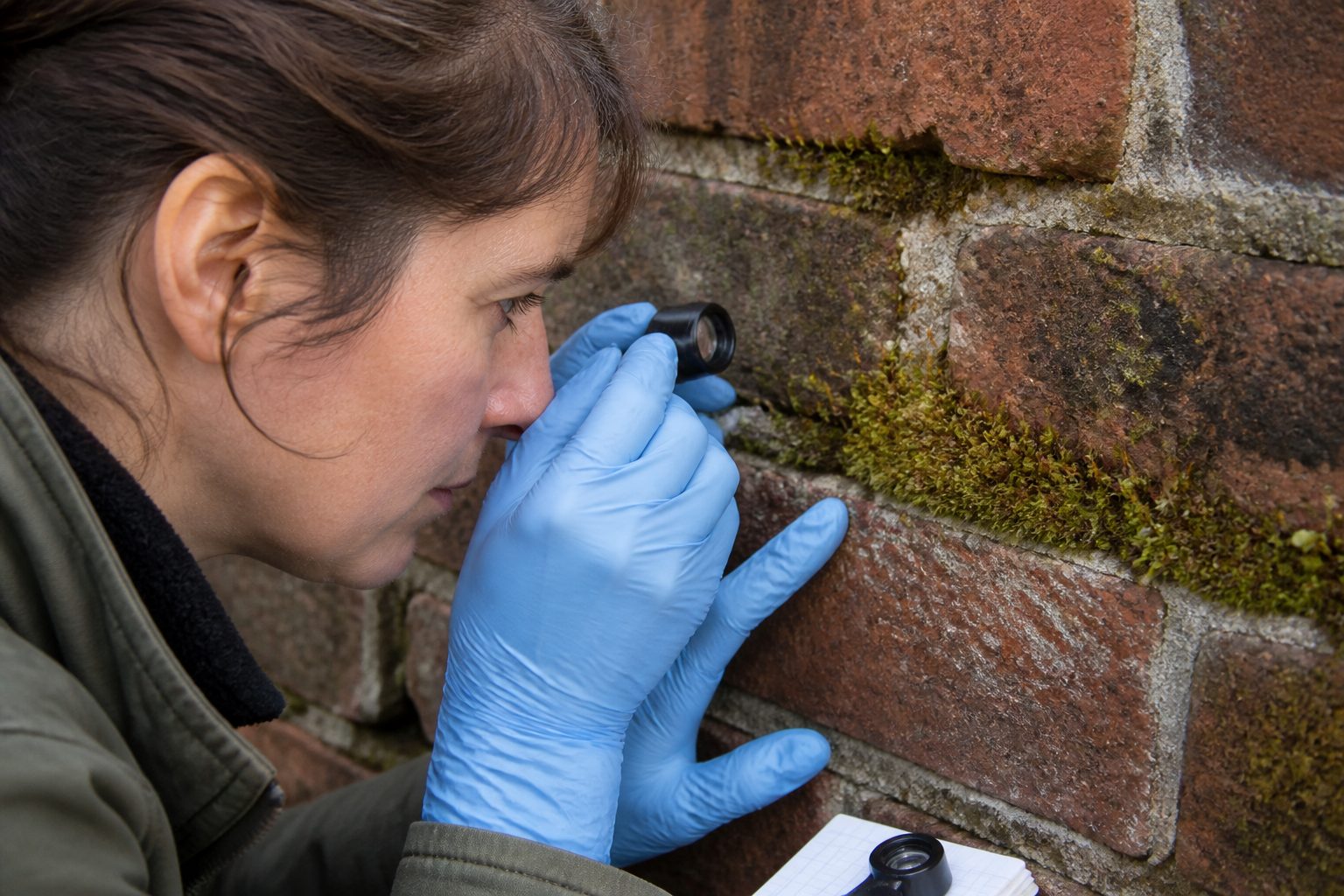
Individual plants maintain a consistent, compact, cushion-like form, unlike sprawling mats of other moss species. This Tortula muralis urban adaptation to dry, exposed conditions minimizes water loss and protects against intense sunlight and wind on city walls.
Leaf margins usually roll inwards when dry, protecting delicate cells from desiccation. This rolling is part of its remarkable drought tolerance on exposed vertical surfaces. Observing these subtle features aids accurate screw moss brick mortar identification.
The Hairpoint: What It Looks Like and Why It Matters
The hairpoint, or awn, is Tortula muralis’ most distinctive feature, simplifying Tortula muralis identification wall screw-moss. This translucent, silvery extension of the leaf midrib often appears longer than the green leaf, giving the cushion a grayish or whitish sheen, especially in dry conditions or bright sunlight.
Under a hand lens, hairpoints are typically smooth, unbranched, and emerge directly from each leaf tip. Their glassy appearance contrasts with the green blade, creating a compelling texture. This consistent feature reliably marks Tortula muralis urban.
Functionally, hairpoints are crucial for survival. They collect water, condensing atmospheric moisture or dew and funneling it to the leaf surface. This enables water absorption even when direct rainfall is scarce on urban walls.
The dense mat of silvery hairpoints also reflects light, shielding chlorophyll-rich cells from intense UV radiation and excessive heat. This protective barrier is vital for moss growing in full sun on heat-retaining surfaces, preventing desiccation and damage.
Hairpoints may deter herbivores due to their bristly nature. This multi-functional adaptation highlights Tortula muralis’ evolutionary success. For Tortula muralis identification, this prominent, silvery awn is the strongest visual clue.
The density of hairpoints creates the overall silvery appearance, most pronounced when dry and leaves are appressed. When wet, hairpoints are less conspicuous as green leaf blades unfurl, but remain visible upon close inspection.
This distinct morphological feature differentiates Tortula muralis from many other urban mosses lacking prominent hairpoints. Grayish-green cushions with obvious silvery tips on urban walls strongly indicate screw moss brick mortar, defining the species.
Where It Grows in Cities: Mortar Joints, Brick Caps, and Concrete
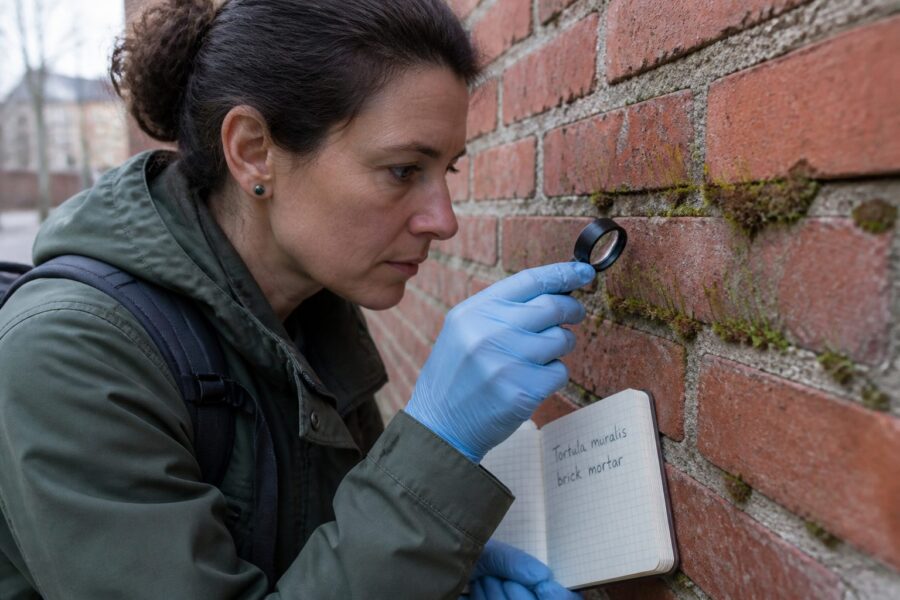
Tortula muralis strongly prefers alkaline substrates, making it incredibly common on various human-made structures throughout urban environments. It thrives in the crevices of mortar joints, along the tops of brick caps, and directly on exposed concrete surfaces, providing ideal conditions, making Tortula muralis urban a familiar sight.
The alkalinity from the lime content in cement and mortar is a key attractant. It also favors sunny, exposed sites with low plant competition and excellent drainage. Observing these common habitats greatly assists in Tortula muralis identification wall screw-moss in the field.
| Urban Habitat | Typical Conditions | Identification Clues |
|---|---|---|
| Mortar Joints | Sheltered, alkaline, retains some moisture | Often forms narrow strips or small patches following the mortar lines; silvery sheen |
| Brick Caps | Very exposed, alkaline, excellent drainage, full sun | Dense, rounded cushions, silvery-gray appearance, especially when dry; often thicker growth |
| Concrete Walls/Pavements | Alkaline, often sunny, exposed to wind | Scattered patches or larger carpets on older, weathered concrete; distinct hairpoints |
| Stone Walls (Limestone/Sandstone) | Alkaline or neutral, depending on stone type, variable sun | Can colonize older stone, particularly porous types; look for the characteristic awns |
| Asphalt Shingles | Exposed, can be slightly acidic to neutral | Less common, but can occur on weathered shingles; cushions are typically smaller and sparser |
Its ability to colonize these seemingly inhospitable surfaces highlights its resilience and specialized adaptations. The rough texture of many building materials provides a suitable anchor for its rhizoids. This affinity for specific urban substrates makes “screw moss brick mortar” a fitting descriptor for its ecological niche.
Even in areas with high foot traffic or pollution, Tortula muralis persists, often pioneering colonization of newly exposed concrete or brick. This pioneering spirit is part of its charm and ecological significance. Keep an eye out for these tell-tale cushions on your next walk; you will start seeing them everywhere.
How Dry vs. Wet Conditions Change Its Appearance
Tortula muralis dramatically changes its appearance with water availability, a phenomenon called poikilohydry. When dry, the moss cushions are compact, tightly curled, and often a dull, grayish-green or silvery. Leaves are tightly appressed, minimizing surface area and water loss, aiding Tortula muralis identification wall screw-moss.
In this desiccated state, prominent silvery hairpoints become highly visible, giving the entire patch a frosted or almost white appearance. This is the state in which Tortula muralis urban is most frequently encountered on sunny walls. The moss enters suspended animation, patiently waiting for moisture.
However, once rain falls or dew settles, the transformation is rapid. Within minutes of absorbing water, the leaves unfurl, revealing their true green color. The entire cushion expands, becoming soft, lush, and vibrant. This rapid rehydration is a hallmark of many bryophytes.
The hairpoints, while still present, become less conspicuous when the moss is wet, as the expanded green leaf blades dominate. This change in appearance is a critical adaptation for survival in moisture-fluctuating urban environments. Observing this transformation helps confirm wall moss identification.
This characteristic rehydration response is a vital survival mechanism. By rapidly absorbing water and efficiently conserving it during dry spells, Tortula muralis thrives where most other plants perish. Its resilience makes it a true pioneer in harsh urban habitats, often the only green growth on exposed concrete.
Its ability to withstand prolonged periods of desiccation is key to its widespread distribution across cities. Even if a patch looks completely dead, rain can bring it back to life in hours. This adaptation is a strong indicator for screw moss brick mortar identification, as few other mosses show such dramatic change.
So, if you are unsure about your Tortula muralis identification, try wetting a small portion of the dry moss with a spray bottle. The almost immediate greening and unfurling of the leaves will provide compelling evidence. This simple field test effectively distinguishes it from lichens or similar non-mossy growths.
Distinguishing Tortula muralis From Similar Urban Species
Tortula muralis has distinctive features, but other urban wall mosses can appear similar. Accurate wall moss identification requires observing several characteristics, not just one. Knowing the common look-alikes helps avoid misidentification and deepens your understanding of urban bryology.
One common confusion arises with other members of the Pottiaceae family, particularly other Tortula or Syntrichia species, which also possess hairpoints. However, subtle differences in hairpoint length, leaf shape, and growth habit can help differentiate them. A detailed understanding of Tortula muralis identification wall screw-moss is valuable here.
- Syntrichia ruralis (Star Moss): Larger, looser cushions; hairpoints often toothed or papillose, not smooth; leaves broader and more spreading when wet.
- Grimmia pulvinata (Cushion Grimmia): Forms very tight, hemispherical cushions; hairpoints are usually shorter and less silvery; leaves tend to be narrower and more pointed.
- Other Tortula Species: Some, like Tortula intermedia, have hairpoints but may differ in leaf shape, margin details, or specific habitat preferences; often requires microscopic examination.
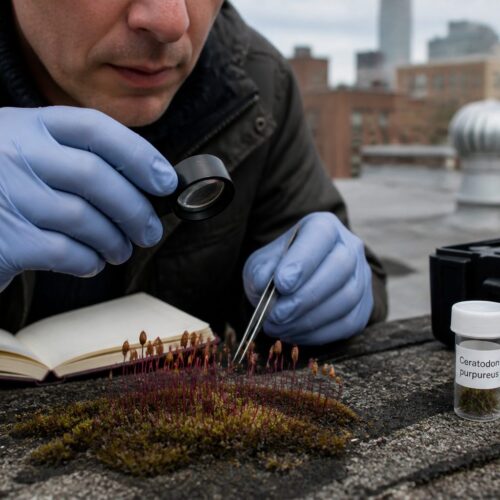
- Ceratodon purpureus (Redshank Moss): Reddish stems, often in sun-exposed areas; leaves lack a distinct hairpoint; forms looser mats rather than dense cushions.
- Bryum argenteum (Silver-moss): Very silvery, almost white appearance, but lacks distinct hairpoints; leaves are small, concave, and tightly overlapping; often found on pavement cracks.
- Didymodon fallax (False-bristle Moss): Green to brownish cushions; leaves are often narrower and lance-shaped; midrib ends in a short, blunt point, not a long hairpoint.
The key to successful Tortula muralis identification lies in combining observations: dense cushion growth, the specific shape of the leaves (oblong-spatulate), and most importantly, the long, smooth, silvery hairpoint. Always consider the habitat; Tortula muralis strongly favors alkaline surfaces like screw moss brick mortar. If unsure, gently pull a few leaves and examine them under a hand lens.
The hairpoint’s smooth, almost glassy quality is a strong differentiator for Tortula muralis; many other hair-pointed mosses have awns that are rough or toothed under magnification. Practicing wall moss identification in your local area will quickly train your eye to spot these crucial differences.
Sporophyte Features That Confirm the Identification
While vegetative features usually aid Tortula muralis identification wall screw-moss, the presence of sporophytes provides definitive confirmation. These reproductive structures, consisting of a slender stalk (seta) topped by a spore-filled capsule, typically appear late winter to early spring, adding interest to Tortula muralis urban observations.
The sporophytes of Tortula muralis are quite distinctive. The seta, or stalk, is relatively long and erect, often reddish-brown, emerging from the center of the moss cushion. It can reach up to 1-2 centimeters, making the capsules quite prominent above the leaves. The seta’s length and straightness are good initial clues.
At the apex of the seta sits the capsule, which is usually cylindrical or narrowly ovate. When immature, the capsule is covered by a hood-like operculum. As spores mature, the operculum typically falls off, revealing the opening. The mature capsule is often brownish or reddish-brown, contrasting with the green or grayish leaves below.
Inside the capsule, after the operculum has shed, you will find the peristome teeth. These are perhaps the most conclusive feature for Tortula muralis identification. Tortula species are known for their long, spirally twisted peristome teeth, visible with a good hand lens. These teeth regulate spore dispersal by twisting with humidity, a hallmark of the genus.
The peristome teeth of Tortula muralis are typically 16, often appearing as a single set or sometimes divided at the base. Their strongly spiraling arrangement, often resembling a tiny screw, is where the “screw-moss” part of its common name truly comes from. Observing these twisted teeth confirms your wall moss identification.
While sporophytes are not always present, especially outside their typical fruiting season, their appearance offers undeniable confirmation. Their presence often indicates a healthy and established screw moss brick mortar colony. Keep an eye out for these tiny, intricate structures during your spring observations; they are a marvel of miniature engineering.
Sporophytes are also an indicator of successful sexual reproduction, which contributes to the moss’s dispersal and colonization of new urban niches. Understanding these reproductive details enhances your overall appreciation for this common yet remarkable bryophyte’s life cycle and Tortula muralis identification efforts.
Can You Cultivate Tortula muralis Intentionally?
Cultivating Tortula muralis intentionally might seem appealing for those interested in greening urban spaces. While its growth can be encouraged, direct cultivation isn’t like planting seeds. It’s about creating the right environmental conditions that mimic its natural habitat, making Tortula muralis urban cultivation a fascinating challenge.
As we have explored, Tortula muralis thrives on alkaline surfaces, particularly mortar, concrete, and limestone, in sunny and exposed locations with excellent drainage. These are not conditions typically associated with conventional gardening, so any attempt at screw moss brick mortar cultivation must prioritize these specific requirements.
One effective method involves preparing a suitable substrate: mix buttermilk or plain yogurt with moss fragments (collected from an existing Tortula muralis patch) and brush this slurry onto a clean, alkaline surface. This provides nutrients and adhesion for establishment. Keep the area moist with a fine mist for the first few weeks to aid establishment.
Selecting the right location is paramount. Choose a spot on a brick wall, concrete slab, or unpainted stone that receives several hours of direct sunlight daily and drains well. Avoid areas that stay constantly wet or are heavily shaded. Patience is key, as moss growth is often slow, taking months for noticeable patches to form.
Maintaining the desired alkalinity of the substrate is also important. If you are using a new, non-alkaline surface, consider pre-treating it with a weak lime solution to raise the pH. Older concrete and mortar naturally provide the necessary alkalinity. Ensuring minimal competition from other plants is also helpful, as Tortula muralis prefers open, undisturbed surfaces.
While you can encourage Tortula muralis to grow, managing its appearance might be a different story. It tends to form compact cushions rather than sprawling carpets, and its silvery-gray dry state is part of its natural cycle. Accepting these natural growth habits is part of appreciating its unique character; it is less about gardening and more about ecological engineering.
For those interested in wall moss identification or urban bryology, cultivating Tortula muralis can be a rewarding experiment, offering direct insight into its growth requirements and life cycle. It is a subtle way to bring more green into the urban landscape, celebrating the resilience of native bryophytes. Success hinges on mimicking its preferred, often harsh, natural conditions.
Conclusion
Tortula muralis, the wall screw-moss, stands as a quiet testament to the enduring power of nature within our bustling urban environments. Its widespread presence on city walls, pavements, and rooftops is a constant reminder of bryophyte adaptability and resilience. Learning Tortula muralis identification wall screw-moss empowers you to recognize this remarkable species and appreciate its unique place in the urban ecosystem.
From its distinctive silvery hairpoints to its remarkable ability to tolerate extreme dry and wet conditions, Tortula muralis offers a wealth of fascinating features for the observant eye. Its preference for alkaline substrates like screw moss brick mortar makes it a consistent inhabitant of our built world. Distinguishing it from similar species requires careful observation of these key characteristics, especially the hairpoint and growth form.
Whether you are simply seeking to identify the green patches on your local brickwork or hoping to encourage Tortula muralis urban growth, understanding its specific needs is crucial. This common yet captivating moss invites us to look closer at the often-overlooked details of our surroundings. So next time you walk past a wall, take a moment to search for the humble, silvery cushions of the wall screw-moss; you will likely find it staring right back at you.