

City parks look manicured, but moss keeps showing up anyway, squeezed into the damp edges that mowers and rakes miss. If you want to identify common mosses in city parks, you need to stop thinking like a gardener and start thinking like a tiny plant that hates drying out.
I learned park moss identification by walking the same loop over and over and noticing what stayed green after a hot week. The best part is that you do not need a lab, you just need patience and a hand lens.
Most urban park bryophytes are tough generalists that handle foot traffic, dog urine, and weird irrigation schedules. Once you recognize a few common forms, you can sort most patches into useful categories without forcing a species name.
Where moss hides in parks (even when grounds are managed)
Moss shows up where maintenance routines create openings, like the strip a mower cannot reach along a curb or fence. Those skinny margins stay slightly taller, hold more humidity, and collect windblown dust that becomes soil.
I look first at irrigation overspray zones because sprinklers make a dependable moisture pattern. You can often trace the arc of a sprinkler head by following a faint green fuzz of moss along the edge of a path.
Shade is the other big hiding place, especially under dense maples, oaks, and ornamental cherries. Even when the ground looks dry, shade slows evaporation enough for moss to survive on brief dew and light rain.
Compacted ground creates its own microhabitat because water runs across it instead of soaking in. That runoff can feed moss at the downhill edge of a trail, near a drain, or around a bench pad.
Managed parks also import moss by accident through mulch, sod, and potted plants in seasonal beds. When that material gets spread, fragments land in cracks and start new colonies if the spot stays damp for a few weeks.

Quick sorting by location: paths, rocks, soil banks, and trees
When I identify common mosses in city parks, I sort by where the patch lives before I even look closely. Location narrows the options fast because many mosses tolerate only certain levels of sun, splash, and disturbance.
Paths and trail edges favor tough, low mats that handle grit and drying wind. Soil banks favor upright tufts that can anchor into loose particles and catch fine sediment.
Tree bases often hold mixed communities where bark texture changes and moisture collects at the trunk flare. Rocks split into sun face and shade face patterns that repeat across a whole park if you pay attention.
This approach keeps park moss identification practical because you are not chasing Latin names on day one. You are building a mental map of habitats, then matching forms to those habitats.
If you carry a notebook, write the location first, then the growth form, then any stand out features like silvery tips or red stems. Later, those notes make it much easier to compare your patch to field guides or local bryophyte checklists.
Lawn-edge mosses: what to look for in short turf zones
Short turf zones are where many people first notice moss, usually because it forms a soft green sheet that refuses to die back like grass. In urban parks, this is often a mix of tiny acrocarp tufts and creeping pleurocarp mats that tolerate mowing height.
Start by checking whether the patch is a tight cushion with stems pointing up, or a flat mat with stems creeping sideways. That one choice helps you identify common mosses in city parks without pretending you can name every species on sight.
| Turf-zone clue | What you usually see | What it suggests |
|---|---|---|
| Forms a smooth green carpet between grass blades | Feathery or threadlike branching that creeps | Pleurocarp mat moss in moist, low-mow edges |
| Looks like peppered green pinheads after rain | Tiny upright tufts, each a few millimeters wide | Small acrocarps that like thin soil and sun breaks |
| Turns silvery or pale when dry, greens up fast | Leaves curl tight, then open within minutes of wetting | Desiccation-tolerant lawn-edge mosses near paths |
| Grows thickest where sprinklers hit first | Denser growth with fewer bare soil gaps | Water-driven distribution, check irrigation patterns |
| Concentrates along curb seams and concrete lips | Thin mats in cracks with trapped grit | Crack specialists using dust as their soil source |
Trail and path mosses: compaction, splash, and disturbance signals
Trails and paved paths create a harsh edge, with compacted soil, salt splash in winter, and constant abrasion. The trailside mosses that survive there tend to stay low and spread sideways, because tall tufts get shredded.
Look for a sharp boundary where foot traffic ends and moss begins, because that line tells you how much disturbance the patch can handle. If the moss creeps right up to the tread, it is usually a tougher type than the one hiding two feet back in leaf litter.
Splash zones matter more than people think, especially near puddle dips and at the base of steps where water runs. Moss there often looks darker and slicker, and you may see algae mixed in like a green stain.
Compaction also changes the soil chemistry by reducing oxygen and increasing runoff, which favors species that can cling to a thin film of moisture. I use a simple test, if the patch stays green while nearby bare soil turns dusty, that moss is adapted to brief wet pulses.
For park moss identification along paths, I pay attention to grit embedded in the stems and to any obvious stem breakage. Gritty, battered mats are common in urban park bryophytes, and they often look messy up close but hold together like felt.
Tree base communities: moisture rings and bark transitions
Tree bases are my favorite places to identify common mosses in city parks because the microhabitats stack up in a small area. You can get splash from rain, shade from the canopy, and a steady drip line that keeps the lower trunk damp.
Many trunks show a moisture ring where moss thickens at a consistent height, often right above the root flare. That ring usually marks where bark stays wet longest after rain, and where soil splash delivers nutrients.
Bark texture changes also matter, because smooth bark sheds moss while rough bark grabs it. On a single tree you might see bare smooth sections, then a band of moss where the bark cracks, then lichen higher up where it dries faster.
Watch for mixed patches that include liverworts, especially in parks with irrigation and dense shade. Liverworts can look like flat green ribbons or tiny leafy sprays, and they often signal a consistently humid spot.
If you are doing park moss identification responsibly, avoid peeling moss off bark to see what is underneath. You can learn a lot by looking for leaf shape, branching pattern, and how the patch attaches at the edges.
Rock and boulder mosses: sun faces vs. shade faces
Rocks in parks act like mini climate stations, with hot, bright faces and cool, damp faces a few inches away. If you want reliable urban park bryophytes to study, boulders give you repeatable conditions you can compare across seasons.
On sun faces, moss often forms thin, tight patches that turn grayish when dry and cling to pits in the stone. On shade faces, you get thicker mats and sometimes taller tufts, especially where water seeps or condensation collects overnight.
Check the top edge of a boulder where water runs and leaves a mineral line, because moss frequently tracks that flow path. In parks with sprinklers, you can find moss stripes that match the spray pattern on rock surfaces.
Do not ignore concrete and brick, because many trailside mosses treat them like rock. Mortar seams and rough concrete pores trap dust, and that dust is enough substrate for a surprising amount of growth.
For park moss identification on rocks, I focus on whether the patch grows in cracks, on flat faces, or around lichen colonies. Those placement choices often separate lookalikes better than color does.
Seasonal changes: when the same patch looks like a new species
Moss can trick you because it changes shape with moisture, temperature, and light. A patch that looks like dull brown fuzz in August can look like a fresh green mat after an October rain.
Dry moss often curls its leaves tight to reduce water loss, which makes the patch look smoother and smaller. When it rehydrates, leaves spread and the same patch suddenly looks more feathery or more spiky.
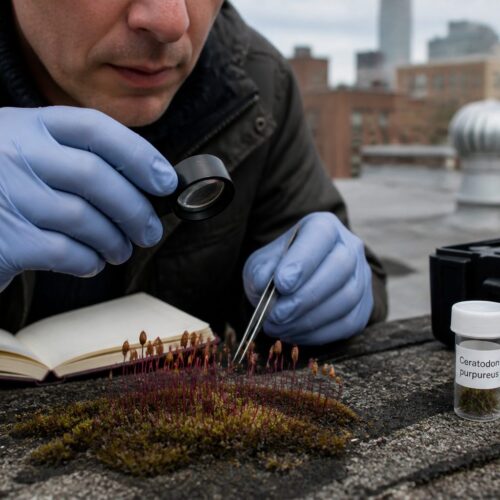
Sporophytes add another layer of confusion, because capsules and stalks can pop up for a few weeks and then vanish. People often assume the stalks mean a different moss moved in, but it is usually the same colony in a reproductive phase.
Winter can flatten things under snow, foot traffic, or freeze thaw cycles, especially along paths. When spring warmth returns, the moss rebounds, and beginners think they are seeing a new species because the texture changed.
If you want to identify common mosses in city parks with confidence, revisit the same patches in at least two seasons. Repeated visits teach you what changes are normal, and that makes your identifications less jumpy.
Simple hand-lens checks for park mosses
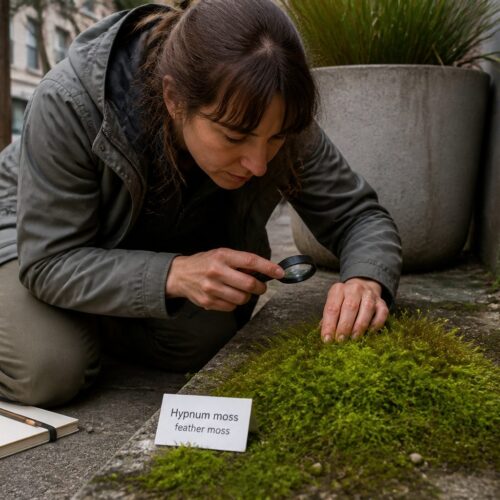
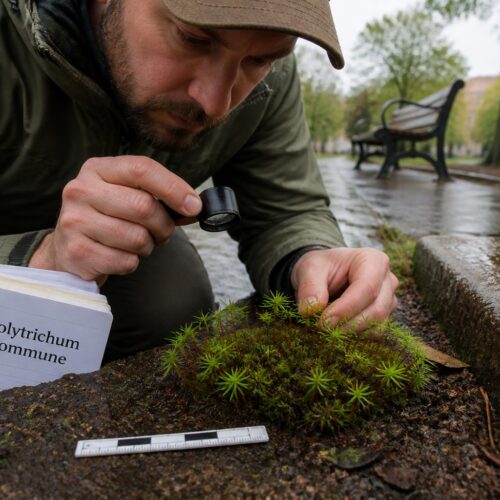
A 10x hand lens is enough for most park moss identification, and I prefer it over phone zoom because it shows true texture. Hold the lens close to your eye, then bring the moss into focus, because that is steadier than holding the lens out at arm length.
Start with growth form, then check leaf arrangement, because those two features do most of the work. If the stems are creeping with side branches, you are likely looking at a pleurocarp, and if stems stand upright in little tufts, you are likely looking at an acrocarp.
Next, look for a midrib, called a costa, running up the leaf, because some common park species have a strong one and others barely show it. A strong costa can make the leaf look like it has a backbone, especially when backlit.
Check the leaf tip shape, because blunt, pointed, and hair tipped leaves each suggest different groups. Hair tips are common on sun exposed rock mosses, and they can make a patch look frosted when dry.
If you see capsules, note their angle, because upright capsules and nodding capsules often separate otherwise similar mosses. I also note capsule color, since some are tan, some are reddish brown, and some stay green longer in shade.
Keeping a personal park moss list without over-labeling
A personal list is how you get better at identifying common mosses in city parks, but the list should allow uncertainty. I write entries like “pleurocarp mat on shaded concrete seam” before I write a species name.
If you jump straight to names, you will mislabel things and then defend the label because you wrote it down. I would rather keep a short list of confident IDs and a longer list of “maybe” patches that I revisit.
- Record exact location, like “north side of pond footbridge”
- Note substrate, like soil, bark, concrete, or granite
- Describe growth form, like tuft, cushion, or creeping mat
- Log moisture pattern, like sprinkler overspray or seep line
- Snap one close photo and one context photo
- Recheck after rain and after a dry week
Respectful observation: avoiding damage in public spaces
Public parks are shared spaces, and moss patches are slow to recover once someone scrapes them off. I treat every patch like a tiny garden bed that nobody planted on purpose but many people enjoy.
Stay on established paths when possible, because stepping off trail often crushes the very trailside mosses you are trying to learn. If you need a closer look, crouch from the edge and use your lens rather than putting a knee on the patch.
Avoid pulling samples unless you have permission and a clear reason, because most park moss identification can happen in place. If you do collect for a class or project, take a tiny fragment from a large patch and leave the edges intact.
Be careful around tree bases, because bark moss can peel off in sheets and leave scars that dry out the trunk surface. I use photos and notes instead of fingernails, and I never pry moss out of crevices on rocks.
Also remember that parks have rules, and some have restoration zones where staff are trying to protect soil and roots. Respectful observation keeps access open for everyone who wants to learn about urban park bryophytes.
Conclusion
The easiest way to identify common mosses in city parks is to combine location clues with a few hand lens traits, then confirm by revisiting patches in different weather. That method beats guessing from color, which changes every time the moss dries out.
As your park moss identification skills grow, you will start recognizing familiar patches like old neighbors, especially along the same trail loop. Keep your notes honest, keep your labels flexible, and you will build a personal guide to the urban park bryophytes right outside your door.