
Moss identification for terrariums is harder than most people expect, because the stuff sold as “sheet moss” or “mood moss” is often a mix of species. If you guess wrong, the terrarium may still look fine for a month, then slowly turn into a patchwork of browning tips and stringy regrowth.
I like moss, but I do not trust moss labels from big box craft stores or vague online listings. A little ID work up front saves you from chasing problems that are actually just mismatched light, moisture, and airflow.
This guide focuses on practical traits you can see with a hand lens, your phone camera, and a week of observation. You will also get a moss labeling system that stays simple enough to keep using after the initial excitement wears off.
Why accurate ID matters in terrariums (growth rate, light, moisture)
Accurate identification matters because mosses that look similar can grow at totally different speeds. In a small terrarium, a fast runner can smother a slow cushion in a season.
Light tolerance is the next reason to care about moss identification for terrariums. Some common woodland pleurocarps stay green in lower light, while many acrocarps stretch and thin out unless they get brighter, indirect light.
Moisture preference is where beginners get burned. A moss that wants constant surface moisture will stall in a ventilated vivarium, while a moss that likes drying cycles can rot in a sealed jar.
Growth form affects maintenance, too. A sheet forming moss can hide moldy substrate and make you think everything is fine until the whole mat lifts like a wet carpet.
Correct ID also helps you match moss care compatibility with your plants and animals. If you keep springtails and isopods, you want moss that rebounds from grazing and foot traffic, not a delicate species that shreds into fragments.

Common moss groups used in terrariums and how to recognize them
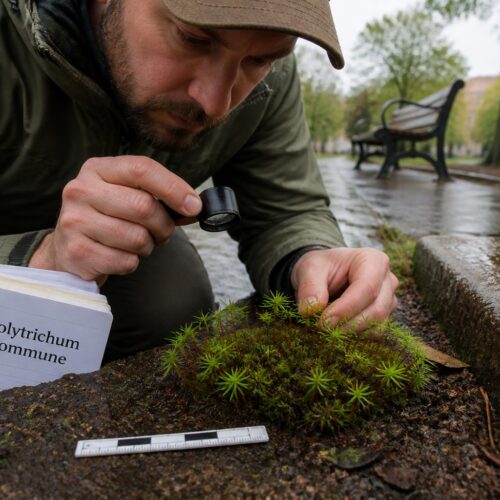
Most terrarium moss types fall into two broad growth habits, acrocarpous and pleurocarpous. Acrocarps grow upright in tufts or cushions, and pleurocarps creep and branch sideways to form mats.
When you look at a clump from the side, acrocarps have obvious stems that point up like tiny bottle brushes. Pleurocarps look layered and feathery, with stems that sprawl and fork along the surface.
Funaria and Bryum style acrocarps often show longer, more visible leaves when they are hydrated. If you mist them and the shoots suddenly look taller and looser, you are probably dealing with an upright, cushion type.
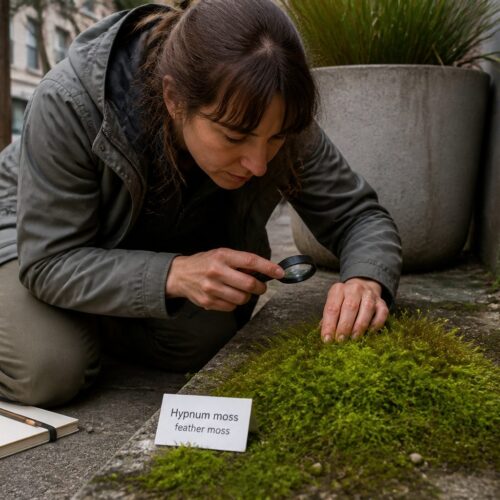
Hypnum and similar pleurocarps tend to flatten into a carpet when they are pressed into substrate. You can often peel a thin section and see branching that looks like miniature conifer twigs.
Sphagnum shows up in terrariums even though it is not a typical “forest moss.” It has a spongy feel, holds a ton of water, and usually has a pale green to tan color with obvious clustered branch heads.
Leucobryum, often sold as mood moss, is a common exception that confuses people. It is an acrocarp, but it forms rounded mounds with thick, pale leaves that can look like a soft green-gray pillow.
Spotting “feather” vs. “sheet” moss traits before you plant
“Feather moss” in the hobby usually means a pleurocarp with pinnate branching that reads as soft and ferny at a glance. “Sheet moss” usually means any mat that can be peeled in a layer, which is why the label causes so much confusion.
Before planting, rehydrate a small piece and spread it on a plate so you can see the structure without substrate hiding the stems. You want to decide whether it forms a true woven mat, or if it is just a pile of stems that happened to ship flattened.
| Trait to check | Feather type (common pleurocarps) | Sheet type (mat-formers and mixes) |
|---|---|---|
| Branching pattern | Forking stems, often feather-like side branches | Variable, sometimes little branching visible |
| How it peels | Peels in stringy layers, stems pull apart | Peels as a thin carpet or felt-like layer |
| Reaction to misting | Fluffs up and shows clear stem architecture | Swells evenly, stays flat like fabric |
| Best placement | Slopes, wood, background seams, topsoil cover | Flat foreground patches, around stones, path edges |
| Common failure mode | Gets leggy in low light, browns at tips | Stays wet underneath, lifts and rots from the base |
Identifying moss that prefers high humidity vs. more airflow
Some mosses want air that stays humid all day, and others want a wetting followed by a real dry down. You can usually predict this by looking at leaf thickness and how tightly the leaves wrap the stem when dry.
Thin-leaved, delicate mats often crisp fast when humidity dips, so they do better under a lid. Thick-leaved cushions often tolerate a fan or vent, as long as you mist deeply enough to rehydrate the core.
Watch how quickly a sample changes color after misting. A humidity loving moss often turns bright green within minutes, while a more airflow tolerant moss may take longer but stays stable between waterings.
Smell is an underrated clue when you are learning moss care compatibility. If a clump smells swampy after two days in a closed cup, it may be a species that needs more gas exchange than your terrarium provides.
Look at where new growth appears during a week of testing. Moss that prefers airflow often pushes new tips along the outer edges, while high humidity mosses may grow evenly across the surface when conditions stay saturated.
Recognizing moss look-alikes that don’t thrive in terrariums
A lot of “moss” sold for crafts is already half dead when you get it, and some of it was never meant to live in a sealed container. If it was dyed, preserved, or baked dry, it will stay pretty for a while and then collapse into lint.
Liverworts and algae can also masquerade as moss in photos. Liverwort thalli look like flat green ribbons or lobes, and algae often forms slick green films that wipe off glass and stones.
Some outdoor rock mosses look perfect until they hit terrarium humidity. Species adapted to sun and wind can turn black at the base, because the terrarium never gives them the drying cycle they expect.
Woodland moss collected from rotting logs can bring in fungi that love constant moisture. That does not mean the moss is “bad,” but it does mean you should quarantine and clean it before it goes near a planted build.
Watch out for clumps with a lot of brown stems and green tips only. That pattern often means the seller harvested old mats, and you are trying to restart them under glass with limited light and oxygen.
Checking for mixed species in a single clump
Mixed species clumps are normal in nature, but they complicate moss identification for terrariums. You may think you are evaluating one moss, then you plant it and one species takes over while the other fades.
Start by teasing the clump apart on a white plate under bright light. If you see two different stem thicknesses, two different branching styles, or two different leaf shapes, assume it is a mix.
Pay attention to color differences that persist after a full soak. Some mixes show a yellow-green mat with darker green shoots poking through, which often signals two species with different hydration behavior.
Check the underside of the mat for rhizoids and trapped debris. One species may form the main felt layer, while a second species rides on top like a living mulch.
If you suspect a mix, plant small, separated pieces in different test cups. You will quickly learn which one is the actual “sheet” and which one is the opportunist that only looked good in the shipping clump.
How to create a simple labeling system you’ll actually maintain
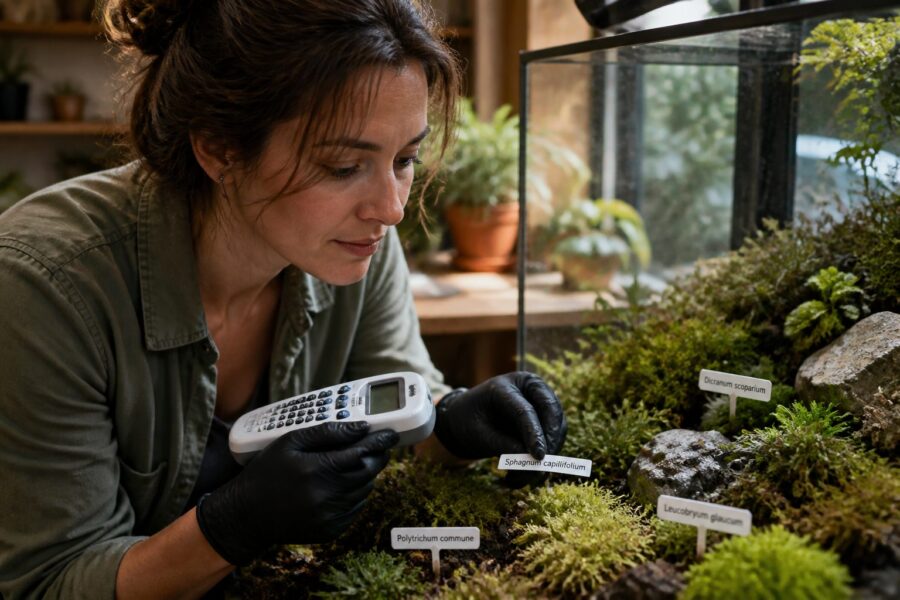
Moss labeling fails when it asks you to become a museum curator. A workable system uses short codes, keeps the labels with the moss, and records just enough detail to be useful later.
I prefer a three part code, source, date, and an ID confidence tag. For example, “BK-2026-04 Hypnum? (G)” tells you it came from a backyard collection in April 2026, and you only trust genus level.
- Waterproof plant tags cut into small strips
- Pencil or paint marker, not ballpoint pen
- Short ID code plus a confidence letter
- One photo of the label next to the sample
- One note about where it sat in the terrarium
- One note about how often you misted
Documenting source habitat to improve future IDs
If you collect locally, the habitat note is often more useful than a species name you are not sure about. “North side of oak trunk, shaded, stays damp” tells you what the moss expects when you bring it indoors.
Write down the substrate, because terrarium moss types often track what they grew on. Bark moss behaves differently from soil moss, and rock moss can sulk if you bury it in peat.
Record exposure in plain language, not fancy categories. “Morning sun for one hour” is better than “part shade,” because terrarium lighting is usually measured in hours and distance.
Moisture notes should include whether the source area ever dries. A moss from a creek edge may tolerate constant moisture, while a sidewalk crack moss may need airflow and drying even if it looks lush after rain.
Take one wide photo and one close photo at the collection spot. When you later compare your terrarium growth to the wild form, those photos keep you honest about whether you are actually growing the same thing.
Quarantine and observation: using growth behavior as an ID clue
Quarantine is where moss identification for terrariums becomes real, because you see what the plant does instead of what the seller called it. A clear deli cup with a vent hole and a simple substrate is enough for a two week check.
During quarantine, you are watching for pests and for growth style. Some moss creeps outward as a thin edge, while other moss stacks upward and forms a thicker cushion.
Track how the moss reacts to a missed misting. If it bounces back after drying and rehydrating, it may be a better fit for ventilated builds and for beginners who forget a day.
Look at where browning starts, because that pattern is diagnostic. Tip browning often points to light or mineral buildup, while base browning in sealed cups often points to stagnant moisture and low airflow.
Use quarantine photos like a time lapse, taken from the same angle each time. When you compare day one to day ten, you can spot branching changes that help you separate similar genera and improve moss labeling accuracy.
When to stop at genus-level identification (and why that’s ok)
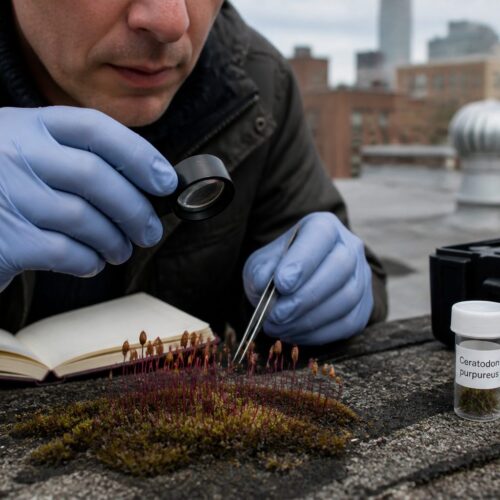
Species level ID often requires microscopic leaf cell details, sporophytes, and reference keys that most terrarium keepers do not want on their kitchen table. Genus level is usually enough to make good care decisions and avoid obvious mismatches.
If you can confidently call something Hypnum, Brachythecium, Bryum, or Leucobryum, you are already ahead of most hobby labels. Those names carry real information about growth form, moisture tolerance, and likely terrarium performance.
Genus level also keeps you from pretending you know more than you do. I would rather see a tag that says “Dicranum sp.” than a confident species name copied from a random product listing.
Use a confidence note as part of moss labeling, like “sp.” for unknown species and a question mark for uncertain genus. That small honesty makes your records more useful when you revisit a build months later.
If you really want species level, wait until you see sporophytes or collect a fresh sample with intact leaves. A stressed terrarium fragment often loses the traits that keys rely on, so forcing an ID can send you in circles.
Conclusion
Moss identification for terrariums is mostly about matching a plant to conditions, not winning a naming contest. When you pay attention to growth habit, hydration response, and airflow tolerance, your terrarium moss types stop being mysterious and start acting predictable.
Keep your system simple, label what you actually have, and write down where it came from. Over time, those notes turn into your own field guide, and your moss care compatibility choices get easier with every build.