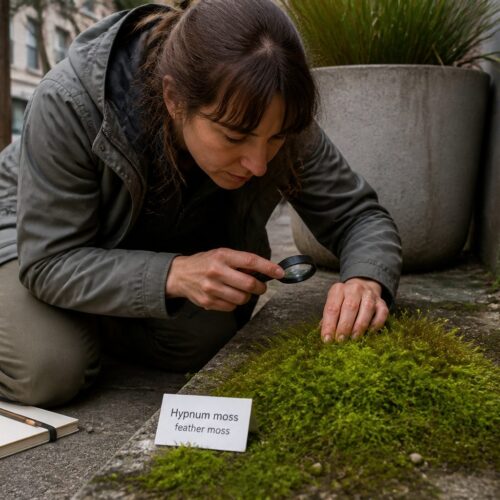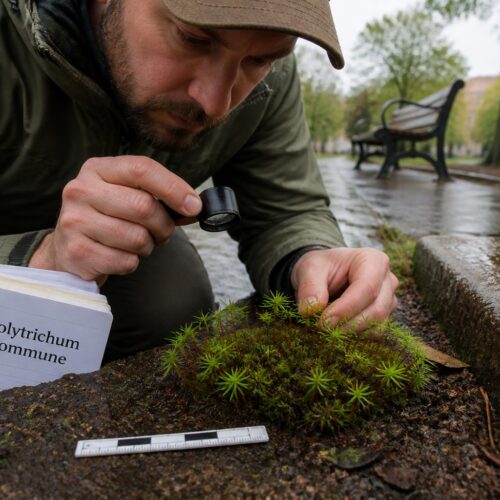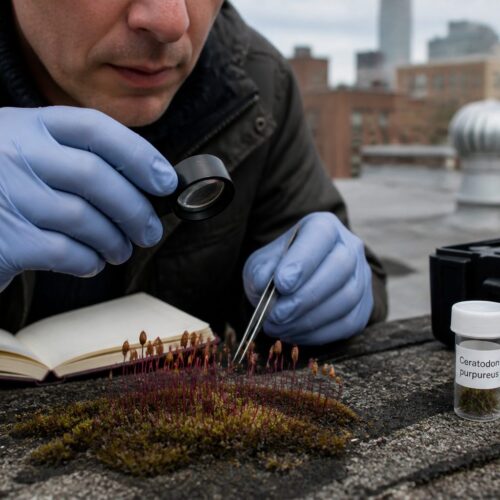


Moss sporophyte identification gets easier once you stop staring at the green mat and start reading the little brown stalks like field notes. Capsules and setas look fussy at first, but they narrow your options faster than leaf shape ever will.
Urban moss patches are often mixed, scraped, and regrown, so the sporophytes you see may belong to only one of several species present. That mismatch is why learning capsule form, seta length, and peristome teeth saves time.
I treat sporophytes like a “bonus level” in moss ID, because they show up briefly and then vanish for months. When you catch them at the right stage, they turn a vague guess into a short list.
When sporophytes show up (and why timing matters)
Most city growers notice sporophytes in late winter through spring, when moisture and cool temperatures line up for many common sidewalk and roof mosses. In a dry summer window, the same patch may look sterile even if it is healthy.
Timing matters because a capsule changes shape as it dries, and an immature capsule can trick you into the wrong moss capsule types. If you only see green, soft capsules, you are often looking at a stage before the diagnostic features harden.
After fertilization, the sporophyte stretches up and the seta length becomes obvious, but the capsule may still be capped by a calyptra. That little hood can hide the operculum outline and any hint of peristome teeth.
Once the capsule ripens, the lid loosens and the mouth details start to matter, especially if you can see a ring of teeth. If you wait too long, weather and handling snap setas and chew up the rim.
In urban cultivation trays, sporophytes often appear after a stretch of steady misting and cool nights, then stall if you switch to warm indoor air. I keep notes on when I first see setas, because date plus microclimate often points toward a genus.
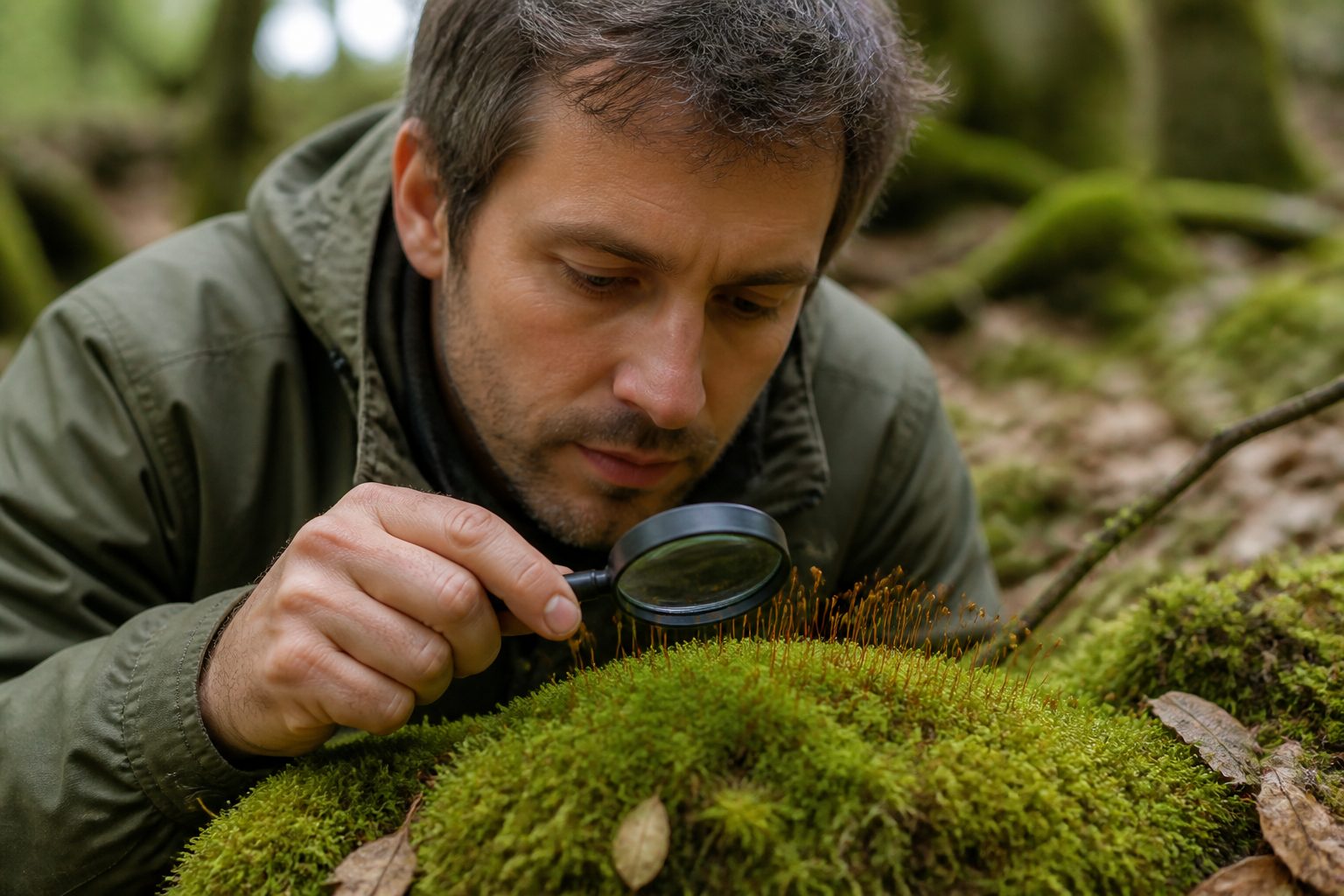
The main parts: seta, capsule, operculum, and calyptra
The seta is the stalk, and it is usually the first thing you can measure without tools. Its length, color, and stiffness can separate lookalikes that share similar leaves.
The capsule is the spore container, and its outline is the headline feature for moss sporophyte identification. Capsule shape plus capsule position often gets you to a genus in one glance.
The operculum is the lid, and its profile can be flat, conical, or beaked depending on the group. A long beak can make a capsule look more pointed than it really is, so I check whether I am seeing lid or capsule wall.
The calyptra is the hood that covers the capsule early on, and it can be smooth, hairy, or split. If you gently remove it with tweezers, do it over a white card, because it drops fast and you may want to photograph it.
When you learn these parts, you stop calling everything a “seed pod,” and your notes get sharper. Sharp notes matter because moss capsule types repeat across unrelated species, but the combination of parts usually does not.
Capsule shape: round, cylindrical, pear-shaped, and curved
Capsule outline is the fastest visual clue, but you need to look from the side and from slightly above to avoid optical tricks. A capsule that looks round from one angle can read as short-cylindrical when you rotate it.
I group shapes into a few buckets and then refine from there, because perfection is not the goal, consistency is. If you can say “pear-shaped and slightly asymmetric,” you are already doing better than “kind of oval.”
| Capsule shape bucket | Common visual cue | What it often narrows toward |
|---|---|---|
| Round to short-ovoid | Looks squat, widest near the middle | Bryum-type urban acrocarps, some Orthotrichum |
| Cylindrical | Parallel sides, length clearly exceeds width | Many pleurocarps, some Dicranum relatives |
| Pear-shaped | Swollen base, necked upper portion | Funaria-like forms, some disturbed-soil species |
| Curved or asymmetric | One side bulges, capsule bends on the seta | Dicranella-style groups, some wet-wall specialists |
Capsule position: erect vs. nodding vs. horizontal
Capsule position is how the capsule sits relative to gravity, and it is more stable than color in most weather. An erect capsule points up, a nodding capsule droops, and a horizontal capsule sticks out like a tiny flag.
Position can shift as capsules dry, so I check several sporophytes in the same tuft before I write anything down. One bent seta can make an erect type look nodding if you only look at a single stalk.
Nodding capsules are common in a lot of sidewalk mosses, and they often pair with longer setas that arc outward. That arc matters in moss sporophyte identification because it changes how spores shed in wind gusts between buildings.
Horizontal capsules can be a great clue in wall-growing species, where setas push the capsule away from the substrate for airflow. When I see true horizontal placement across multiple stalks, I stop obsessing over leaves and start comparing sporophyte keys.
Erect capsules can still have a tilted operculum, so do not confuse a slanted lid with a slanted capsule. I like to photograph the same capsule from two directions to confirm the true axis.
Seta clues: length, color, and surface texture
Seta length is one of those traits people ignore because it feels too simple, but it separates many common genera fast. Even a rough “short, medium, long” note helps when you compare your photos to herbarium images.
Color tells you about maturity and sometimes about the species, but you have to control for lighting and wetness. A wet brown seta can look nearly black, while the same seta dries to amber in a sunny window.
Surface texture is underrated, and it shows up in macro photos as a glossy sheen or a dull, slightly rough look. Some setas look smooth like wire, while others show faint bumps or twists that catch dust.
If you cultivate moss indoors, watch for etiolation, because low light can stretch setas and throw off your sense of normal seta length. I have miscalled species in trays because the setas grew longer than they would outside.
Broken setas are common in high traffic spots, so I look for the scar at the base of the capsule to see if the stalk snapped. A snapped stalk can make a long-seta species look like a short-seta one, which is a classic trap.
Peristome teeth: what you can and can’t see without a scope
Peristome teeth sit at the capsule mouth and control spore release, and they are a gold standard feature in moss sporophyte identification. The problem is that many teeth are too fine to count cleanly without at least a hand lens.
Without magnification, you can still learn a lot by asking one question, does the capsule mouth look clean or fringed after the operculum falls. A clean mouth suggests reduced or hidden teeth, while a fringed rim suggests obvious peristome teeth.
- Use a 10x loupe before you buy a microscope
- Check the capsule only after the operculum drops
- Look for a single ring vs. a double ring of teeth
- Note whether teeth curl inward when dry
- Photograph the mouth against a dark background
- Avoid touching the rim, teeth snap easily
Spore release behavior and what it suggests
Spore release is easy to miss because it is slow and often happens when you are not watching. If you tap a ripe capsule over black paper, a faint dusting can tell you the capsule is open and functional.
Some capsules “puff” spores when they dry quickly, especially in heated apartments with low humidity. That behavior often pairs with peristome teeth that react to moisture, opening and closing as conditions change.
Other capsules dump spores more freely once the lid is gone, and the mouth looks wide and plain. When I see that, I suspect reduced peristomes and I focus on moss capsule types and capsule position instead.
In street-side patches, grit can clog the capsule mouth and make a toothed peristome look absent. I sometimes rinse a single capsule with a drop of clean water on a toothpick, then let it dry and check again.
Spore color is usually subtle, but you can sometimes see yellowish vs. dark dust on paper. I do not treat color as a primary character, but it can confirm that you are looking at spores and not urban soot.
Matching sporophytes to the correct gametophyte in a mixed patch
Mixed patches are normal on bricks, planters, and compacted soil, so you cannot assume the nearest green stems made the sporophyte. A single fertile tuft can throw setas up through neighboring species like a little fence.
I start by tracing the seta down to its base with a pin or toothpick, moving slowly so I do not rip the stems. If the seta disappears into a dense mat, I separate a tiny plug and examine it under a loupe.
Look for a cluster of archegonia or perichaetial leaves around the seta base, because that “nest” often differs from ordinary leaves. Even without deep botany, you can see the fertile shoot looks tighter and more layered.
If you are collecting for later ID, keep the sporophyte attached to a small piece of its original tuft. A loose capsule in a bag is almost useless for matching later, and you lose the context that makes seta length meaningful.
In cultivation, I label trays by source and avoid mixing collections until I have checked for sporophytes. Once two species grow together, moss sporophyte identification becomes half botany and half detective work.
Photographing sporophytes for later comparison
A good sporophyte photo beats a long written description, but only if you show scale. I keep a cheap plastic ruler or a coin in frame, then crop later.
Take at least three angles, side view for capsule shape, top oblique for the mouth, and a full stalk shot for seta length. Phone macro modes work fine if you stabilize your hands against a wall or table.
Lighting matters more than camera brand, and indirect window light is my default. Direct sun blows out the capsule mouth and hides peristome teeth by turning the rim into a bright ring.
Use a simple background, like black paper for pale capsules and white paper for dark setas. Busy backgrounds make it hard to judge capsule position and they confuse autofocus.
I name files with date, site, and a quick tag like “nodding pear capsule, long seta,” because memory fades fast. When you later compare moss capsule types across seasons, those tags are the difference between progress and frustration.
Common misreads: old capsules, broken setas, and weather damage
Old capsules shrink, wrinkle, and darken, and they can look like a different shape category than they did when fresh. A pear-shaped capsule can collapse into something that reads round if you only see it dried and battered.
Broken setas are the biggest reason people misjudge seta length in urban moss. If the capsule sits unusually low in the canopy, assume damage before you assume a short-seta species.
Opercula fall off naturally, but wind and rain can rip them early, leaving a mouth that looks “open” before it is mature. That early opening can make you think peristome teeth are missing when they are simply not exposed yet.
Freeze-thaw cycles crack capsule walls and distort capsule position, especially on exposed concrete. I have seen erect capsules lean permanently after a cold snap, which can send you down the wrong key path.
Urban grime is its own kind of weather damage, and it can coat the capsule mouth like paint. If you suspect dirt, a gentle rinse and a fresh photo often reveals the real rim structure.
Conclusion
Moss sporophyte identification works best when you treat the sporophyte as a set of repeatable measurements, capsule shape, capsule position, and seta length first, then mouth details like peristome teeth. That order keeps you from getting stuck on a single flashy trait that may be damaged or immature.
If you grow moss in the city, plan your observations around the short window when capsules ripen and lids drop. When you pair careful photos with a few honest notes about moss capsule types and stalk traits, you can narrow species with a confidence that leaf-only ID rarely gives.