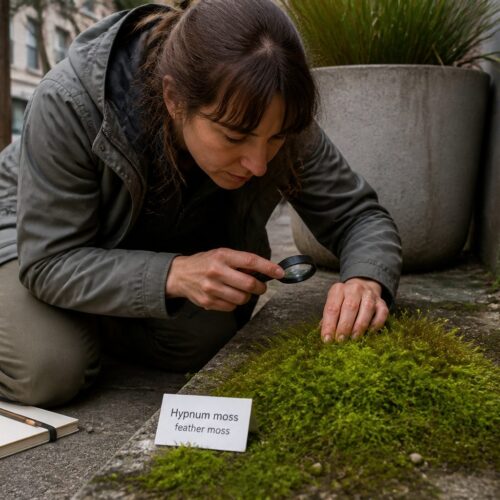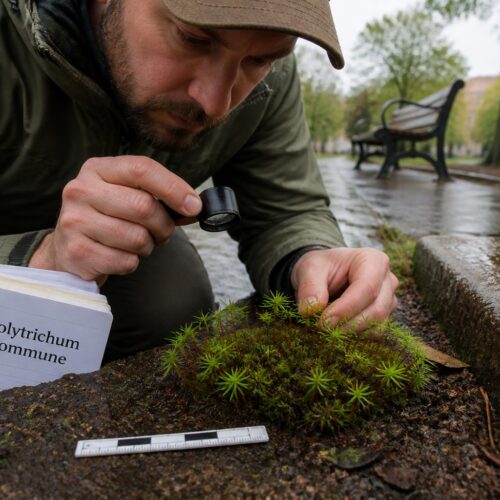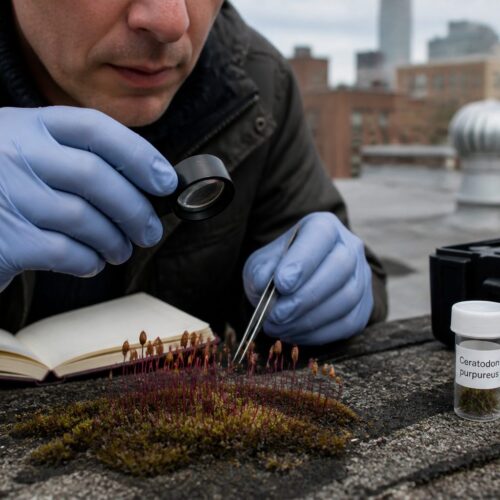

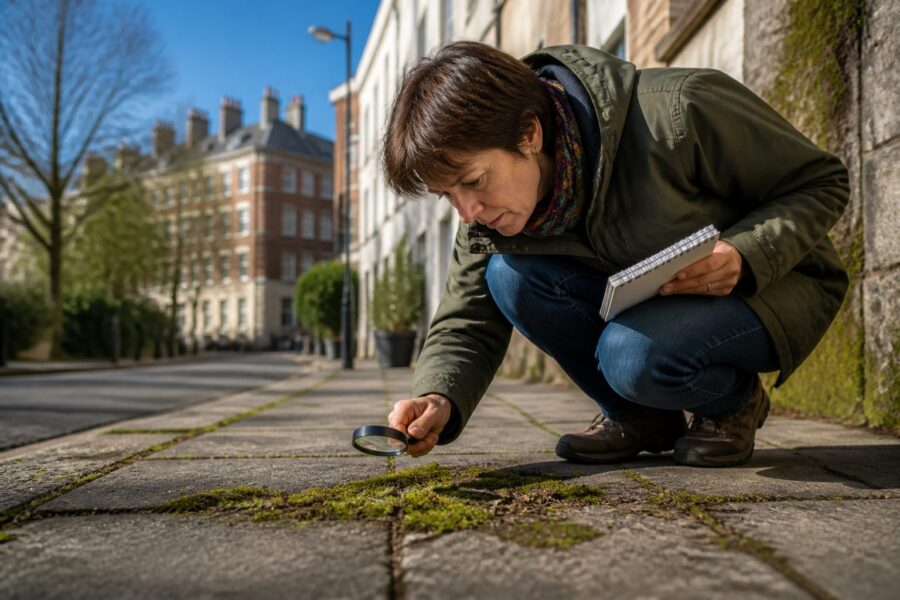
Winter is when urban moss watching gets honest, because the easy cues go quiet and the reliable ones stay. If you want moss identification in winter urban settings to feel less like guessing, you have to lean on structure, not seasonal color.
I like winter bryophytes because they force you to slow down and look at the parts that matter year round. The bonus is that city surfaces stay exposed, so you can compare patches on brick, concrete, asphalt edges, and tree bases in one short walk.
Cold season moss can look dead when it is only dry, and it can look green when it is mostly algae. Winter field work is about separating those two situations with repeatable checks you can do with a hand lens and a phone camera.
This article focuses on what you can still identify reliably, even when moss ID in dormancy is the rule instead of the exception. You will get better results if you treat winter as a scouting season and spring as the time you confirm names.
What winter changes (and what stays useful) for moss ID
Winter changes the speed of everything, including how fast shoots rehydrate and how quickly capsules open and empty. It also changes how often you see leaves spread out, which is why many people get frustrated with moss identification in winter urban spots.
What stays useful is architecture, meaning the way a moss builds a cushion, a mat, or a loose tuft. Growth form survives drought, frost, and road salt better than subtle leaf details.
Attachment still matters in winter, especially whether a patch sits on soil, bark, mortar, or bare concrete. Urban substrates act like filters, and many winter bryophytes keep their favorite surfaces even when they look miserable.
Texture is a good winter cue because it is less seasonal than color, and you can feel it with a fingertip if you are careful. A slick, glossy mat suggests different groups than a shaggy, wiry tuft that catches grit.
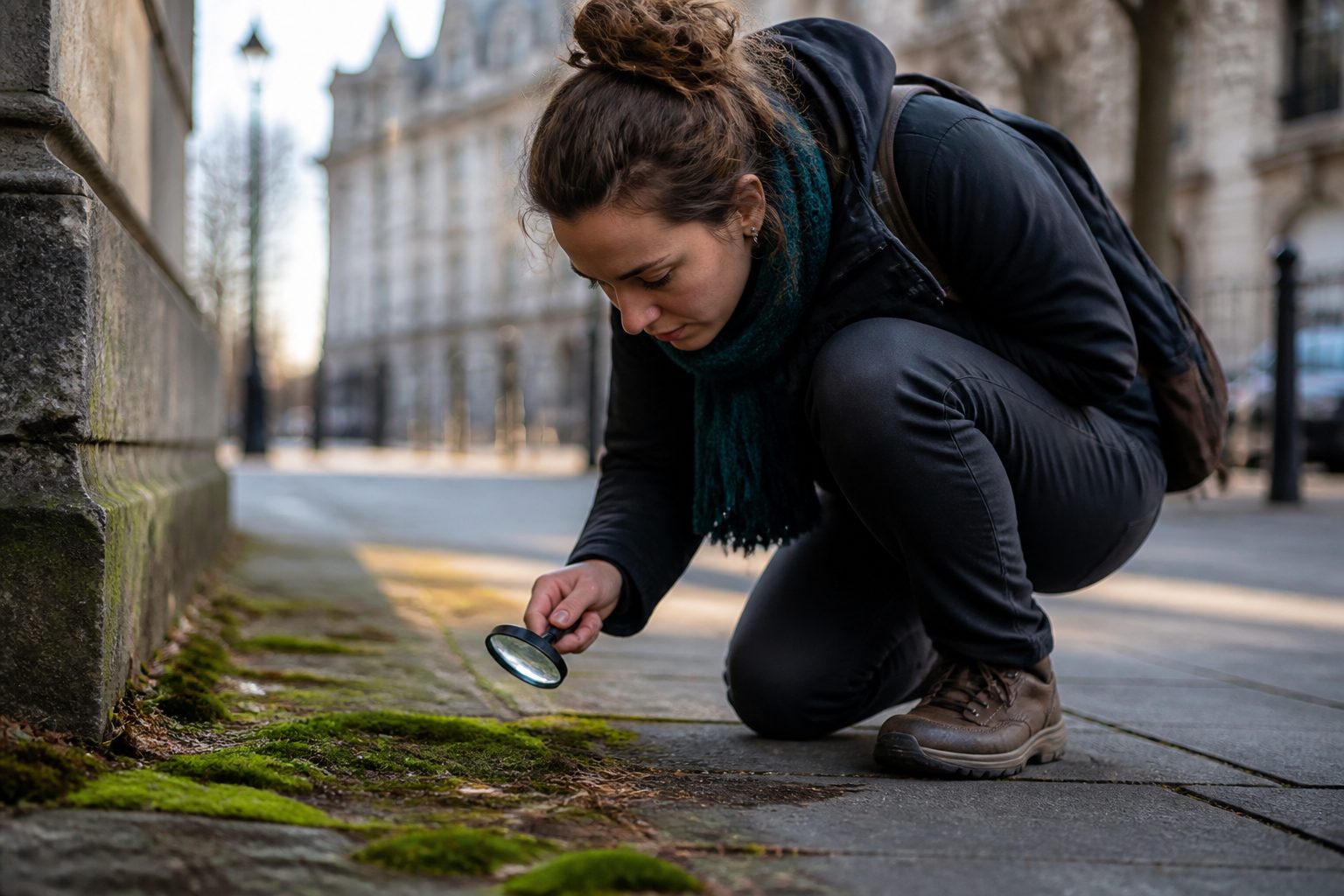
Sporophytes can be the winter gift, because many capsules persist long after the green parts shut down. When you see stalks and capsules, you can often narrow an ID faster than you can with leaves alone.
Finding active patches: warm walls, runoff zones, and sheltered spots
If you want usable traits in the cold season, go where water stays liquid and surfaces warm up a little. South facing brick walls, stone retaining walls, and building foundations often hold the best winter activity.
Runoff zones are reliable because they rehydrate moss even when the air is dry. Look below downspouts, along curb seams, and at the base of steps where meltwater funnels and refreezes.
Sheltered spots matter more than people think, especially under shrubs, benches, and stair landings. Wind is a brutal desiccant in winter, so a patch that avoids it can stay partly open and readable.
Urban heat islands create tiny gradients you can use, like the warmer side of a parking garage or the leeward side of a masonry wall. I often find cold season moss greener near HVAC exhausts, though you should avoid collecting or touching anything near chemical runoff.
Tree bases can still work in winter, but focus on the protected side where snow piles and melts slowly. Bark mosses often look flattened in frost, yet you can still compare bark texture, patch edges, and whether the shoots climb into crevices.
Reading dry-state traits without overinterpreting color
Dry moss can turn tan, gray, almost black, and that shift is rarely a species level clue in the city. Road dust, soot, and salt mist can stain a patch in a week, so I treat winter color as a warning label, not an ID feature.
Instead, read how a patch dries, meaning whether it contracts into tight cushions, stays as a flat felt, or breaks into crumbly fragments. Those behaviors are consistent enough to support moss ID in dormancy when leaves will not cooperate.
| Dry-state cue | What it can mean | Urban note to check |
|---|---|---|
| Patch shrinks into firm cushions | Often acrocarpous growth form, many pavement species | Look for cracks, mortar gaps, and gritty edges |
| Patch stays as a flat, felted sheet | Often pleurocarpous mats, creeping stems | Check shaded concrete, stone, and damp wall bases |
| Shoots look wiry and stand up even when dry | Many tufted species with stiff leaves or strong costa | Common on roofs, ledges, and exposed masonry |
| Surface looks glossy when dry | May indicate smooth leaf cells or a dense cuticle | Confirm it is moss, not algae film on stone |
| Patch breaks into brittle flakes | Stress from salt, repeated freeze-thaw, or thin substrate | Compare with a nearby sheltered patch on the same wall |
Leaf curling and twisting: when it is a feature vs. a stress response
Leaf curling is one of the best winter cues, but only if you treat it as a pattern and not a one time snapshot. Some mosses predictably crisp up into tight spirals when dry, while others only crumple because the patch is stressed.
Start by checking multiple shoots across the patch, including the center and the edges. If the same twist shows up everywhere, you are more likely seeing a built in trait rather than random damage.
Watch the direction of twisting, because consistent right or left spiraling can be a clue at the genus level for some groups. If twisting switches direction from shoot to shoot, I assume dehydration and mechanical wear are driving it.
Stress curling often comes with other ugly signs, like broken tips, bleached bands, or a gritty crust that glues leaves together. In moss identification in winter urban settings, that crust is common near roads and can make any species look wrong.
If you can safely add a single drop of clean water to one small corner, do it and wait a minute. Feature curling tends to relax into a repeatable leaf posture, while stress damage stays messy and uneven.
Sporophytes in the cold season: capsules that persist
Winter is when I stop ignoring sporophytes, because they often outlast the readable leaves. Capsules can persist on stalks through freeze-thaw cycles, even when the leafy shoots look like brown lint.
Look at capsule shape first, like round, pear shaped, or long and cylindrical. Then check the angle, because some species hold capsules upright while others droop or curve.
Seta length is practical in the field, especially in urban moss where you can compare against grit size and nearby leaf litter. A tall stalk lifting a capsule above the cushion points you toward different groups than a short stalk tucked into the leaves.
Capsule lids and teeth can persist too, and a hand lens can sometimes show whether the mouth looks smooth or fringed. If you can see a ring of peristome teeth, you are already doing better than most winter moss walks.
Do not assume that a capsule means the plant is currently active, because many winter bryophytes carry last season’s sporophytes. The capsule still helps you narrow an ID, then you can confirm later when growth resumes.
Snow and ice effects: what to observe before it melts
Snow is a temporary greenhouse, and it can keep moss damp and insulated even when the air is bitter. When snow pulls back, you sometimes catch patches in a half hydrated state that is perfect for moss identification in winter urban sites.
Ice tells you where water actually travels, not where you assume it goes. A thin ice sheet on a wall base often traces a seep line that supports cold season moss long after the rest of the wall dries.
- Photograph patch edges right at the snow line
- Note whether shoots are flattened or still springy
- Check for grit bands left by meltwater flow
- Look for capsules poking through ice crust
- Record substrate moisture, wet, damp, or dry
- Mark the aspect, north, south, east, or west
Hand-lens targets that work well in winter
A 10x hand lens is enough for winter work if you pick the right targets. You are looking for bold traits that survive dormancy, like costa strength, leaf margins, and the way leaves attach to stems.
Check whether the costa runs to the leaf tip, stops short, or extends as a short awn. That single trait can separate common urban groups when color and size are misleading.
Leaf margins can be flat, rolled back, or toothed, and winter dryness often makes rolled margins easier to notice. If margins look rolled, verify it on several leaves so you do not confuse it with curling from drought.
Look for hairpoints, especially on roof and wall species, because they can stay visible even when everything else is shriveled. Hairpoints catch frost crystals, so you may see them as a pale fuzz in cold light.
Stem leaves versus branch leaves can still show contrast in some pleurocarpous mats, even in moss ID in dormancy. If you can spot a creeping stem with smaller side leaves, you can often rule out cushion forming acrocarps quickly.
Photography in low light: sharpness and white balance tips
Winter photos fail for two reasons, blur and weird color casts from shade and streetlights. Fix blur first, because a sharp brown photo beats a soft green one every time.
Brace your hands on a wall or the ground, and shoot bursts so at least one frame lands sharp. If your phone allows it, tap to focus on the capsule or leaf tips, not the background concrete texture.
Use exposure compensation to protect highlights on snow and pale mortar. Overexposed snow can trick your camera into turning moss gray and lifeless, which ruins later comparisons.
White balance matters more in winter because shade is blue and city lighting is yellow or green. If you can set a custom white balance, use a neutral surface like clean paper, or at least shoot one frame that includes a gray sidewalk for reference.
Take one wide shot to show habitat, then a tight shot for traits, then a lens shot through your hand lens if you can manage it. That three photo set makes moss identification in winter urban logs much easier when you review them months later.
Common winter look-alikes: algae coats and gritty biofilms
In winter, algae can impersonate moss better than you would expect, especially on damp concrete. A green film that looks plush at a distance often turns out to be slick and structureless up close.
Biofilms and cyanobacteria can also form dark, gritty skins on stone and brick. They blur the edges of real moss patches and can glue leaves shut, which makes winter bryophytes look like they lost their normal form.
Use the hand lens to check for stems and repeating leaves, because algae does not have that organized pattern. If you cannot find any leaf ranks or shoot tips, treat it as a look alike until proven otherwise.
Grit can create fake leaf teeth and fake hairpoints, especially when salt crystals dry on the surface. I have misread salt sparkle as capsule parts, and it is an easy mistake in cold light.
If you suspect algae over moss, look for a boundary where a true moss tuft rises above the film. In moss identification in winter urban settings, mixed patches are common, so you may need to separate what you photograph and what you name.
Building a winter ID log to compare with spring growth
A winter log is how you turn uncertain IDs into solid ones, because you can revisit the same patch when it wakes up. I keep my entries short, because long notes get skipped when it is cold.
Record the substrate in plain words, like brick mortar, concrete curb, asphalt crack, or oak bark. That one detail often explains why a patch behaves like cold season moss in one place and like a spring green carpet in another.
Give each patch a simple code and a precise location, like the northwest corner of the library steps or the third brick pier on the south wall. GPS helps, but city canyons can drift, so a written landmark matters.
Add a quick moisture rating at the time you saw it, because winter wetness changes daily. A patch that looked dead on a windy afternoon may look fully open after a night of fog.
When spring arrives, revisit and photograph the same patch from the same angle, then compare curling, capsule status, and leaf spread. That comparison is where moss ID in dormancy turns into confident names, and it is satisfying in a way winter alone is not.
Conclusion
Winter moss identification in urban areas works when you trust structure, habitat, and persistent sporophytes more than color. The city gives you warm walls, runoff lines, and sheltered corners that keep winter bryophytes readable if you know where to look.
Cold season moss rewards repeat visits, because one wet morning can reveal traits you could not see all month. If you build a small winter log now, spring confirmation becomes quick, and moss identification in winter urban walks starts to feel reliable instead of hopeful.