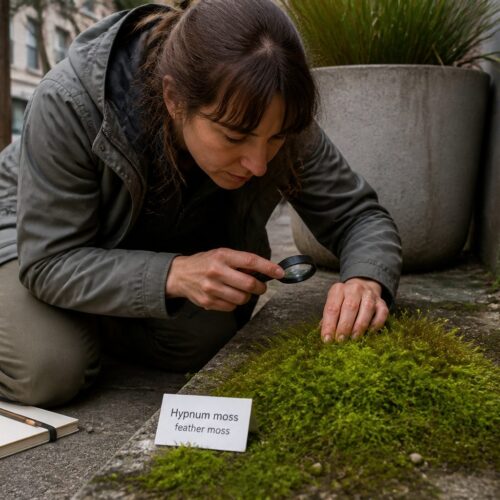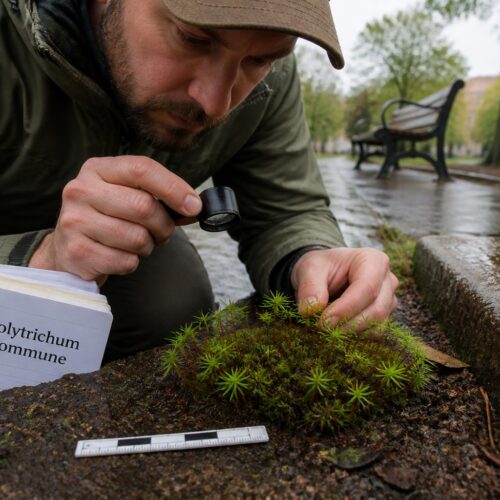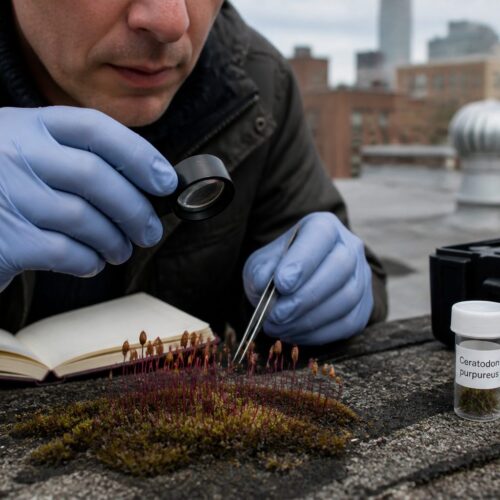


Moss leaves are small, but they carry most of the clues you need for a confident field ID. When you learn a few plain terms, moss leaf anatomy for identification stops sounding like a lab exercise and starts working like a checklist.
I write notes on moss the same way I label spice jars, short words that still mean something later. If you can describe leaf shape, a moss costa, and a leaf margin moss trait, you can usually narrow the options fast.
You do not need a microscope to start, but you do need to slow down and look at one leaf at a time. Most mistakes happen when people describe a whole tuft as if every leaf in it behaves the same.
What You’re Looking At: Basic Moss Leaf Layout
A moss leaf is usually one cell layer thick, attached to a stem, and arranged in spirals that can fool your eyes. For moss leaf anatomy for identification, ignore the spiral at first and pick a single clean leaf near the middle of a shoot.
The broad part of the leaf is the blade, and the base is where it wraps or clasps the stem. If the base is wide and sheathing, write that down because it separates groups quickly.
Many leaves have a midrib called the costa, and it can run partway or all the way to the tip. When the costa is thick, it can make the leaf look folded even when the blade is flat.
The edges of the blade are the margins, and they may be flat, rolled, toothed, or smooth. A leaf margin moss note is often more stable than color, because color changes with light and moisture.
The tip, also called the apex, is where a lot of quick ID happens in the field. Tips can be short and blunt, needle sharp, or extended into a pale hair point that catches light.

Leaf shape categories that matter for ID
Leaf shape sounds subjective until you limit yourself to a few useful buckets. For moss leaf anatomy for identification, I stick to shapes that show up in keys and that you can judge with a hand lens.
Lanceolate leaves are spear shaped, widest below the middle, and they taper to a point. Many common sidewalk mosses land here, so you need costa and margin traits too.
Ovate leaves are egg shaped, wider near the base, and they often look softer and less rigid on the stem. When ovate leaves also have a short costa, you are often in pleurocarp territory, but check growth form before you commit.
Linear leaves are long and narrow, and they can look like tiny green needles when dry. If linear leaves also twist when dry, that posture becomes part of your moss leaf shape description.
Lingulate leaves are strap like with nearly parallel sides for much of their length. They show up in some wet habitat species, and the margins often tell the story better than the overall outline.
When a leaf is broadly rounded with a sudden point, call it obovate or spatulate only if you are sure, because those words get tossed around loosely. I would rather write “rounded blade, short point” than force a fancy term that I will misread later.
The costa (midrib): absent, short, single, or double
The moss costa is one of the first things I check because it is easy to see and hard to unsee. It can be absent, short and fading, long and reaching the tip, or split into two costae.
Look at several leaves because costa length can vary along a shoot, especially near the tip where leaves are smaller. If you only check one leaf, you can talk yourself into the wrong group.
| Costa type | What it looks like in the field | Common ID implication |
|---|---|---|
| Absent | No clear midrib, blade looks evenly thin | Points toward groups like many Hypnales, confirm with growth form |
| Short and double | Two faint ribs near the base that fade quickly | Common in some pleurocarps, easy to miss when leaves are wet |
| Single, ending midleaf | One rib that stops around the middle | Often separates similar moss leaf shape types within a genus |
| Single, percurrent or excurrent | Rib reaches the tip or sticks out as a tiny point | Frequent in acrocarps, pairs well with margin and tip notes |
Leaf margins: flat, rolled, toothed, or smooth
The leaf margin moss traits are where you start separating lookalikes that share the same general leaf shape. Margins can be flat, recurved, revolute, toothed, or so smooth they look like cut paper.
Recurved margins roll back just near the base, while revolute margins roll back along most of the leaf length. If you see a shiny edge line, you may be seeing a rolled margin catching light rather than a true border of thickened cells.
Teeth can be obvious, like a saw, or they can be tiny bumps you only catch by changing the angle of your lens. When teeth are present only near the tip, write that, because “toothed” alone is too blunt to be useful later.
Some mosses have a border, a line of elongated or thick walled cells at the edge that makes the margin look framed. A bordered margin can make a leaf look stiffer, and it can stay visible even when the leaf is wet and translucent.
Be careful with dirt and algae because they can fake a toothed edge by clinging in little clumps. If the margin looks ragged, rinse it with a drop of water and check again before you log a margin trait.
Margins also change with drying because a rolled edge can relax when wet and disappear. That is why I write margin notes twice, once for dry posture and once after I mist the sample.
Leaf tips: acute, hair-pointed, and everything between
The tip is where you can get quick wins in moss leaf anatomy for identification, especially with a hand lens. A clean tip tells you more than a whole paragraph about “overall look.”
Acute tips come to a simple point, and they are common across many groups, so treat them as a baseline. If the point is long and narrow, call it acuminate, but only if it really looks drawn out.
Obtuse tips are blunt, and they can make a moss look soft or puffy when dry. When you see blunt tips paired with a short costa, check if the plant is a pleurocarp creeping along bark or stone.
Hair points are pale, glassy extensions, often made of elongated cells, and they can be short or dramatically long. They snag dust in cities, so a gray hair point might be clean white underneath if you rinse it.
Some leaves end with the moss costa itself sticking out, which is different from a true hair point. If the extension looks green and firm, it is often excurrent costa rather than a hyaline awn.
Tips also tear easily, especially on dry roof mosses that get stepped on. If the apex looks broken, find a protected shoot inside the cushion and check the tips there.
Leaf cell patterns you can sometimes see with a hand lens
You will not see individual cells clearly with every hand lens, but you can often see cell patterns as texture. This is where moss leaf anatomy for identification starts to feel like real botany without needing a microscope.
Look for whether the blade looks smooth, faintly netted, or strongly areolate, like tiny window panes. Strong areolation often shows up when the leaf is wet and the cells become more transparent.
Some species have big, clear basal cells that make the leaf base look paler or more see through. If the base looks like a little clear sleeve around the stem, note “hyaline basal area” even if you cannot see the cell walls.
Papillae are bumps on cells that can make the leaf look frosted or dull instead of glossy. Under angled light, papillose leaves often look matte, while smooth leaves reflect like tiny plastic.
Check if the leaf has a border of long cells because that border can stay visible when the rest of the blade blurs. A border plus a strong moss costa combination can narrow options fast in many urban genera.
If you have a phone clip lens, a quick stacked photo can reveal more than your eye can hold steady. I still write my notes as if I will lose the photo later, because that happens more than I like to admit.
Wet vs. dry leaf posture: a reliable clue when used right
Leaf posture is how the leaves sit on the stem when dry versus when wet, and it is one of my favorite field clues. It pairs well with moss leaf shape because the outline can look totally different after a misting.
Some mosses press their leaves tight to the stem when dry, making shoots look wiry or threadlike. Others spread wide when dry and then relax into a softer, flatter look when wet.
- Dry leaves appressed to the stem
- Dry leaves crisped or wavy
- Dry leaves twisted in a spiral
- Wet leaves spreading widely
- Wet leaves becoming translucent and showing costa
- Leaf tips bending backward when wet
Common mistakes: when leaves lie to you
The first lie is scale, because a whole cushion hides the fact that individual leaves are tiny and variable. If you only look at the outer leaves, you will describe sun stressed leaves instead of typical ones.
The second lie is distortion from drying, which can curl margins and make a smooth leaf margin moss trait look rolled. Mist the sample, wait a minute, and then check whether the margin relaxes back to flat.
The third lie is damage, since city moss gets scraped, salted, and sandblasted by grit. A broken tip can mimic an obtuse apex, and torn margins can mimic teeth.
Another trap is assuming the moss costa is absent because you cannot see it on a dark leaf. Change the angle, backlight the leaf, or look at a younger leaf that has less pigment.
Mixed patches happen all the time on brick and concrete, where two species grow interwoven. If your moss leaf shape notes keep contradicting each other, you may be sampling two different mosses in the same pinch.
Finally, do not trust color words like “bright green” or “olive” as ID traits unless you pair them with habitat details. Light, water, and nitrogen drift can repaint the same species in a week.
How to take useful close-up photos of leaves
A good photo for moss leaf anatomy for identification shows one leaf in focus, not a fuzzy green mound. I aim for three shots, whole patch, one shoot, and one single leaf pulled aside.
Use side light, like a window or a low sun angle, because it makes the moss costa and margin texture pop. Flash straight on tends to flatten everything and turn wet leaves into glare.
Put something for scale in the frame, like a ruler edge, a coin, or even a fingernail, and keep it consistent. A millimeter matters when you compare mosses with similar leaf shape categories.
If your phone hunts for focus, place a plain card behind the shoot so the camera locks onto the leaf edge. A dark card helps with pale hair points, and a white card helps with dark, glossy leaves.
Take one photo dry and one after a light mist, because posture changes can be diagnostic. I also take one backlit shot, holding the leaf against the sky, to reveal whether the costa is single, double, or truly absent.
Do not over edit the photos because sharpening can invent teeth on the margins. If you adjust anything, adjust exposure a little and leave the texture alone.
Turning observations into an ID note you can reuse
Write your ID note like you will read it six months later with no memory of the day. A reusable note has the same few fields every time, so your brain stops improvising.
Start with habitat and substrate, like “concrete seam, shaded, near sprinkler,” because that narrows the candidate list fast. Then write the growth form, cushion or mat, and whether stems creep or stand upright.
Next, add the leaf traits in a fixed order, moss leaf shape, moss costa, and leaf margin moss details. When you keep the order consistent, you can compare notes side by side without rereading whole paragraphs.
Include wet versus dry posture, even if you think it is obvious, because it is easy to forget later. If leaves twist when dry, say how, like “tight spiral” versus “loose wave.”
Finish with uncertainty, like “margin looks faintly toothed near tip, could be dirt,” because honesty improves your later IDs. I also write what I did not see, like “no hair point,” because absence is still a trait.
If you use an app or a key, record the genus you considered and why you rejected it. Those little rejections teach you faster than the final name does.
Conclusion
When you keep your terms simple, moss leaf anatomy for identification becomes a repeatable skill instead of a one time lucky guess. Leaf shape, the moss costa, and a leaf margin moss note give you a solid core that works across city walls, park stones, and garden planters.
Take a minute to check a few leaves, dry and wet, and your IDs will get calmer and more accurate. The best part is that your notes get better with every patch you look at, because moss rewards consistency more than speed.